Medical groups may recommend procedure on boys, but opponents say benefits exaggerated
By Deborah L. Shelton
Chicago Tribune
(MCT)
For years the medical establishment in the U.S. has avoided advising parents on whether to circumcise their newborn sons, saying the benefits do not outweigh the risks. Now, however, new research suggests the procedure could be used to combat a major health problem: AIDS.
Evidence that the surgery can help prevent the transmission of HIV has led both the
The groups are expected to make their decisions late this year or early in 2010, but already their actions are sparking debate over the medical ethics associated with a long-standing cultural practice. The U.S. has one of the highest circumcision rates in the world, though rates have fallen over the last several decades.
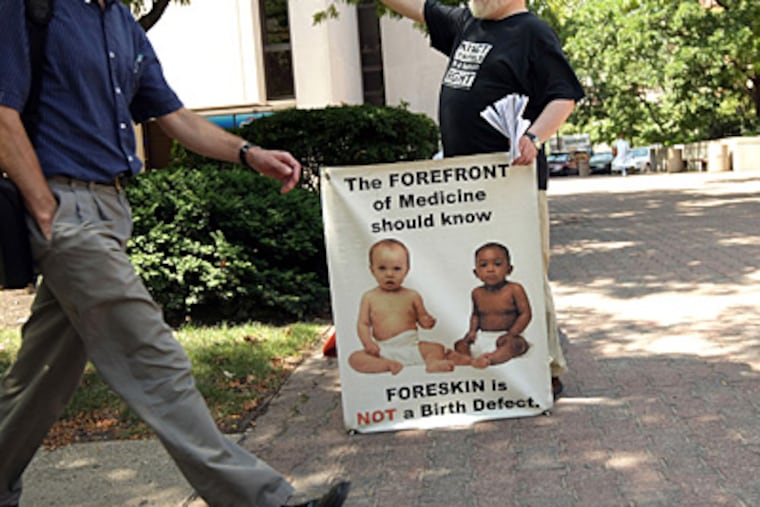
Vocal anti-circumcision groups, who refer to themselves as "intactivists," applaud that trend and oppose any changes in medical policy. They say male circumcision — the surgical removal of some or all of the foreskin from the penis — is an unnecessary mutilation performed without consent.
Until now, mainstream medical groups have said circumcision should be decided by cultural, religious and personal preferences. Potential benefits include lower rates of urinary tract infection and cancer of the penis, which already is rare; the surgery carries risks of bleeding, infections and removal of too much skin.
"Since medical evidence doesn't push us one way or another, we should leave it up to the parents," said Dr.
Potentially changing that equation are clinical trials in
Still, the studies do not settle the question. It's not clear, for example, how well research in
CDC spokeswoman
The federal agency also is planning a study in the U.S. to study the use of adult circumcision to prevent the spread of sexually transmitted diseases.
Scientists think circumcision can protect against HIV because the tissue of the foreskin has a high number of target cells for HIV infection and is susceptible to tearing during intercourse, providing an entry point for the virus. The higher rates of certain sexually transmitted diseases, such as syphilis, observed in uncircumcised men also may increase susceptibility to HIV infection, studies suggest.
Intactivists say claims that circumcision prevents various diseases are exaggerated, at best. The majority of American men are circumcised, but STD rates are as high or higher than those in countries where circumcision is rare, said
Her organization views male circumcision as akin to female genital mutilation, a practice widely condemned by physicians and human rights advocates. It is illegal to perform female circumcision, which involves partial or total removal of the genitalia or other genital injury, in the U.S. on girls younger than 18.
"There's no ethical justification for differentiating male genital alteration from female genital alteration," Chapin said.
An estimated 79 percent of adult males in the U.S. are circumcised, according to government polling conducted from 1999 to 2004 as part of the
Infant circumcision rates have fallen over the last several decades, and in 2006, the most recent year for which the government had data, just more than half of baby boys were circumcised. Since 1999, 16 states have eliminated
Regional circumcision rates vary widely, from 34 percent in the West to 78 percent in the Midwest. Rates also differ at
Strandjord, whose late father was once a physician at the hospital, lives nearby. To protest, he stations himself at the corner of
Intact America recently launched a national campaign aimed at persuading parents not to circumcise, but Strandjord said his protest is aimed at doctors. "Why are they doing something that no medical organization in the world recommends?" he asked.
Dr.
"If they ask, 'Is it necessary?' most of us would say no," he said. "If they say, 'We are thinking about it,' I say, 'That's fine.' If they say, 'We're thinking about not having it,' I say, 'Fine.'"
His advice to parents who don't have strong feelings one way or another: "If you have no opinion about it, I wouldn't circumcise my kid."
"She made us feel very guilty about our decision," said Pisani, who at the time was living in
During his wife's 48-hour hospital stay, three other doctors asked why the baby was still intact, he said.
Hospital officials declined to comment on the particulars of the case but said that, in general, they regard circumcision as a decision ultimately made by parents.
"It is the physician's responsibility to provide parents with the information to help them make a decision based the on the risks and benefits and what they believe to be best for their own child," hospital spokeswoman
Neither the pediatrics academy nor the
"Male circumcision is an elective procedure to be performed, at the request of the parents, on newborn boys who are physiologically and clinically stable," according to a joint policy statement issued by the two groups.
But Dr.
"If there is a 10 percent benefit for urinary tract infections and 60 percent for HIV and 50 percent for (human papillomavirus), you are protecting yourself against all of these diseases," he said.
Neither boy suffered complications, but one had to undergo the procedure a second time because not enough foreskin was removed.
"(Circumcision) would have been more painful for them when they were older, and I thought it could become a medical issue," she said. "I think it was a choice they would want me to make."