Wistar researchers home in on treatment for cancer-causing virus
Nearly 50 years after the Epstein-Barr virus was discovered to cause human cancers, there are no good treatment options for the 200,000 new cases diagnosed annually, most of them in the world's poorest places.
Nearly 50 years after the Epstein-Barr virus was discovered to cause human cancers, there are no good treatment options for the 200,000 new cases diagnosed annually, most of them in the world's poorest places.
The Wistar Institute aims to change that. The illustrious Philadelphia research center last month received a three-year, $5.6 million grant from the Wellcome Trust in London to continue developing a novel anti-viral drug.
"We certainly hope that this first-in-class drug we are developing will slow the progression or - even better - cure these deadly cancers," said Wistar senior scientist Troy Messick.
That goal is still far off, as the drug has to be enhanced, further shown to work in animals, and then tested in people. But Wellcome Trust, the global charity dedicated to improving health, is heavily invested in the Wistar project. Three years ago, the trust awarded $4.7 million to Messick and co-leader Paul M. Lieberman to discover the drug they are working on. It disables a protein, called EBNA1, that the virus produces and needs to survive.
Interfering with a viral protein is nothing new - that's how antiviral drugs work - but EBNA1 is a particularly tough target for a drug to reach because it is deep in the infected cell's nucleus, not on the surface.
EBNA1 is essential to the virus, enabling it to infect, replicate, and permanently hide out as a latent infection in white blood cells.
An estimated 90 percent of all adults have a latent infection. Most develop no illness, or nothing worse than mononucleosis, the highly contagious "kissing disease" known for leaving young adults feeling tired and weak for months.
In rare cases, however, infection combines with immune and environmental factors to cause nasopharyngeal cancer (cancer in the back of the nose), certain aggressive lymphomas, and stomach cancers. Epstein-Barr-related cancers are most common in parts of Africa and Southeast Asia.
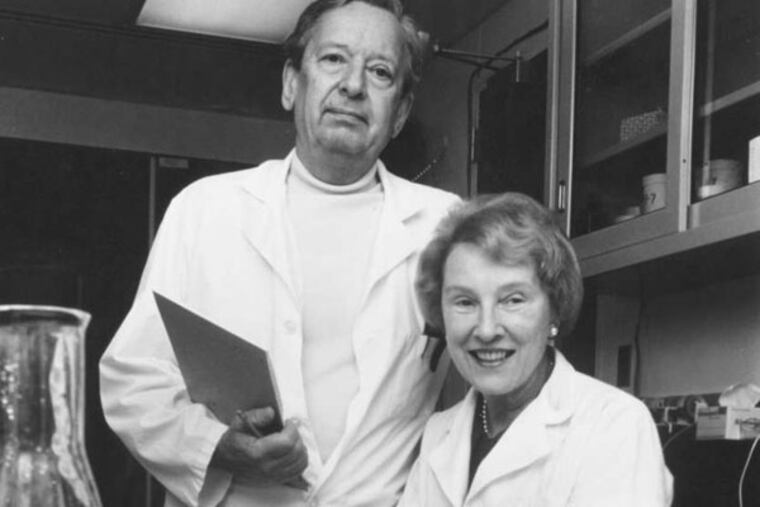
The cancer connection was suspected by the two scientists who discovered the virus in the early 1960s (and for whom it is named). But back then, the theory of carcinogenic viruses was unproved and controversial. It was Gertrude and Werner Henle, husband-and-wife virologists at Children's Hospital of Philadelphia, who in 1968 convincingly established the link between Epstein-Barr virus and Burkitt lymphoma, a leading killer of children in equatorial Africa.
"The virus is unusual because it is ubiquitous," Lieberman said, "yet only one percent of infections result in cancer."
No drug is specifically approved for Epstein-Barr-related cancers, and standard treatments - surgery, radiation, chemotherapy - are problematic. The malignancies tend to be advanced when diagnosed, and are often inoperable and quick to recur.
"For some EBV cancers of the head and neck, surgical removal is next to impossible due to the delicate and critical tissues in the area," Messick said. "Radiation can cause permanent nerve or spinal cord damage. Chemotherapy can also have devastating consequences, from hearing loss . . . to renal failure."
The toxicities would likely be far fewer with a drug that targets a protein found only in the virus, which is found only in cancerous white blood cells.
To discover such a drug, the Wistar researchers tested a library of more than 600,000 chemical compounds. This "high-throughput screening" approach uses robotics, software, and sensitive detectors to rapidly identify compounds that react with the viral protein.
"There were zero" promising compounds, Lieberman recalled.
So the researchers switched to a newer, even more sophisticated approach that involves testing hundreds of individual small molecules. The problem with "fragment-based drug design" is that the molecules are like scraps of puzzle pieces - any linkage to the target is weak. To strengthen the linkage, reactive fragments have to be atomically bonded together.
Every time the fragments are changed or rearranged to improve effectiveness, the new drug candidate has to be tested in rodents for safety, a process that takes at least a month.
"It took about two years to go from nothing to the lead drug candidate that we're now optimizing," Lieberman said.
It also took help from two partners: the Fox Chase Chemical Diversity Center in Doylestown and DavosPharma in Upper Saddle River, N.J. The teamwork has enabled the kind of research that normally occurs only in large drug companies, Messick said.
The researchers have met with the U.S. Food and Drug Administration to discuss the design of human studies, expected to begin in 2018. If the drug succeeds in early clinical trials, Wistar would be in a position to find a commercial partner - a pharmaceutical company - to underwrite the final trials.
It is even possible, the researchers say, that an effective drug would work against a chronic, disabling disease also linked to Epstein-Barr virus: multiple sclerosis.
"There is an absolute, real need for new, targeted therapies," Messick said.
215-854-2720
@repopter