Clean environments start at home
Eco-awareness is everywhere these days. You want to do your part toward a cleaner, more sustainable world, but with so many choices, you're drowning in details.
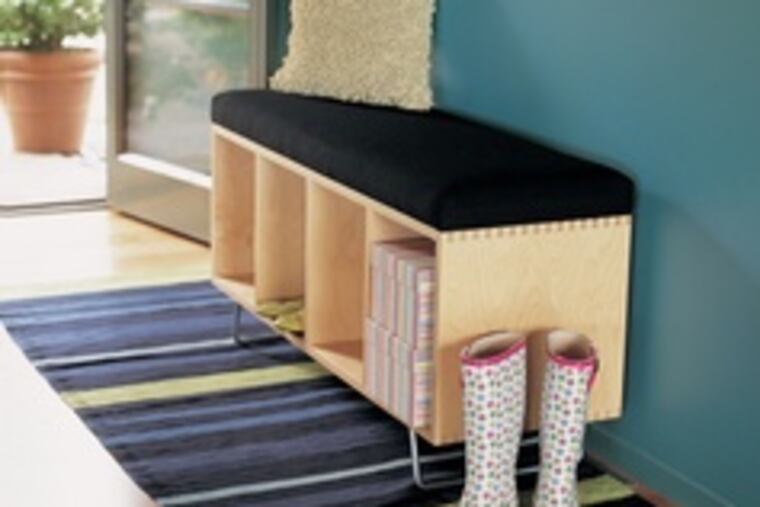
Eco-awareness is everywhere these days. You want to do your part toward a cleaner, more sustainable world, but with so many choices, you're drowning in details.
Where's a sensible, effective place to begin?
"Start with your health and the health of your family and go from there," says interior designer Kimberly Rider, author of The Healthy Home Workbook: Easy Steps for Eco-Friendly Living and Organic Baby: Simple Steps for Healthy Living (Chronicle Books, $24.95 each).
As she explains in her introduction to The Healthy Home Workbook: "Every choice you make when you create your home environment is important in that it is an opportunity to select materials and practices that can improve your family's and your own health. In the long view, a healthy household is healthier for the environment as well."
And it doesn't need to be a chore.
"You don't need to be a contortionist to implement a sustainable lifestyle. It's mostly about applying common sense. Many of us are a lot greener than we give ourselves credit for," says Lili Wright, a green-lifestyle designer and owner of Wright Design in Philadelphia.
When sustainability experts recommend making healthy choices, minimizing the pollutants and chemicals in our homes is the main thing they're talking about. Chemicals known to be hazardous to humans can be in our air, our water, what we put on our bodies, and the furnishings in our homes.
Indoors, the biggest offenders are fresh paint, floor finishes, and the formaldehyde in glues and particleboard furniture.
"The real issue," Wright says, "is the toxic cocktail created from the off-gassing of all of the furnishings, carpets, varnishes, cleaning products, glues, etc., combined.
"Our lungs and skin metabolize our environment. We watch what we eat, but we don't think about what we're breathing and what we absorb through our skin," she says. "Why eat healthy food and then breathe formaldehyde?"
Nowadays, most homes are sealed so tightly against drafts that there's little air exchange, says Rider. Because chemicals continually give off gas from even the water you shower in and your dry-cleaned clothes, the air you breathe in your home can give you headaches, dizzy spells, cause difficulty breathing, and worse.
"The best way to improve indoor air quality - especially in cold climates where you can't always open a window - is to be particularly mindful of what you bring into your airspace," Wright says. "Unless made from natural, healthy materials, the emissions from new furnishings, accessories, carpet, fabrics, and paints can take years to dissipate."
What to do?
Well, you can refresh a room without repainting simply by washing the walls. Use a mild castile soap-and-water solution, add some essential oil, and treat yourself to a little aromatherapy while scrubbing.
Also, you can avoid furniture made from particleboard. "If it has that 'new' smell, it's probably got bad stuff in it," cautions Wright.
Try slipcovers instead of new furniture, she says. There are lots of fashionable, eco-friendly fabrics now, and a good workroom can make slipcovers so tailored that your pieces will look new.
Bring in some houseplants too, Wright recommends.
"They are natural and very cost-effective air filters. You get a new look, beautify your space, and clean your air all at the same time," she says. "And you don't have to create a jungle. A few carefully placed plants can go a long way to providing cleaner air."
It stands to reason that purer air inside our homes adds up to purer air outside (and vice versa).
Water also has a big role in creating - and maintaining - a healthy home.
Most tap water is healthier, cheaper, and lower in calories than anything else you can drink. And if you give it the same conditions bottled water gets, it can be just as refreshing.
Keep water in the coldest part of your refrigerator, in a sealed glass or plastic container. Be sure the container stays tightly sealed, and don't store other liquids in it, or it will pick up odors or flavors.
Before filling the container, run the faucet a while, to get standing water out of the pipes. See if it doesn't taste like the bottled water from some remote (and probably fictitious) crystal-clear spring.
Review your local water department's water-quality report. But even if everything checks out, your pipes can affect your water's safety, so have the water tested for heavy metals and chlorine.
"Consider adding a whole-house water-filtration system," Wright says. "Then you won't be bathing your body or your organic fruits and vegetables in chlorine and other potentially harmful chemicals."
Of course, choosing tap water cuts down on the millions of discarded plastic bottles that, even with recycling, are becoming a landfill problem.
To keep harmful substances out of natural waterways, use biodegradable, nontoxic cleaning, laundry and personal-care products.
When all is said and done, Wright says, "the five most important tools in creating a healthy house are your five senses."
"What do you enjoy looking at, which smells please you, et cetera. Trust your senses to know what's healthy and pure."