GreenSpace: Roll out the barrels to collect rain
Bill Hoffman used to fight rainwater. He was in the waterproofing business, and for 18 years worked to keep it out of basements.
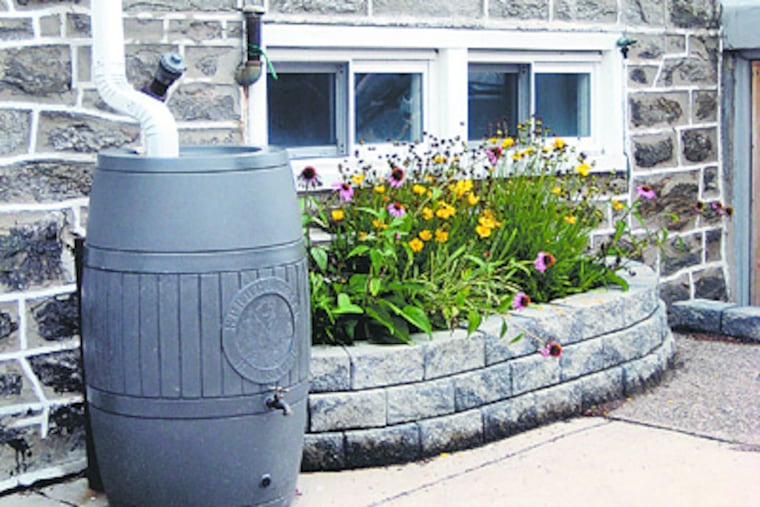
Bill Hoffman used to fight rainwater.
He was in the waterproofing business, and for 18 years worked to keep it out of basements.
Now, he collects it.
About four years ago, he bought a rain barrel online and installed it on a downspout of his Haddonfield home.
And with the next rainstorm, he became a micro-champion in the water cycle.
The problem with rain - especially in a paved urban environment - is that it gushes down the streets, carrying all manner of contaminants, from car oil to dog poop.
In Philadelphia and many other places, it then funnels straight into the sewer system, which in a big storm becomes overloaded, which means the water and all its teeming ingredients - raw sewage as well - overflow into streams, polluting them and eroding their banks.
The barrel technology is simple. In a project taking less than an hour, for someone who's handy, the flow is diverted from a downspout to a barrel.
All kinds are available. Home Depot has them ranging from $99 (a 40-gallon barrel that looks like a rock) to $229 (also 40 gallons, but fancier, with grooved sides).
A screen keeps out bugs like mosquitoes, which breed in water and can carry West Nile virus.
An overflow outlet with a hose attached allows any excess to drain away instead of streaming out next to the house. And possibly into the basement.
While one rain barrel won't make much of a difference, a ward-full might.
That's why the Philadelphia Water Department has been so gung-ho for the last several years, offering rain barrel seminars and giving participants 54-gallon barrels that would otherwise cost $164.99.
The department has given away 1,234 barrels. Figuring on 64 storms annually, the Office of Watersheds calculates that the barrels keep 4,264,704 gallons of water a year out of the region's sewers and waterways, said program manager Joanne Dahme.
Other municipalities have done likewise. Last year, Collingswood used funds from a state recycling program to buy rain barrels and sell them to residents at a discount.
Commissioner Joan Leonard, who hatched the idea, was worried. What if nobody wanted one?
Instead, residents stormed the gates. Collingswood sold all it had, 50 last year, 150 this year.
Rain barrels are getting so much cachet that the city named them as a strategy in its Greenworks sustainability plan released last week.
It's not just stormwater. Hoffman's rain barrels - he now has five - give him free fresh water for irrigating his garden and washing his car.
Barrels have spigots at the bottom, and as long as the flow is downhill, you're set.
All this makes so much sense. Why use costly treated water for washing a car? Plus, rainwater has none of the additives of treated water, such as chlorine and fluoride, so it's better for plants.
The only things holding rain barrels back at this point seem to be education and aesthetics.
Although some are attractive - resembling terra cotta urns, for instance - most are big brown blobs.
But their time is coming. Last year, East Falls so badly wanted residents to embrace rain barrels that it hosted a design contest. The winning barrel from the Philadelphia University team looked like an attractive bench.
Joy Lawrence, who heads the Pennsylvania Horticultural Society's sustainable neighborhoods program, is hoping the artistic community will help out with more ideas.
According to one estimate, an inch of rain on a 1,000-square-foot roof yields 623 gallons of water. So figure your roof and forge ahead.
Just be careful. Being a mini-stormwater manager can become addictive.
Sheila Bello of Whitpain Township now has her barrel draining into an entire "rain garden," with plants that thrive where it's soggy.
As for Hoffman?
He's made it his business: the Rain Harvest Co. And, yep, his business card identifies him as "Rainman."