Volunteers spend a day greening the city
Over the weekend, 1,000 new residents put down roots in Philadelphia. They are the best kind of neighbor - cool and self-possessed, upstanding and good-looking. And although they will never pay taxes, dish any gossip, or lend you a cup of sugar, by merely moving in they have helped improve property values and morale throughout the city.
Over the weekend, 1,000 new residents put down roots in Philadelphia. They are the best kind of neighbor - cool and self-possessed, upstanding and good-looking. And although they will never pay taxes, dish any gossip, or lend you a cup of sugar, by merely moving in they have helped improve property values and morale throughout the city.
No need to worry that they have teenagers who play drums. They're trees. Sycamores and pin oaks and flowering cherries. Little saplings with trunks no thicker than baseball bats.
Between sunrise yesterday and sunset today, 2,000 volunteers working in 34 neighborhoods planted the trees in parks and in wells cut into concrete sidewalks.
The project, the 10th annual "Fall for Your Park," involved numerous state, city, and local organizations that contributed money, plants, gardening equipment, muscle, music, and boxes of Polish pastries.
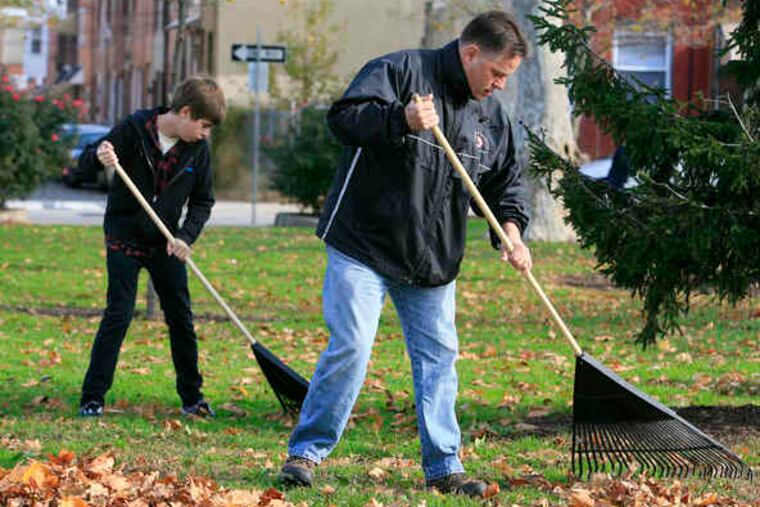
Christine Long, 77, and her husband, Bill, 73, got up early to catch the 8 a.m. No. 25 bus from their senior housing complex in Fishtown to Campbell Square in Port Richmond. Until two years ago, they lived a few blocks from the park, which is at Allegheny Avenue and Belgrade Street. They volunteer Monday evenings from April through November, helping to rake leaves, mulch, and pick up litter.
At 10 a.m., when the politicians arrived for a formal ceremony, Christine had already filled a large plastic bucket with garbage she'd collected, probing her long-handled grabbing tool into the grass and bushes.
Bill, who had an unsuccessful hip transplant last year, leaned on a cane held in one hand, his grabbing tool in the other, as he slowly took the winding park path toward his wife of 49 years.
Even though they no longer live in Port Richmond, he said, they feel an allegiance. "We get together with about 15 others to clean up people's trash and papers," he said. "We enjoy it."
A dozen regal London plane trees and maples, planted during the nation's sesquicentennial, have lived to witness Campbell Square's fortunes rise and fall. In the 1950s, the park, with three Roman Catholic churches around it, was a communal backyard.
"You used to see First Communion processions coming through," said Joan Reilly, senior director of the Pennsylvania Horticultural Society's Philadelphia Green program, which coordinated yesterday's event. "But neglected spaces become dangerous spaces."
By the 1970s, residents were warning their children to stay away. The tangled weeds had grown hip high, and no one ventured in except drug dealers and their clientele, whose trading floor was carpeted in broken needles, crushed glass, weeds, and filth.
Barbara McCabe, 48, the city's parks coordinator, grew up in Port Richmond. She has photographs of herself when she was 5, standing smiling in the park during its glory days, and memories of it after it turned moldy and bleak.
"In the late 1990s," she recalled, "I received a letter from Susan Ongirski. I didn't know her, but I had seen her around." Ongirski, who gets around the neighborhood in a wheelchair, wanted to know if the Parks and Recreation Department could clean up Campbell Square.
The two women, working with other volunteers, began picking up the garbage. They applied for a grant from the city and got seed money to plant four trees.
Ten years later, Campbell Square serves as a model of how a neighborhood can repair itself - with about $450,000 of help from the government, foundations, and companies.
"I saw how they revitalized this park," Port Richmond resident Mickey Flaville said.
The community now holds dances in the park on summer nights, men gather to play cards, mothers push kids in strollers, and young professionals who have moved into the neighborhood walk their dogs.
"You have to maintain it," Flaville added, noting that just last week he picked up discarded hypodermic needles and broken beer bottles. "But we're winning the war."
Flaville has lived in Port Richmond since he was a young man. After six years of volunteering for Friends of Campbell Square, the group that cares for the park, he was named chairman last year.
"There's not a lot of us, but we do what we have to do," he said. He pointed to a CCC patch sewn onto his denim 2008 Phillies World Series jacket.
"My father was in the Civilian Conservation Corps," he said. "This is in my blood."
The weekend effort puts the city a few steps closer to its goal of planting 300,000 trees over the next five years.
By 2028, the city hopes to have doubled its green canopy from its respectable 15 percent to an estimable 30 percent. And that, said Mayor Nutter, would not only provide more shade during the summer, but also help reduce flooding, protect clean-water resources, and improve air quality.
To demonstrate just how much fun trees are to have around, Nutter and a half-dozen other elected and appointed officials attended yesterday's welcoming party in the square.
The notables gathered around a spindly flowering cherry.
They bowed at the waist and, holding long-handled spades, froze in position, smiling, as an assistant ran around depositing dirt into the metal scoops to make it look as if everyone had been hard at work digging a hole.
"One, two, three!" a photographer cued.
The pols dumped the dirt at the base of the already-planted tree.
"One more time!" the photographer said, and they all did it again.