GreenSpace: Gas mowers a menace, to Earth and us
In the growing movement to replace chemical-guzzling lawns with greener domains - think rain gardens with native species - one environmental evil of the lawn is often overlooked: the gasoline mower.
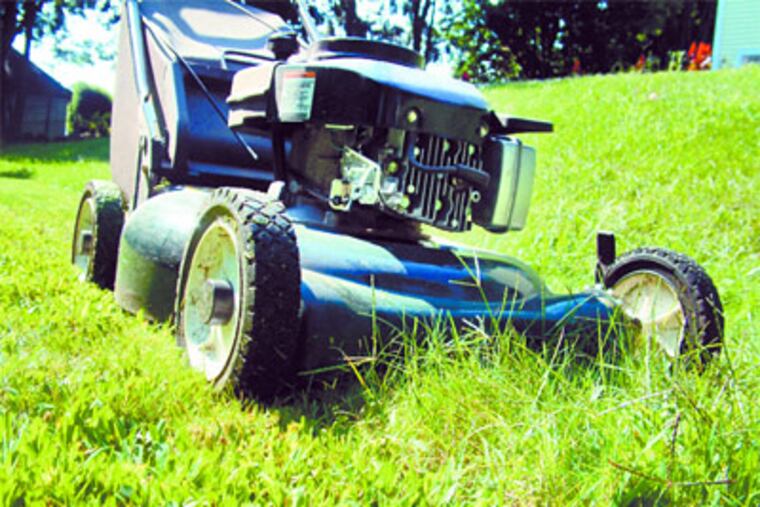
In the growing movement to replace chemical-guzzling lawns with greener domains - think rain gardens with native species - one environmental evil of the lawn is often overlooked: the gasoline mower.
These things, it turns out, are the smokestacks of garden equipment.
According to the U.S. Environmental Protection Agency, mowing your lawn with a typical gasoline-powered mower for one sweaty hour unleashes as many hydrocarbons as driving the average car almost 200 miles.
Hydrocarbons are the chemicals that on hot summer days - when most people mow their lawns - contribute to the formation of ground-level ozone, or smog.
Environmental problems also contribute to health problems.
Smog can cause shortness of breath, wheezing and coughing. It can exacerbate chronic lung problems such as asthma and emphysema.
So mowers "are running typically at the absolute worst time for breathers," said Frank O'Donnell, president of Clear Air Watch, a national advocacy group.
The EPA has issued new mower rules, requiring tiny catalytic converters, but they don't take effect until next year.
There's an alternative, and I don't mean those little push mowers that my grandfather had, although they certainly have a fan base among super-ecos and fitness devotees.
I mean electric mowers. To be sure, the early versions had their limitations, chief among them the power cords.
O'Donnell has used one for 17 years. Reaching the edges of his lawn requires three extension cords, which means the project inevitably involves tangles and cursing. But he still loves it.
Electric mowers now have rechargeable batteries. Neuton and Black & Decker are two of the major companies that make the mowers. Typically they'll mow a third of an acre - the average size of the U.S. lawn - per charge.
In 2008, Neuton mowers were part of two industrial innovation museum exhibits in Chicago and Washington. But the mowers were already getting plenty of attention in more practical circles.
In recent years, dozens of regional air pollution agencies around the country have begun lawn mower trade-in programs, offering electrics at a reduced price if people fork over a working gas model.
They incorporate catchy little phrases urging residents to "mow down air pollution" or "get your grass off gas."
California's South Coast Air Quality Management District - recall the brown haze of Los Angeles - has been doing it for eight years, and last year's offering of 4,800 mowers sold out in four days.
This year, the agency is offering 9,380 mowers. Four models that normally would cost $349 to $499 sell for $100 to $165.
The agency and the state make up the $1.6 million difference.
When this year's program is over, 37,800 gas lawn mowers will have been ditched.
"To take thousands and thousands of these polluting machines out of people's backyards and send them to the scrap heap and replace them with zero-emission rechargeable battery mowers is a big step in the right direction," said spokesman Sam Atwood.
I don't know of any similar programs here.
If the pollution savings don't motivate you, here are some mowers with a high fun factor. Several companies offer robotic electric mowers that zip around an area defined by special markers, chomping on the greenery as they go.
One is even solar-powered.
Not everyone is instantly awed by electric mowers.
Carrie Edwards of Linwood, N.J., won a Neuton in a raffle sponsored by the regional Clean Air Council in 2008.
When the mower arrived and they opened the box, her husband and sons sniffed. They thought it looked girlie.
So at first, they stuck with gas. She figured it was a macho thing. "They just think they have to get out there with the stinky old lawn mower."
But Edwards didn't. "You just push a button. There's no cord-pulling, there's no gas, there's no smell," she said.
Neither was there spillage - one more environmental woe for gas lawn mowers.
Best of all, perhaps, she found the mower lessened another kind of pollution: noise.
"It's like a hum," Edwards said of the machine. "You don't disturb anyone."
How could this not catch on? Sure enough, the other day, Edwards noticed that one of her sons had cut the lawn. He'd used the battery-powered mower.