A community outreach effort to explain insurance plans
Shirley Tax spends her days at Chinatown Medical Services fielding questions from patients who bought health insurance on the Affordable Care Act marketplace.
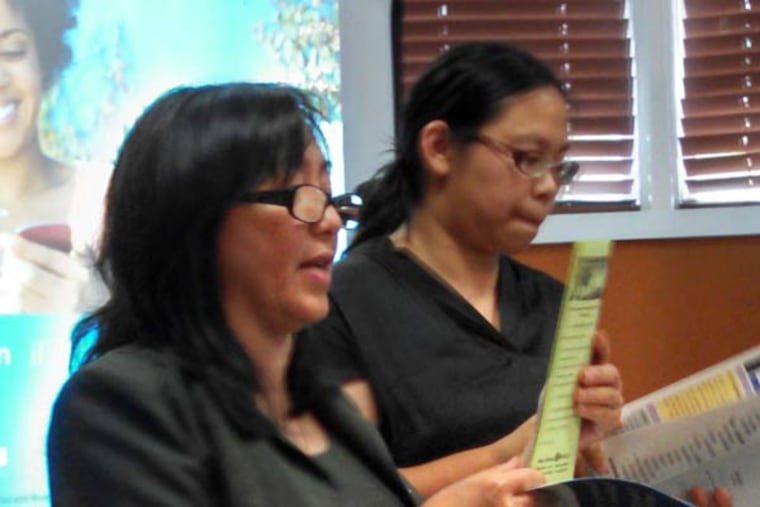
Shirley Tax spends her days at Chinatown Medical Services fielding questions from patients who bought health insurance on the Affordable Care Act marketplace.
Most of those queries revolve around Independence Blue Cross' best-selling, silver-level Keystone HMO Proactive plan. Tax says patients signed up for the tiered plan without really understanding how it worked. So when they receive a bill they take it to Tax and ask her to explain it.
"Most of them didn't have insurance before," Tax, 26, says of her clients, many of whom are immigrants. "They don't know what they have to pay. For most, this is the first time they have had a physical examination in the United States."
Truth be told, Tax, an Obamacare enrollment specialist, didn't understand all of the Proactive plan's nuances herself. That's why she was sitting in the second row taking notes and asking questions during Independence's education session at the Philadelphia Chinatown Development Corp.'s office on Aug. 7.
The meeting, one of 30 scheduled to run through September, is part of the insurer's broader strategy for educating consumers on how to use their new health insurance.
It's also another sign that consumers will need help using these plans in the most economical way possible.
"Our strategy is to engage as many members as possible who are new to insurance so they can understand the value of the plans they have purchased," says Paula Sunshine, Independence's vice president of consumer affairs.
"We chose the Chinatown Development Corp. because we know that it is a trusted resource for people in that community," Sunshine adds. "We've been at some mosques and churches. We are where the trusted advisers are."
The company is also meeting with navigators, certified application counselors, brokers, nurses, social workers, and even financial counselors.
During community meetings, people can ask questions about any of Independence's plans. Most center on finding a primary care physician if in an HMO and how to obtain and use referrals.
But the road show is clearly built around using the different tiers in the company's Proactive plan, the first of its kind for individuals in the Philadelphia area. This HMO plan uses three tiers for hospitals and doctors - preferred (lowest cost), enhanced (middle), and standard (most costly).
Members can use any doctor or hospital in the network. But the higher the tier, the more they pay out of pocket. There is, for example, no deductible to use a tier 1 provider but there is a $3,000 deductible for most individuals using tiers 2 and 3.
About 60 percent of Independence's doctors and hospitals are available at the preferred (tier 1, lowest cost) level.
Most of the 20 people at the Chinatown meeting wanted to understand the tiers. The presentation, conducted in English by Independence's Mary Blount and translated into Cantonese by local insurance broker Christina Chen, ran close to an hour.
Blount carefully explained every aspect of the Proactive plan while Chen translated and audience members jotted down notes. Multiple-choice questions were seeded throughout the slide show.
All were straightforward, such as: In a true emergency, where do you go? A) a neighbor B) the pharmacy C) a specialist D) the emergency room. All said D without Chen's translation.
A question about brand and generic prescription drugs made it clear that in the Proactive plan, if you chose a brand drug when a generic was available, you have to pay the cost difference.
The presentation ended with Blount's reminding the audience they can access information any time online, or by downloading the IBX mobile app, calling the new customer-service number (1-844-258-3463), or visiting the Independence Express.
Resources for Human Development, a nonprofit, also offers help from trained navigators: 855-668-9536.
Sunshine says based on the rising number of new customers registering on the member portal, the outreach strategy is working. HMO members are also using the site's online tools to select primary care physicians.
215-836-0101