What's asbestos doing in kids' crayons?
When it comes to the hazards of coloring with crayons, I was stumped. What's the worst that could happen? A child would color outside the lines?
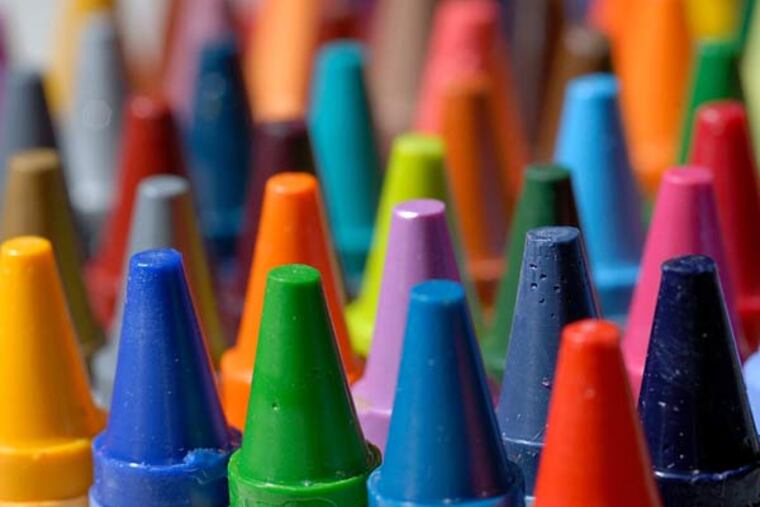
When it comes to the hazards of coloring with crayons, I was stumped. What's the worst that could happen? A child would color outside the lines?
No. It turns out there's the little matter of cancer-causing asbestos fibers.
Recently, the Environmental Working Group Action Fund, a national nonprofit, commissioned a test of crayons and found that several brands - some marketed under the kid-appealing names of Mickey Mouse, Teenage Mutant Ninja Turtles, and Power Rangers - contained asbestos fibers.
OK, so maybe your child isn't going to be breathing in crayons, and the asbestos just might stay put. Then again, contaminated crayons could release microscopic fibers as they are worn down, the EWG contends, adding that the average child uses 730 crayons by the age of 10.
And what about some of the toy fingerprint kits the group also tested? The powder in some of these, which kids are instructed to apply and then blow off, also contained asbestos. So the potential for inhalation is even greater than with the crayons.
"No one should be exposed to asbestos, but the fact that some children's toys are contaminated with this material is outrageous," said Sonya Lunder, senior research analyst with EWG and coauthor of the study.
All of the crayons and toys that contained asbestos were imported from China. (The complete results are available at www.asbestosnation.org.)
The researchers figure asbestos in the toys was due to talc, a mineral that is used as a binding agent. Asbestos is often found near talc deposits, and is a well-known contaminant.
Astoundingly, this wasn't the first time asbestos had been found in either product. Contaminated crayons were found in 2000, and toy crime-scene kits tested positive for asbestos in 2007.
After the previous findings, American crayon manufacturers pledged to stop using talc. But did everyone else? That's why the EWG tested the products again. This time around, Lunder said, no American-made products tested contained any asbestos.
The National Cancer Institute has concluded that "overall evidence suggests there is no safe level of asbestos exposure."
So plenty of people are concerned.
Philip Landrigan, professor of pediatrics and preventive medicine at Mount Sinai Hospital in New York, called the presence of asbestos in toys "an unacceptable risk." Landrigan, who reviewed the study, but was not involved in it, is an asbestos expert and former senior adviser to the Environmental Protection Agency on children's environmental health.
Consumer Product Safety Commission spokesman Scott Wolfson told a reporter for Environmental Health News that the commission was taking the report "very seriously. . . . Children's safety is of the utmost importance to our agency."
But he also said the commission could not take regulatory action before investigating thoroughly and making its own determination about any safety risk.
The day the report came out, Sens. Edward J. Markey (D., Mass.) and Richard J. Durbin (D., Ill.) sent a letter to the commission, asking the agency to ban talc from children's products and to issue a rule on asbestos, much as it has banned lead or plasticizers called phthalates in children's products.
"Children's playtime should be filled with fun, not asbestos," they wrote. They said the commission "needs to have the resources necessary to intercept these dangerous imported products before they reach the hands of children, and retailers should quickly cease sales and issue voluntary recalls of toxic products."
With all we know about the diseases asbestos causes, many people think it has been banned. Instead, it is more of a poster child for the failings of the Toxic Substances Control Act, which has not been updated since 1976, although Congress is considering new legislation now.
Part of the concern is that, even if just a smidgen of asbestos gets into the lungs of a child, because that child presumably has a long time to live, he or she has more time to develop an asbestos-related disease than a similarly exposed adult. So the risk would be higher.
Lunder said the labels of these toys did not say the products contained talc. And parents can't shop their way out of the problem by not buying toys from China. There are just too many other sources of these products. Lunder recently went to a restaurant, and the staff brought out unbranded crayons for her 5-year-old. She sighed and let the child use the crayons, but insisted on a hand-wash before eating.
When Lunder first saw the recent test results, she immediately thought of a science kit her young children have. It consists of experiments you can do with stuff from the kitchen.
She experienced a moment's panic when she remembered the toy had a fingerprint- detection test in it. But when she checked, she discovered that the experiment called for children to use cocoa powder or corn starch.
"And I thought, 'Yeah, why not?' We have really easy examples of identical products without the carcinogen." The use of talc in such products, she said, is "completely avoidable."
Indeed, although asbestos in crayons may not be at the top of a parent's worry list, why have it on the list at all?
"In my ideal world, there would be no parent worry list about chemicals in toys," Lunder said. "You'd be worried about getting the bike helmet on right." Or whether they're eating enough vegetables or brushing their teeth properly.
"That's the world I want to live in," she said.