Well Being: Chi energy healer to return to Phila.
When Seok Seo Park was 18, he began practicing tai chi and a martial art called hapkido. At tournaments, he would see people get injured, and he became interested in how to alleviate muscular problems and pain.
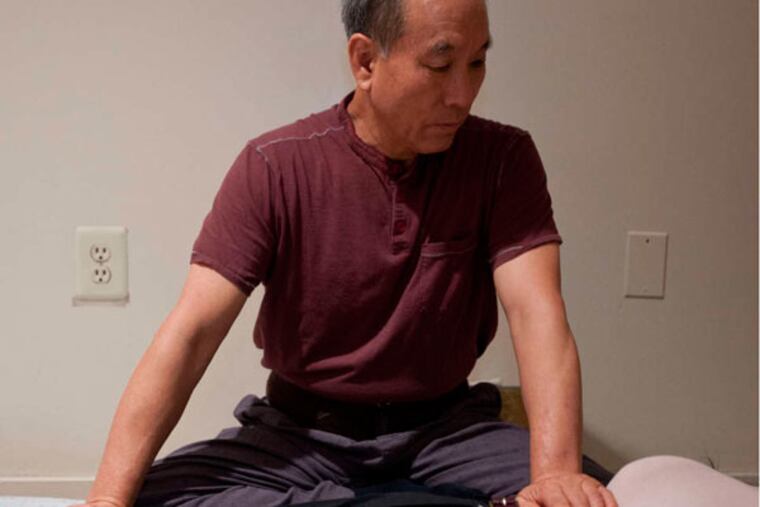
When Seok Seo Park was 18, he began practicing tai chi and a martial art called hapkido. At tournaments, he would see people get injured, and he became interested in how to alleviate muscular problems and pain.
He enrolled at the Pusan School for Acupuncture in South Korea and the Taipei Changron Chinese Medicine College in China. Over time, his focus became chi energy healing, and he studied with 30 to 40 masters, adopting what he considered most effective and developing his own system.
"One has to be especially attuned to the universe and Mother Nature to be an effective chi master, as one has to use one's own chi energy and the spiritual energy of the universe for healing," says Park, who is addressed by respectful clients and disciples as "Master Park." "I spent a lot of time meditating in temples in the mountains to clear my own chi."
Chi, also known as qi (both usually pronounced "chee"), "runs through everything," Park says. "It is the life force of existence. It is energy."
When you're in pain, whether physical or emotional, your energy gates are blocked, Park says. He seeks to unblock these barriers and free your chi by using his own chi energy and intense finger pressure at points in your body where he detects blockages.
When your chi energy is freed, relief and health arrive because your own chi, or life force, promotes healing, Park explains. Your chi can be blocked by physical trauma or mental issues. Sometimes you can feel the blockage, a sense that your body or mind needs release.
For the last 21 years, Park has been coming to Philadelphia twice annually to offer chi healing at the Health Connections Center, on Second Street adjacent to Head House Square. He was lured here by the center's director, Anne Khoury, a former lawyer who met him here after a doctor's recommendation and who credits him with rejuvenating and transforming her life.
Park, who lives in the South Korean city of Changwon, is a compact, muscular man who looks much younger than his 65 years. His treatment sessions typically last 15 to 20 minutes (and cost $60), and they are rigorous and comprehensive. He digs his fingers into all parts of your body, from toe to crown. Some people feel a change after a single session, but most require from five to 20 before experiencing significant relief, he says.
Michael Gardner, 54, a former teacher from New York, has seen Park for two courses of treatment, initially for intense flulike symptoms and depression. Says Gardner: "He totally healed me. My sister was stunned. She said I looked 10 years younger."
The second time was this summer, when Gardner was suffering from severe gastrointestinal distress.
"He's amazing," Gardner says, "a mystery, a marvel, unique and gifted in a way that can't be explained."
Peter Eobbi, 69, of Philadelphia, began seeing Park to boost his immune system, which is compromised due to HIV, and to ease back pain and other orthopedic problems. He continues to see him regularly.
"You don't have to tell him where the pain is," Eobbi says, "because he goes right to it. He has this intuitive sense."
Wendy Wilson, 73, of Massapequa, N.Y., first saw Park about 12 years ago in Manhattan. She has since made several trips to Philadelphia for treatment, including a monthlong stay last summer. He has helped her recover from post-cancer fatigue, lymphedema, respiratory ailments, and an arthritic knee.
"He completely cured the lymphedema, and my body works more energetically in general," Wilson says. "I really think he's a genius. He improved my mobility to such an extent that I was able to go up and down stairs rapidly."
Park visits the United States through a visa granted to those with extraordinary ability. His visa applications have been supported regularly by American physicians interested in alternative, complementary, and integrative medicine.
According to the National Center for Complementary and Alternative Medicine, "A review of scientific literature suggests that there is strong evidence of beneficial health effects of tai chi and qi gong" - the practice on which Park's work is based - "including for bone health, cardiopulmonary fitness, balance, and quality of life." The assessment by the center, part of the National Institutes of Health, is based on a 2010 review published in the American Journal of Health Promotion of the results of 66 randomized controlled trials that compared the practices with other forms of exercise or nonexercise control groups.
Daniel Monti, executive and medical director of the Myrna Brind Center of Integrative Medicine at Thomas Jefferson University, praises Park for his "highly uncommon" training and technique. "I am aware of many individuals who have benefited from his treatments," he wrote in a recent letter.
Richard Petty, scientific director of the Promedica Research Center in Georgia - and founder of what had been an early integrative medicine program when he was a member of the University of Pennsylvania medical school faculty in the late 1990s - calls Park "a giant in his field."
"I am not aware of anyone else in the world who has his unique combination of skills," Petty wrote.
"If you are in physical or emotional pain, you should try chi energy healing," Park urges. "I've seen thousands of patients, and the ones who were the greatest skeptics are the ones who emerge from a session completely surprised and amazed by how they feel afterwards."
"Well Being" appears every other week, alternating with Sandy Bauers' "GreenSpace" column. Contact Art Carey at art.carey@gmail.com.