Film produced by the Franklin Institute explores benefits of exploring space
A giant blinking eye appears on the screen, followed by a close-up of how optic nerves are connected to the brain. Before long, viewers are whizzing through space.
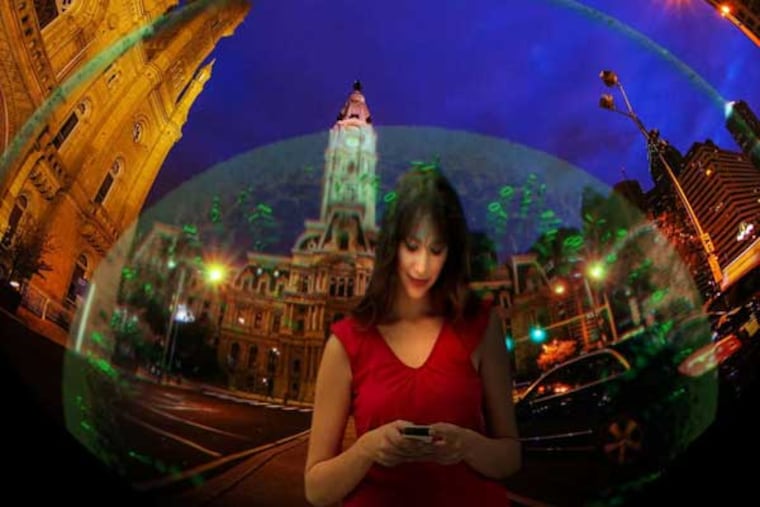
A giant blinking eye appears on the screen, followed by a close-up of how optic nerves are connected to the brain. Before long, viewers are whizzing through space.
The computer-rendered graphics are worthy of any science-fiction film, but this is a movie about science facts.
Called To Space & Back, coproduced by the Franklin Institute and a New Hampshire company called Sky-Scan Inc., the film explores the benefits of space exploration. It started showing daily at the science museum this week.
The half-hour movie was shot at an eye-popping 60 frames per second - at least double what you usually see at a movie theater - allowing for quick lateral movement without blurring. It is a full-dome show, meaning it covers the entire round screen in the Fels Planetarium, so be prepared for an eyeful.
Two projectors beam high-resolution images from opposite sides of the dome, each channeling the output of four computers. All of it is seamlessly stitched together, along with the audio, said the Franklin Institute's chief astronomer, Derrick Pitts, one of the producers.
"It's like having the Rockettes all doing their kicks at the same time," said Pitts, who was involved with ensuring script accuracy among countless other details.
The opening sequence with the eye explains how light signals are relayed to the brain. Then the movie shifts to humankind's yearning to cast its eye into space, through the use of telescopes.
Narrator James May, best known from the British TV show Top Gear, relates the latest advances in communications satellites. On the screen is a snazzy digital rendering of radio waves pulsing from satellites to the Earth's surface.
Then the film shows how satellites are used on Earth. A motorist zips around City Hall, guided by a dashboard GPS screen as techno music pulses through the theater's 15 speakers.
The narrator also describes technologies first developed for the space program that now have applications on Earth. Among them is a kind of laser that can be used to clear arterial blockages, a device first developed to study the Earth's atmosphere from space.
Other space spin-offs include cordless drills and fire-resistant clothing. Then there are the numerous lightweight products made from composite materials, such as tennis rackets and sporting helmets.
In addition to Philadelphia, the movie is showing in science museums worldwide, including in Australia and South Korea.
At the Franklin Institute, admission to one planetarium show is included with a regular museum ticket. To Space & Back is the newest of several options, and the only one produced in-house.