Penn going all out for a small science
When you take a picture of something that measures just a few atoms across, you need an awfully steady place to mount your camera.
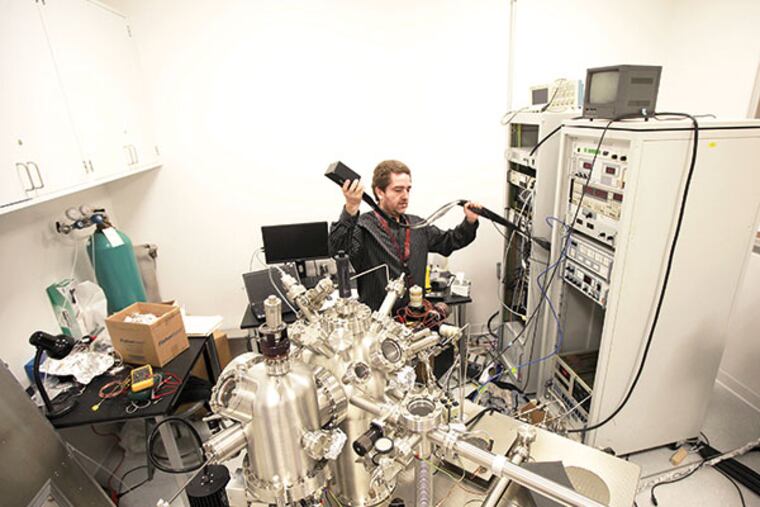
When you take a picture of something that measures just a few atoms across, you need an awfully steady place to mount your camera.
This explains why, on the corner of 32d and Walnut Streets, construction crews hammered and dug their way 18 feet into the ground. They sank stout caissons into the underlying Wissahickon schist. And then, in a "sweet spot" designated for a series of high-tech basement labs, they poured a slab of concrete three feet thick.
The result, despite the nearby urban rumble of trucks, buses, and trains, is an unyielding platform for "cameras" - really, electron microscopes - to study particles that are billionths of a meter in diameter.
The University of Pennsylvania's Singh Center for Nanotechnology officially opens Friday. But already it is abuzz with scientists with such diverse goals as improving solar panels, analyzing ancient pottery, and battling cancer with drug-laden nanoparticles that seek and destroy tumors.
"My vision is that this will be a catalytic place," said Mark G. Allen, who came from the Georgia Institute of Technology to be the center's scientific director.
Nanotechnology is the latest frontier in the higher-education arms race, as universities seek to lure the hottest researchers by purchasing the snazziest equipment and facilities. Penn State built a highly regarded nanoscience complex in 2011, for example, and the University of Delaware has one in the works.
The $92 million Singh Center appears to put Penn in the top tier, said Mark A. Reed, a Yale University electrical-engineering professor who works with nanotechnology.
"If a school does not have a center such as this, they have little chance to keep up with cutting-edge research," Reed said.
Penn's center is named for K. P. "Kris" Singh, a Penn alumnus who donated $20 million toward the project. Singh is president and chief executive officer of Holtec International, which makes equipment for the energy industry and has its technical headquarters in Marlton. Singh also is one of the owners of Interstate General Media, the parent company of The Inquirer.
Singh initially pledged $10 million toward the construction cost, until Eduardo D. Glandt, dean of Penn's engineering school, asked if he would consider doubling his gift. Singh said he would, provided Holtec won a contract to remove and store the leftover fuel from the site of the Chernobyl nuclear accident. It did. The work is still underway.
Singh said his interest in nanotechnology was ignited a decade ago, when a nano-inventor made him samples of a light, ultra-strong aluminum-based material called a metal matrix composite. A version of that material is now used to make Holtec's casks for storing spent nuclear fuel, which are widely used at nuclear plants across the country.
But Singh said that his support for the new building has little to do with his ongoing business interests and that he chose the project specifically because he did not want to appear self-serving. His goal: to ensure that his alma mater and the region are leaders in a field so new that it is hard to predict all the advances it will yield.
"It's going to be as significant as plastics were for the 20th century," Singh said.
Penn already had a sophisticated array of equipment to manipulate and analyze electronic circuits and other materials at the nanoscale. But the new center, in addition to boasting several new electron microscopes and other devices, is designed to make the existing equipment work better.
Take the building's "clean room," which removes all but the tiniest particles from the air with filtration units and a high-end HEPA filter that would put your vacuum cleaner to shame. The room, designed for creating miniature circuits, is 100 times cleaner than the air in Penn's previous nano-labs, said Noah Clay, director of the Singh Center's nanofabrication facility.
"If you are somebody with allergies, the clean room is a great place to work," Clay said.
The idea for the center was first hatched in 2004 by the leaders of Penn's engineering school and its School of Arts and Sciences, and it quickly won the support of Amy Gutmann, who became university president that year.
"It's got endless possibilities for really multiplying the impact of cutting-edge science in our community," Gutmann said.
Among the scientists who will use the Singh Center is Penn physics professor A.T. "Charlie" Johnson, whose research includes the study of graphene - gossamer sheets of carbon that are just one atom thick. One of his goals is using graphene to detect disease.
The idea is to attach antibodies for a particular disease protein to a sheet of graphene, which acts as an electrical conductor. When such a protein binds to the antibody, the graphene is perturbed in such a way that alters the electrical signal to indicate the presence of the disease, he said.
"We can easily imagine making 1,000 graphene devices on one little wafer that could test for 1,000 things simultaneously," Johnson said.
Allen, the center's scientific director, said other future nano-devices could include chemical sensors in smartphones that could measure air pollution or food spoilage.
Then there is Marie-Claude Boileau, a researcher at Penn's Museum of Archaeology and Anthropology, who wants to use the center's electron microscopes to identify the components of ancient ceramics from the Middle East and Thailand.
Whoever is using the equipment, Douglas Yates is convinced it is on solid ground.
Yates oversees the portion of the center that houses the electron microscopes. He tested one of the devices recently by seeing how long he could keep an electron beam trained on a clump of gold atoms that measured one nanometer across.
Five minutes later, it had not budged.
215-854-2430