Phila. art students flesh out long-gone dinosaurs
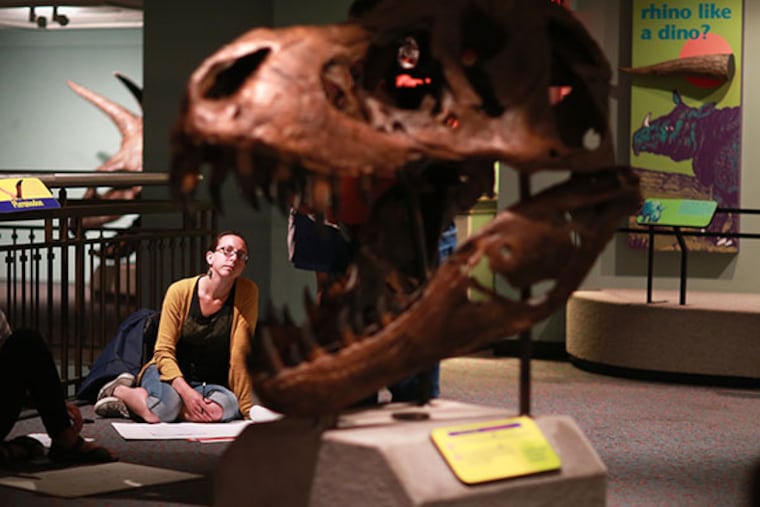
Art students commonly learn to draw by sketching a model who is not wearing clothes. In the dim, after-hours light at the Academy of Natural Sciences, Jason Poole's students are drawing from a model without flesh: a dinosaur skeleton.
Art students commonly learn to draw by sketching a model who is not wearing clothes.
In the dim, after-hours light at the Academy of Natural Sciences, Jason Poole's students are drawing from a model without flesh: a dinosaur skeleton.
How can you draw a creature no one has ever seen? The bones are key, providing a framework for artists to envision fully formed prehistoric beasts with muscle and skin.
Every Monday night for 10 weeks this fall, the 13 adult students enter a side entrance of the venerable natural history museum, sign in with a security guard, and head off to Dinosaur Hall, where they squat on the floor in the shadows of Tyrannosaurus rex.
Poole, 44, of East Oak Lane, is their guide, equal parts art teacher and anatomy instructor.
"Very light, just so you can see the bones as a guideline," he said this week as he wandered the room, peering over students' shoulders at their sketch pads.
Each student was sketching a T. rex skull, working from a life-size cast of a fossil nicknamed Stan, after the fossil hunter who found it years ago in South Dakota. Yet no sooner did they outline their skulls in pencil than they started to obscure their handiwork with meaty dino-flesh and pebbly scales.
"I guess I'll be covering up a lot of this stuff," said class member Meg Lemieur, 30, of Kensington, giving her detailed skull a final look.
Poole's official day job is coordinator of Dinosaur Hall, and he was a member of the Drexel University-led team that last month announced its discovery of a 65-ton dino named Dreadnoughtus. The lifelong fossil nut also is a trained artist, and has done illustrations for scientific journals, museums, and National Geographic.
The dino-drawing class allows him to share both of his passions. It is an offering of the Fleisher Art Memorial, the art school in South Philadelphia, but it is hosted at the academy, which is part of Drexel, because that is where the bones are.
Dinos make up only a small fraction of the museum's 18 million specimens, but let's face it, as the big boys near the front entrance, they are a marquee attraction.
The art class contains 13 students, 9 women and 4 men, including graphic designers (Lemieur is one of them), a retired engineer, a freelance illustrator, and a retired administrator for the military.
The cost is $210 for Fleisher members and $235 for nonmembers - plus a $60 lab and materials fee, which comes with an academy membership.
Bones are not the only guide to drawing prehistoric creatures, Poole told his students. Also helpful are clues from their living relatives. Among those are birds, which paleontologists consider to be modern dinosaurs, and crocodiles, which are somewhat related.
Another clue is fossilized skin. Poole passed around mounted sections of dino scales, telling students that as with crocs, the scales tended to be smaller in areas that saw a lot of motion - the arms, for example. Scientists also have attempted to determine the color of dino skin by studying the remains of what may be pigment granules, but there is debate over their interpretation.
Poole started collecting fossils with his father at age 8 or 9 on hikes in central Pennsylvania, and has now worked in various capacities at the academy for 23 years, starting out as a volunteer fossil preparator.
He started teaching himself to draw as a boy, using comic books, then attended the Philadelphia High School for Creative and Performing Arts. He went on to study commercial art and graphic design at the Antonelli Institute, then located in Plymouth Meeting. He also continued to indulge his passion for prehistory, taking courses in geology, taxonomy, and gross anatomy at the University of Pennsylvania and Drexel.
Poole's expertise comes through during the class.
When drawing the head, the bones around the eye should show through, he said. Those in the temple section will be covered by flesh. The bones are a guide, but do not let them overpower the drawing, he warned.
"You want these things to look alive, to look natural," the art teacher said.
Poole's talents range beyond art and fossils. He also periodically conducts a public skewering of bad science-fiction movies, joining two colleagues in a running commentary during the museum's Mega-Bad Movie Night.
Poole injects some humor into his art class, too. Take the question of whether to draw a dino with lips. There is some debate on this issue, but Poole told his class that he leans toward lipless creatures, citing the examples of birds and crocodiles.
"I have never seen a bird with a lip," he said. "I have never seen a crocodile with a lip, although I've tried not to get too close."
Watch Jason Poole draw a wall-sized rendering of the dinosaur Hadrosaurus. It took six hours but is shown in a 3-minute time-lapse video here.
215-854-2430