Butterfly is half-male, half-female
It was like any other Friday morning for Academy of Natural Sciences volunteer Chris Johnson: help clean the butterfly exhibit, feed the insects, check to see if any new ones emerged overnight. Black ones, red ones, spotted ones, and. . .
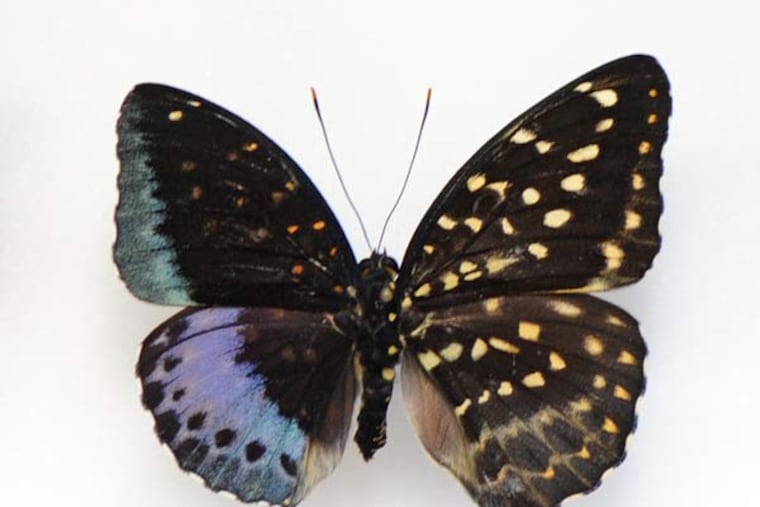
It was like any other Friday morning for Academy of Natural Sciences volunteer Chris Johnson: help clean the butterfly exhibit, feed the insects, check to see if any new ones emerged overnight. Black ones, red ones, spotted ones, and. . .
Whoa.
As Johnson watched, an adult butterfly unfolded wings that were deep brown with tan spots on the right side, and black with a border of jade, violet and light-blue on the left.
Johnson, 66, a retired chemical engineer from Swarthmore, knew it was a gynandromorph: half male and half female.
"I got goosebumps," he said.
Johnson had been told by museum staff about the possibility of this unusual phenomenon, caused by a chromosomal abnormality, but never expected to see it. It goes on display Jan. 17 at the natural history museum on Logan Circle, along with a half-male, half-female avian specimen that was collected in the 1800s: an oriole with brick-red feathers on one side, olive green on the other.
Scientists do not know how often such creatures come to be in the insect world, because in most cases, males and females are so similar in appearance that a gynandromorph would not be spotted, said Jason Weintraub, entomology collection manager at the academy, part of Drexel University.
It cannot happen in humans, for biological reasons that take a bit of explaining, but for some butterfly species, the rate has been estimated at one in 8,000. Evidence suggests that radiation exposure can lead to higher rates of this condition, Weintraub said.
Such individuals are not the same as hermaphrodites, which have male and female characteristics. When the male-female split occurs down the middle, as with the academy's butterfly, the animal generally has half of the male organs and half of the female, and is infertile.
Academy scientists have not performed a detailed examination of their find, which was made in October and is being announced this week in the museum's member newsletter.
Curatorial assistant Greg Cowper took a quick look at the specimen on Monday and could not see half of a "clasper," an external organ used to hold the female during mating. Weintraub said the museum would welcome a full analysis by a scientist who specializes in this type of butterfly, perhaps including a micro-CT scan to see inside it.
The insect was raised on a butterfly "farm" in Malaysia, one of many locations around the world that regularly supply specimens for zoos and museums. Once they have morphed from caterpillars into pupae - covered with the hard shell known as a chrysalis - the insects can be easily shipped in a box.
The academy's butterfly is from the species Lexias pardalis. It does not have a common name but belongs to the larger family known as the brush-footed butterflies - so called because their front legs are very small and look like brushes.
The oft-studied monarch butterflies also are in this family, and schoolchildren who examine them often make the mistake of thinking the insects have just four legs, Weintraub said.
When Johnson found the gynandromorph, he immediately notified David Schloss, coordinator of the academy's Butterflies! exhibit. Rather than release the insect into the exhibit, where it could have been damaged, they turned it over to Weintraub, who preserved and mounted it for display.
Butterflies generally live for just a few weeks anyway, and more are always on the way from Malaysia, Costa Rica and other locales - where raising the insects is an important source of income and an incentive to preserve areas from development.
An insect can develop the male-female split in one of several ways - among them the abnormal division of sex chromosomes early in development, Weintraub said.
There are no human gynandromorphs because the formation of genitals and other sexual characteristics is stimulated later in the embryo stage by the release of hormones throughout the body, said Arthur P. Arnold, a University of California, Los Angeles biology professor who studies sex chromosomes.
In insects, on the other hand, cells "know" they are male or female from the start. Once an abnormal chromosome division occurs, the results get passed on to future cells - half with the male version, half the female.
The oriole to be displayed alongside the academy's new butterfly was apparently collected in the 1840s, said Nate Rice, manager of the academy's ornithology collection.
Biologists are more accustomed to reading about such things, Rice said.
"To actually physically see it," he said, "it's a big deal."
215-854-2430
Read about the butterfly farmers who supply the academy with specimens at http://bit.ly/1HGttDU