Outfitting low-income homes for energy efficiency
Joan Young's roof was leaking. The furnace wasn't in great shape, either. But the 70-year-old retiree had few options. "When you're working, it's different. You find the money," she said. On Social Security, "you just deal with what you can, and you try to keep the bills from being expensive, so you turn down the heat and you put on more clothes."
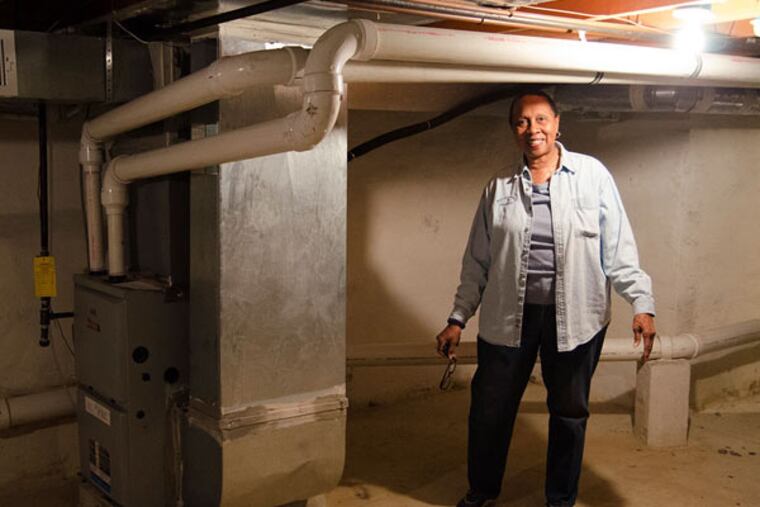
Joan Young's roof was leaking.
The furnace wasn't in great shape, either.
But the 70-year-old retiree had few options. "When you're working, it's different. You find the money," she said. On Social Security, "you just deal with what you can, and you try to keep the bills from being expensive, so you turn down the heat and you put on more clothes."
Then Young learned of a pilot program in Philadelphia that is seen as a way to conserve energy, aid the poor, make homes healthier to live in, and perhaps even act as a hedge against homelessness, bolstering the supply of low-income housing in the city.
Today, she has a new roof, a new heater, and a newly weatherized basement and attic - plus an estimated 30 percent savings in heating costs.
"It is very much improved," Young said of her home. "It's quieter. It's warmer. . . . I'm happy."
Having finished Young's home and 29 others like it in Mantua, the Energy Coordinating Agency (ECA), a city nonprofit administering the project, is holding a contest to find an entire block that needs similar work. Having one location will allow the work to be done more cheaply. Plus, given that the homes usually are connected, improvements in one often benefit the neighbors' homes.
None too soon, energy advocates say.
The rowhouse stock in Philadelphia has historically provided affordability for low-income homeowners, said Rick Sauer, executive director of the Philadelphia Association of Community Development Corporations, which works on equitable development - allowing people to stay in neighborhoods as the areas improve.
According to the ECA, the city is losing that battle. Many of the homes are old and have been poorly maintained. So cold air seeps in, the plumbing drips, and the roof gets soggy. Because of that, low-income Philadelphians have a high energy burden, paying up to 35 percent of their monthly income for energy and water. The national average is less than 10 percent.
Every year, at least 40,000 city households lose gas, electricity, or water service because of unpaid bills.
"It's a problem that has always been there, and now it's getting worse," said Liz Robinson, executive director of the ECA. She has made it her mission to reinvent the Philly rowhouse, transforming it from an energy-waster into an energy-saver.
ECA provides weatherization services for low-income people, but the "severe deterioration" of their homes is often a barrier. A leaky roof can't be insulated.
In the past, a federal weatherization program that is among the most generous ECA administers allowed for $1,500 in home repair costs. Now, standards have tightened, and the limit is $700.
"So if a roof is leaking and you don't repair it right away, that leak gets worse, and it gets worse pretty fast. And it leads to a lot of other damage," Robinson said. "The problem quickly grows to the point where it can exceed the budget of any of these programs."
The ECA has to disqualify many of the people it targets - the highest energy users - because their homes are among the most severely deteriorated. "We are literally rejecting more than 60 percent," she said.
The city Housing Development Program can provide free "basic systems repair" for low-income residents, but that program, too, has been cut, and the waiting list has grown long.
The new program, EnergyFIT Philly, is focusing on neighborhoods that have concentrations of homes that ECA is rejecting for weatherization. The goal is to find one block, do the repairs and weatherization, log data, and see how it all can be replicated.
"And we are bringing a different set of tools. We will be able to repair all the structural damage, provide a new roof and deep energy savings in one package," Robinson said.
The homes selected will get a better roof than the normal asphalt. ECA intends to install innovative foam roofs, aiming for an overall 50 percent reduction in energy costs for each home.
Through the program, the ECA also will be able to address household moisture, which leads to mold and other health issues.
The work is "groundbreaking," said Jeff Allegretti, president of Innova Services Corp., which focuses on creating and preserving affordable, energy-efficient housing in the city. He said that finding money to fix deteriorating homes had been "elusive."
He particularly likes the foam roofs, as they solve many problems, including tight spaces, aged wiring, and a buildup of heavy roof materials.
Much of the money comes from a $1.13 million grant from the Britain-based Oak Foundation, which has programs for the environment plus housing and homelessness. It sees the loss of affordable housing as one of the causes of homelessness.
Matching funds have come from the city's Housing Trust Fund, administered by the Office of Housing and Community Development. Its director, Deborah McCulloch, said "programs like this are important to explore. . . . Energy-efficient processes have the potential to reduce overall utility costs and housing maintenance, which reduce the money that a family has to spend."
Robinson has seen what happens otherwise, especially in neighborhoods that are gentrifying. "Houses there are in very poor condition, they are unstable and cannot remain the way they are. The low-income occupant is on the verge of giving up. . . . Meanwhile, developers are walking around with wads of cash."
"It's pretty tempting" to sell, Robinson said.
But she said she has also seen neighborhoods where house values rise from $30,000 to $300,000 in "a very short period of time." A homeowner who gets help through programs like EnergyFIT Philly may be able to hang on and reap the benefit of the gentrifying neighborhood.
"It has a lot of implications and benefits for the individual," Robinson said, "but also for the neighborhood."