Penn scientists' work on 'ghost particles' contributed to Nobel win
They are among the most numerous particles in the universe, subatomic ghosts silently whizzing through our bodies millions of times a second.
They are among the most numerous particles in the universe, subatomic ghosts silently whizzing through our bodies millions of times a second.
And yet physicists were mystified as to why two-thirds of these particles, called neutrinos, seemed to be missing in action.
This year's Nobel Prize in physics is going to a pair of scientists from Canada and Japan who discovered what was really happening, the prize committee announced Tuesday.
The project led by the Canadian scientist, deep inside a nickel mine near Sudbury, Ontario, got a big assist from the University of Pennsylvania. The team of several hundred researchers and technicians included more than a dozen from Penn, who helped design and build high-tech particle detectors and analyzed the results, first published in 2001.
The findings from both the Canadian and Japanese groups revealed that neutrinos, once thought to be massless, in fact have a small amount of mass - calling into question fundamental theories about the interaction of matter. (Make that a very small amount of mass. An electron is millions of times heavier than a neutrino.)
With further research on neutrinos and their subatomic kin, scientists expect to improve their understanding of such cosmic mysteries as exploding stars and the formation of the universe.
The prize will be awarded in Stockholm on Dec. 10 to Arthur B. McDonald of Queen's University in Canada, who led the project in the nickel mine, and Takaaki Kajita of the University of Tokyo, who led experiments in a Japanese zinc mine.
Why mines? The thousands of feet of rock act as a shield against cosmic radiation that would interfere with the scientists' measurements deep underground. Neutrinos, on the other hand, can slip right through.
In the Canadian mine, the neutrinos were detected by measuring their interactions with molecules of "heavy" water, in a giant plastic tank built 6,800 feet beneath the surface.
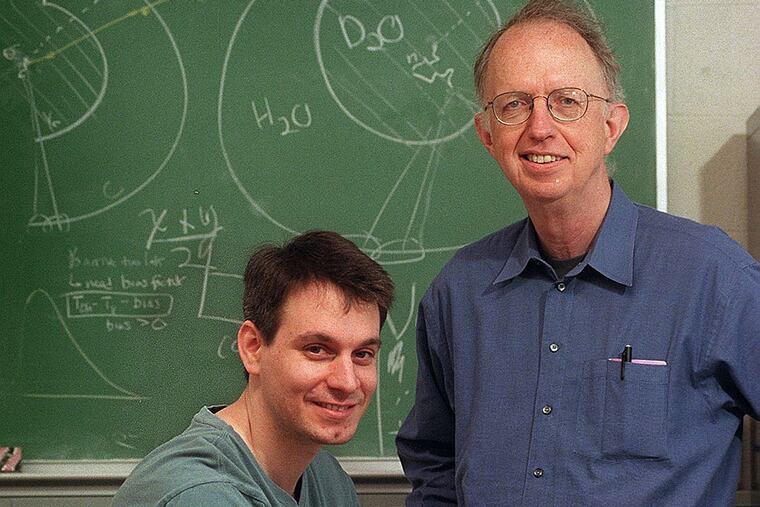
Penn physics professor Josh Klein, one of the team members, recalled plunging deep into the earth inside a cagelike elevator, accompanied by miners.
"I spent a large part of two years going down every day, for eight to 10 hours," Klein said Tuesday.
The air pressure that far beneath the surface is noticeably higher, said fellow Penn physics professor Eugene Beier, another key team member.
"It's something that you don't do with a stuffed-up head," Beier said.
By rule, a Nobel may be shared by no more than three people. That means the efforts of many go without official recognition, as science is increasingly conducted by large teams of researchers.
The choice of McDonald to represent the Canadian project made sense, as he was its director, said Klein.
"I think he would be the first to say that the result was the product of the work of many dedicated and talented people," Klein said.
Not just many people, but people from three disciplines, added Beier: particle physics, nuclear physics, and chemistry.
"It's science that is made possible by having multiple disciplines coming together," Beier said.
The name neutrino was bestowed in the 1930s by celebrated Italian physicist Enrico Fermi, using the same root as the English word neutral because the particles had no electric charge. Fermi won the Nobel in 1938 for his work on another atomic particle, neutrons.
Scientists calculated in the 1960s how many neutrinos should be produced by the nuclear reactions that make the sun shine. But measurements detected only one-third of that number.
The Canadian experiment was designed to see if perhaps the missing neutrinos had changed into a different "flavor."
So the scientists used two neutrino detection methods: one that detected them in their initial state as "electron" neutrinos, and one that detected all kinds of neutrinos, which include two other varieties known as "tau" and "muon."
Sure enough, the results of the second method yielded roughly three times as many neutrinos as the first.
And because they had changed identity, that meant they had mass, Klein said.
Here's why: Previously, the particles were thought to be massless, and therefore were traveling at the speed of light - meaning, under the laws of physics, that they were immune to the passage of time.
But because they had changed identity, that indicated they did experience time, and therefore the particles had mass, Klein said. Still, much work remains to be done before scientists understand how neutrinos fit into the cosmos.
"We do not know how to make predictions about how neutrinos will behave," Klein said. "We don't know the fundamental nature of neutrinos."
Maybe that will have to wait for a future Nobel.
215-854-2430@TomAvril1