Run faster, jump higher on anti-gravity treadmill
Running is the perfect aerobic activity. It speeds your heart rate quickly, involves the body's major muscles, and elicits a flood of anxiety-reducing opiates that bring mental peace.
Running is the perfect aerobic activity. It speeds your heart rate quickly, involves the body's major muscles, and elicits a flood of anxiety-reducing opiates that bring mental peace.
The downside is the toll it takes on the bones and joints. After a half-century of running, I'm convinced that our Maker did not design our bodies to pound away day after day for miles on concrete and macadam. The evidence is overwhelming: Too many runners are sidelined in their 50s and 60s by orthopedic woes, from worn-out cartilage to stress fractures.
Right now, I'm dealing with a torn meniscus in my right knee. It may be the result of gradual degeneration hastened by an accident nearly 10 years ago that changed the alignment of my right leg.
The meniscus is a bifurcated wafer of cartilage in the knee joint that provides a measure of shock absorption. When we're young, it's thick and relatively moist. As we age, it dries out and become thinner and prone to tears.
Fortunately, there is help for addicted runners like me who want to continue to run and train and rehab body parts that seem, like the meniscus, beyond repair.
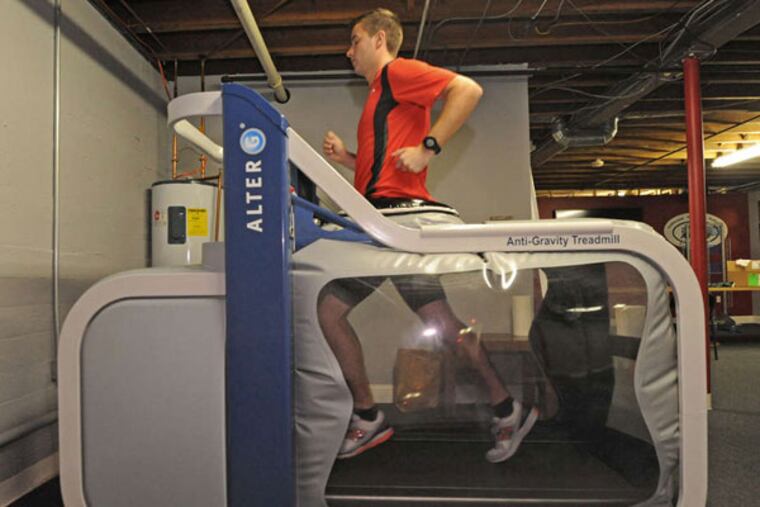
The device is called the Alter G, an antigravity treadmill developed by NASA to simulate weightlessness.
I had the chance to try one at the Running Company of Haddonfield, which has a model in the basement. (Charge: $50 an hour) It is used often by elite athletes, and area track and cross-country coaches rent time on it for their teams, said Dave Welsh, 36, owner of the store as well as others in Moorestown and Mullica Hill.
"It alleviates impact for rehab and for supplemental training," said Ralph Harris, 28, a running specialist at the Haddonfield store and a running coach at Camden Catholic High School and for private clients. "It bridges the gap between being injured and being able to run with your full body weight."
The Alter G is an inflating air chamber, sealed around your waist with a zipper that can reduce your body weight from 1 to 80 percent in increments of 1 percent. For most people, the most effective range is between 20 and 25 percent. I ran at a setting of 18 percent and was able to maintain my normal stride and speed with no pain in my knee. Above 50 percent, the floating sensation is like walking on the moon. It was so easy I didn't feel I was getting a workout.
The Alter G enables someone recovering from a stress fracture who has just begun walking without a boot to begin jogging with normal mechanics and to experience the benefit of training by developing muscles, tendons, and ligaments around the joints that have atrophied from disuse during recovery.
If you're an elite runner, the antigravity treadmill, by reducing your weight, enables you to run faster, to move your legs more swiftly, thus developing or maintaining fast-twitch muscle fiber, Welsh said. In that respect, it's superior to an underwater treadmill, whose circumambient resistance, while strengthening muscle, slows a runner considerably. It's estimated that for every five pounds lighter you are, you can run a mile four to five seconds faster. Over the distance of a marathon, that can amount to two minutes, and the difference between qualifying for Boston and having to wait until next year.
The Alter G is used by a wide range of professional sports teams and physical therapy and rehab facilities. It is helpful for obese people embarking on an exercise program and enables people afflicted with Parkinson's to move in a confident, balanced way. Olympic-caliber athletes such as Erin Donohue use the Alter G in training. It permits them to do harder workouts, especially speed intervals, without risking injury while enhancing neuromuscular control and muscle memory.
The Alter G has done wonders for Welsh. A hurdler at Haddon Township High, he wasn't fast enough to compete at Division One Lehigh, so he switched to distance running, participating in events up to 10,000 meters. He uses the Alter G after abbreviated long runs for post-workout intervals, such as 200-meter repeats, or repeats of 400 and 600 meters at full race pace.
It has paid off. At age 35, he set a PR in the mile: 4:16. He has run the 1,500 meters in 3:59. His ambition is to keep his mile time under 4:20 until he reaches age 40. The Alter G, he says, helps him continue at that wicked pace.