A daughter gives birth, everything changes
I had been waiting for the call ever since my daughter told me that she and her husband had "pulled the goalie." So when she said, "I'm pregnant," I wasn't surprised.
I had been waiting for the call ever since my daughter told me that she and her husband had "pulled the goalie." So when she said, "I'm pregnant," I wasn't surprised.
My daughter Ariel Stern and her husband Jesse Silverman had been married 3 1/2 years. She was 30, the same age I was when I had her. And yet, I couldn't fathom the change. Child to mother. Mother to...
Good God.
At 61, I am way past my due date. A recent AARP study found that the average age of first-time grandparents is 47. But we boomers have trouble letting go of our delusions that we are too young for almost everything.
Trusting that inevitability will conquer all, I focused on the present, doing what I could to help. Pouring nose-tickling glasses of ginger ale for her nausea. (Bless you, Canada Dry.) Sifting through my closet for elastic-waist pants that might adapt to her swelling belly. (She never wore them. Some generational divides are just too wide.) Letting her squeeze my hand until my fingers turned white when, three-quarters of the way through her pregnancy, her doctors worried that she might have gestational diabetes and she needed her umpteenth vial of blood drawn. (False alarm.)
The hard work, of course, was all hers. And she was not above letting everyone know how much effort it required.
During family dinners, when her siblings asked her to get up and help clear the table, she'd demur, "I am growing a human."
It never worked, but was good for a laugh.
Her husband bore up well through all three trimesters, despite some understandable pre-paternal anxiety about how they were going to afford the $304,480 that the Department of Agriculture, with bizarre precision, projects it will cost to raise a baby to the age of 18.
I have always loved my son-in-law, but I am forever indebted to him for letting me in on this adventure, from the day the doctor peered into the dark shadows of the ultrasound and announced, "there are no boy parts," to the grueling marathon of labor.
Other than the obvious fundamentals, so much has changed in the way babies are born.
In the 1950s, my mother was parked in a bare room to tough it out on her own until her doctor, who didn't even know her name, waltzed in for the "ta-da" delivery.
In the more enlightened 1980s, my husband and I took Lamaze classes for weeks, practicing relaxation techniques. Our midwife stayed with us through 26 hours of labor and an emergency C-section.
My daughter and son-in-law had only three quick sessions with the hospital's childbirth educator, picked up some basic tips and spent more time preparing their overnight bags than mastering the art of focused breathing.
And while they would have loved their obstetrician to deliver the baby, it was not an option. Instead, they were handed over to successive shifts of strangers.
This system, in which "hospitalists" perform most in-patient care, began gaining popularity in the 1990s. The advantages, according to the American Congress of Obstetricians and Gynecologists, are that it gives doctors more predictable schedules and . . . "may help with liability premiums."
The downside?
My daughter had no relationship with the people who would help her through this intensely personal experience.
She had spent the morning trying to decide whether she really was in labor.
Oh, sweetheart, I told her. We've all heard stories about women who wake up one day complaining of indigestion, then plop out twins.
Not happening.
At 11 a.m., we arrived in the Perinatal Evaluation and Testing Unit at Pennsylvania Hospital. I had been dancing by my daughter's bedside, half in excitement, half in an attempt to distract her from the contractions, when the midwife came in the room.
"Are you her doula?" she said, raising an eyebrow.
"No, I'm her mother."
"Oh," she said drily, "because you don't seem like one. Doulas are usually so calm and centered."
A doula, I knew, is a labor superhero, offering a gentle hand, soothing words and sage advice.
Sort of like a mother. Only less invested, better paid, and apparently less inclined to bust a groove.
The midwife may not have cared for me. But she seemed confident and competent, so I said nothing, reassuring myself that my daughter was in good hands, and this labor would not last long.
Her cervix had already dilated four centimeters, nearly halfway to the magic 10 needed before she could push. Surely, with a head start like that, she would be spared the ordeal that I'd gone through.
It was the first of many wrong predictions I'd make over the next 22 hours.
She was transferred to a labor and delivery room and greeted by a nurse who wrote her name on a white board and under the heading "Goals," put "Avoid Pitocin" and "Avoid Epidural."
Statistically, my daughter had less of a chance getting through labor without them than I did.
Pitocin, which strengthens contractions, accelerates labor and feels like a bullet train tearing through your pelvis, is given to 23 percent of women in labor, more than twice as often as in 1990.
Epidurals, the anesthetic administered through the spine, was less common in the 1980s when we were told that the procedure would prolong labor, harm our babies, and give us brain-crushing headaches.
Now that most of those fears have been laid to rest, as many as 70 percent of women get epidurals.
My son-in-law, calm and centered (as a doula!), settled into a chair, leaned in close to my daughter and like a conductor, led her in a concert of controlled breath, quickening with each agonizing crescendo.
They had prepared a playlist on her iPad, including "Push It," by Salt-n-Pepa, "I Wanna Be Sedated," by the Ramones, "New Soul," by Yael Naim, and "Let it Go," from the film Frozen. But she was too consumed trying to keep it together to make room for irony or humor.
"I like it peaceful," she said, opting for silence.
At 4 p.m., she was still only four centimeters. Demoralized, she asked for some painkillers. They infused some through her IV, but it brought her about as much relief as a nice cup of tea.
We helped her hobble into the shower, which turned out to provide more diversion than comfort. The temperature gauge was broken, so she was alternately blasted with scalding water, then pelted with cold.
At 6 p.m., she learned she had only reached six centimeters. The news broke her spirit.
"I'm done," she said. "I can't take anymore. I want an epidural."
I didn't know what to say. Watching her twist in pain, I realized the limits of my gentle hand, soothing words, and sage, outdated, advice.
My son-in-law, fortunately, knew what to do. He was already out in the hall, talking to the nurses.
The anesthesiologist, speaking softly, had her sit up and bend forward while he swabbed her back with antiseptic and told her to stay very still.
"How long will it take to work?" she asked.
"Not long," he said, inserting the needle into her spine, followed by a tube as fine as filament.
Within minutes, blissed-out, she smiled. "Epidurals," she said, "are a gift from the heavens."
I went over to the white board and without regret, used my finger to erase "Avoid epidural."
Later, when they gave her Pitocin, I erased that goal, too.
She started pushing before sunrise. After two hours, I could see the baby's head, and cried, "She's almost here!"
Not.
"She's sunny side up," the midwife announced. Facing up, the baby would have a harder time slipping under the pelvic bones. An obstetrical resident with a reputation as a crackerjack baby turner arrived. Closing her eyes in concentration, she reached in, wedged her fingers around the baby's skull and twisted.
Again. And again.
"I'm sorry," she said finally. "She won't budge."
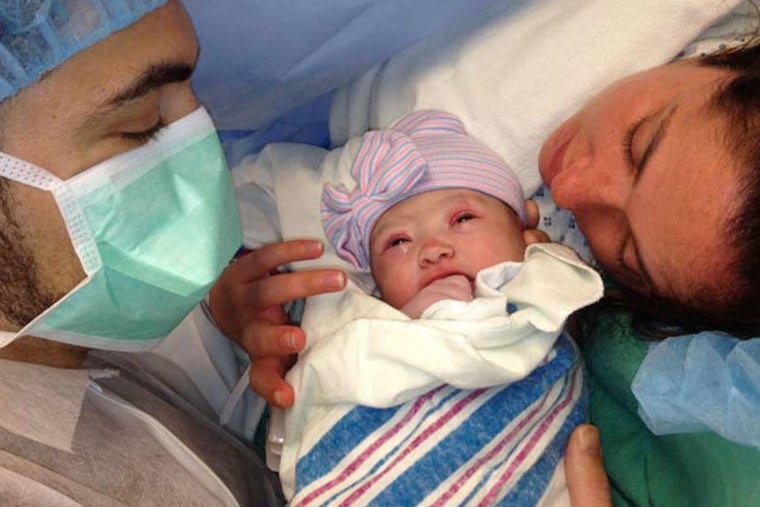
So at 7:45 a.m., my daughter was wheeled, sobbing, to the operating room for a cesarean section.
Reese Annabelle Silverman. Born 8:02 a.m., bruised and battered from the battle with her mother's pelvic bones. Seven pounds six ounces of the purest form of love.
As I held her, running the back of my knuckle against her velvet cheek, I vaulted back 30 years.
Except for the infant LoJack clipped to her ankle, she felt exactly like all my babies, the curve of her back so familiar, the same involuntary twitches of her face as the muscles performed their repertoire. A yawn. Frown. Smile. Wince.
Photos sailed out to friends and families and instantly, a flurry of exclamation points was launched in return. Could she really be so gorgeous already?! Mazel tov! Congrats! She looks just like . . .
Her aunt.
Her mother.
Her father.
All and none of the above.
Herself.
Over the next five sleepless days and nights, I sang rusty lullabies, rocked that baby until my knees ached, and tried to force reality to sink in.
Buffered back and forth by the memories of my own children's birth, catapulted into the present. The same intense rush of feeling. Only this time, for my daughter's daughter.
All she has to do to be loved is simply be.
The day they brought her home from the hospital, I dug out the photo album from my daughter's first year. The glue had dried and the pictures, colors faded, drifted off the pages like autumn leaves.
My daughter had seen them all before, but holding one taken in the operating room, minutes after she was born, her eyes teared up.
"I used to relate to me in these," she said. "Now I relate to you."