DVD touts reborn train stations
Over the years, as passenger service ceased and the importance of railroads waned, many stations were abandoned. Some fell into disrepair and were demolished. But others were rescued by romantics, entrepreneurs and visionaries, and resurrected, with passion and creativity, as homes, restaurants, shops, libraries, offices. One even became a glassmaking factory.
The tracks still show the gleam of use, and more than a dozen Norfolk Southern freight trains rumble by each day. But the grand stone edifice that was once the Phoenixville station no longer presides over a busy railroad artery.
Where there are two tracks, there once were five. Townsfolk rode to Philadelphia, steam locomotives hauled hopper cars loaded with coal to feed the hungry furnaces of Phoenix Iron & Steel.
In the early 20th century, every city and town across Pennsylvania, home to the mighty Pennsylvania Railroad, had a station. It was both the front door of the community and the gateway to the wider world.
Over the years, as passenger service ceased and the importance of railroads waned, many of these stations were abandoned. Some fell into disrepair and were demolished. But others were rescued by romantics, entrepreneurs and visionaries, and resurrected, with passion and creativity, as homes, restaurants, shops, libraries, offices. One even became a glassmaking factory.
Two rescued stations are in Chester County - the Berwyn station on what used to be the PRR's Main Line, and Columbia Station in Phoenixville, once a bustling stop on the Reading Railroad. Both architectural treasures are among 16 featured in a 2002 documentary that has now been released on DVD.
"There are lots of train stations in Pennsylvania, but I was looking for the oddballs, something a little different and unexpected," says Jerry Sawyer, who wrote and produced Pennsylvania Train Stations - Restored and Revitalized for Penn State Public Broadcasting. "I was trying to find interesting people whose experiences converting these structures might inspire others to do the same."
The Berwyn and Phoenixville stations are not only beloved relics of the region's rail heritage but also reminders of how the past can enrich the present.
Mark Bussler, a producer for Inecom Entertainment Co., the Pittsburgh-based maker of historical documentaries that is distributing the DVD, says the stations represent "a nice story about people who put great effort into saving something obsolete, but also sturdy and beautiful. Instead of bulldozing them for a fast-food restaurant or big-box store, they've adapted them to modern times and new purposes."
Phoenixville station, built of native purple sandstone in the Italian-villa style, was erected in 1858. With twin towers and Gothic highlights such as rose and tracery windows, it captures in its architecture the ambition of a town proud of its burgeoning industrial might and confident of its future.
That future dimmed in the 1960s and '70s as business at the steel mill dwindled. In 1973, the station was shuttered. For 10 years, it was abandoned and boarded up. A group of private investors eventually bought it and converted it into a catering hall and banquet facility. They rechristened it Columbia Station, after the town's storied Columbia Hotel.
For the last 10 years, the building has been leased by Robert Ryan, 57, whose family business, Robert Ryan Catering at Columbia Station, hosts about 140 functions - weddings, galas, fund-raisers, corporate events - at the distinctive site.
"It's a privilege to be here," Ryan says. "It's a very unique, historic building, and people really like that."
Ryan was initially concerned that being next to an active railroad line might be a distraction and detraction. It has proved just the opposite.
"I'm overwhelmed by how many train buffs are out there," he said. "People just seek out a train station."
Though no train buff himself, Ryan is not immune. In 2000, he bought and restored the ultimate lawn ornament: a steel caboose. The heated, air-conditioned relic now serves as a private reception room for bridal parties and a staging area for garden weddings. Surprisingly spacious, it can accommodate 18 people for cocktails.
When Bob Macchione and his wife decided to quit their corporate jobs and launch their own business, they were looking for an old property of some sort - "anything but a strip shopping center," Macchione says.
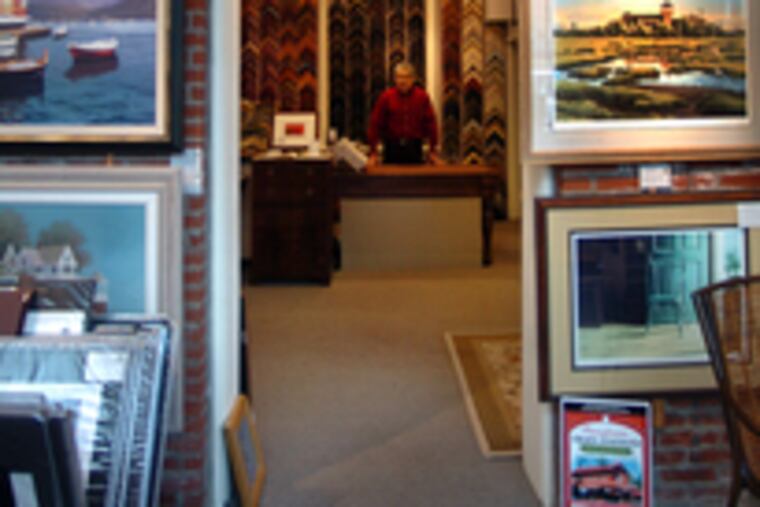
When they learned that the Berwyn station, boarded up for 20 years, was about to be rehabilitated and rented out, they knew they had found the right spot for their frame shop and art gallery. They signed the lease in September 1986, took part in planning the reconstruction, and opened for business the following December.
"Things took off for us immediately," Macchione says. "This was really the de facto center of town, and people were so excited when the boards came off and it was reopened."
Macchione's business, the Frame Station Gallery, occupies the first floor of the brick-and-frame structure, which was built in 1884. Macchione calls it "one of the nicest landmark properties in the area."
While the interior of the station has been remodeled into a frame shop and art gallery, the original molding around doors and windows remains. Other exterior features - the brickwork, the curved roof brackets, the Tuscan red-and-cream color scheme - are refreshed remnants of the building's past.
Visitors are invariably charmed and impressed. "I notice that people's heads go up," Macchione says. "Maybe it's the height of the building and the fact that it's an old train station. The appeal is nearly universal."
Although there's no display of railroadiana in the shop, Macchione has framed plenty of railroad art. The other day, as he examined a print of a streamlined steam locomotive with a body designed by the legendary Raymond Loewy, Macchione remarked: "The style and engineering are gorgeous. What a symbol of American strength and ingenuity."
Of the train station, Macchione said, "It's been wonderful. Preservation of art and memories is what we do. So the building in a way represents our business. We love old trains, and we love old buildings. We feel like the de facto caretakers of this place. We keep it tidy and plant flowers. This is our home."