Dick Jerardi: Late season excellence puts Temple, Saint Joseph's, Villanova in Big Dance
THREE WEEKS ago, there was a very good chance that no city team was going to be in the NCAA Tournament for the first time since 1977. Now, there are three.
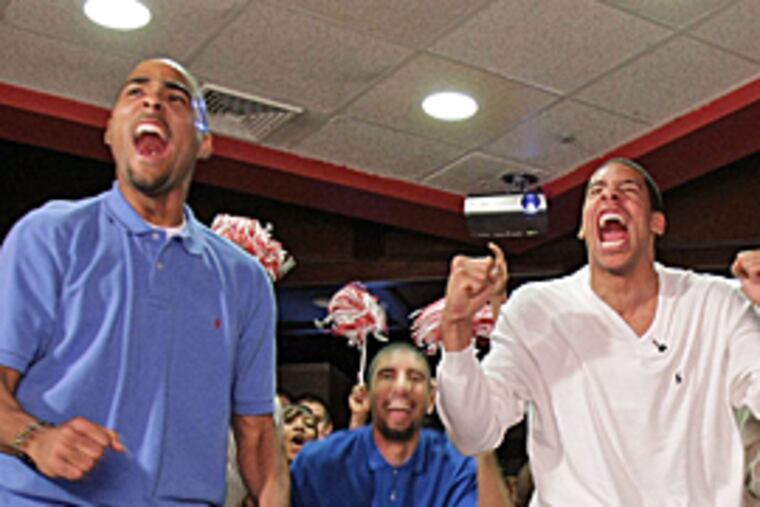
THREE WEEKS ago, there was a very good chance that no city team was going to be in the NCAA Tournament for the first time since 1977. Now, there are three.
Providentially, while so many other potential NCAA teams were imploding in their tournaments, Temple and Saint Joseph's were storming through theirs and Villanova finished its regular season strongly and then beat Syracuse in the opening round of the Big East Tournament, a virtual elimination game. Villanova and St. Joe's were among the last at-large teams invited.
The city teams played their way in by winning games against good teams at the right time. Last impressions matter. The Hawks and Wildcats clearly needed them. And the Owls took all doubt out of the equation.
It is the first time since 1999 that three city teams made the NCAAs, when Temple, Villanova and Penn did so.
Temple proved its late-season form was no mirage. The Owls kept right on winning in Atlantic City and took the Atlantic 10 championship with a comeback win over Saint Joseph's Saturday night. In Fran Dunphy's second season, Temple is back where it was so often under John Chaney - A-10 champs and in the NCAAs. No. 12 seed Temple will play No. 5 seed Michigan State on Thursday in Denver. If the Owls win, they will play the winner of Big East champion Pittsburgh-Oral Roberts on Saturday.
The Hawks surely looked like an NCAA team in early February and then faltered over the final weeks of the regular season. They stormed through the A-10 Tournament, trailing for just 10 of their first 140 minutes of play until the Owls caught and passed them in the second half. The selection committee obviously took note of that performance, the two wins over No. 10 Xavier in 8 days and how competitive the Hawks were all season against a solid schedule. No. 11 seed St. Joe's will play No. 6 seed Oklahoma on Friday in Birmingham, Ala. If they win, the Hawks will play the winner of Louisville-Boise State on Sunday.
Villanova looked lost when its five-game losing streak ended with that rout by St. Joe's at the Palestra. But coach Jay Wright tweaked his lineup, inserted veteran Dwayne Anderson in the starting lineup, gave Scottie Reynolds more run at the point and got big wins down the stretch against Connecticut and West Virginia. The Wildcats' young team got better late in the season, which is something the committee really likes to see. No. 12 seed 'Nova, which will play in its fourth consecutive NCAA, will play No. 5 seed Clemson on Friday in Tampa. Win and the 'Cats will play the Vanderbilt-Siena winner Sunday.
"I think it's great that three Philadelphia teams got in,'' Dunphy said. "I think it shows the level of basketball here in Philadelphia and the Big 5. I was very excited for Jay [Wright] and Phil [Martelli].''
One minute after St. Joe's name came up, Dunphy called Martelli . . .
Martelli said 1 minute after Villanova's name came up, he called Wright.
"It's a real basketball brotherhood in this city," Martelli said.
When asked about three Big 5 teams making the field, Wright said, "I think that Temple helped us, I really do. It is awesome for three Big 5 teams to be in it. Temple is another conference champion and another road win that helped us. The Big 5 teams raised our RPI because they had great seasons. That is the great thing about the Big 5, and that is the way it should be.''
The No. 1 seeds, in order, were no great shock - North Carolina (East), Memphis (South), UCLA (West) and Kansas (Midwest).
Overall No. 1 seed UNC has the clearest path to the Final Four in San Antonio. The Tar Heels start play in Raleigh, a few miles from their campus. They then have to journey all the way to Charlotte (where they just won the ACC Tournament) for the regionals. There was a special request for UNC to play at the Deandome, but the committee rejected that.
The six BCS leagues got 28 of the 34 at-large bids. The others went to the Atlantic 10 (Xavier, St. Joe's), West Coast (St. Mary's, Gonzaga), Sun Belt (South Alabama) and Mountain West (BYU).
Georgia won four SEC games during the season and won four more in the tournament, three in 26 hours. The SEC started at the Georgia Dome and concluded on Georgia Tech's campus because of Friday's tornado.
Georgia beat Arkansas yesterday, approximately 20 minutes before the brackets were revealed. Thus, there was an at-large team that was taken off the board to make room for Georgia. Only the committee members and anyone else in the room will know that team's identity.
"We had five contingency plans,''' said committee chairman Tom O'Connor, referring to yesterday's games that ended late in the day.
When San Diego won the West Coast Conference and Western Kentucky the Sun Belt, that lessened the at-large pool. Arizona State, Virginia Tech, Massachusetts and Ohio State were among the teams that probably were considered for the final spot that Georgia took.
Former Big 5 assistants - Steve Donahue (Cornell), Randy Monroe (UMBC) and Fran McCaffery (Siena) - accounted for nearly 10 percent of the 31 automatic qualifiers.
Donahue, a longtime Penn assistant, ended the 20-year Ivy League reign of Princeton and Penn by leading his team to the first unbeaten league record, other than P and P.
Monroe, an assistant under Speedy Morris at La Salle, got UMBC to its first NCAA in just his fourth year as head coach.
McCaffery, who played at Penn and then was an assistant there, has carved out a unique place in tournament history. Just 35 coaches have taken three teams to the tournament. Four (Rick Pitino, Eddie Sutton, Jim Harrick, Lefty Driesell) have taken four teams. Only two have taken three teams from one-bid leagues to the tournament - Driesell (James Madison, Georgia State, Davidson and, of course Maryland) and McCaffery (Siena, Lehigh, UNC Greensboro).
Nobody took a harder path to the tournament than Coppin State. Fang Mitchell's team was 4-18 when February began. It had lost at Kent State, Hawaii, Arizona State, Ohio State, Dayton, Marquette and Indiana. It played at Marquette on a Friday night, took a bus from Milwaukee to Bloomington, Ind., after the game and played IU at noon on a Saturday.
Coppin needed to win four games in 4 days to win the Mid-Eastern Athletic Conference. The Eagles beat Howard by one, Hampton by one, Norfolk State by two and Morgan State by two to win the title. Tywain McKee (Bartram) scored 33 points in the title game, including the game- winner in the final seconds.
For all that, Coppin gets Northeast winner Mount St. Mary's in the opening-round game in Dayton tomorrow night. (They should play somewhere in Maryland as the schools are about an hour apart.)
The play-in winner gets UNC Friday in Raleigh, the city where Coppin just won the MEAC. Sounds like potentially a rather easy trip for Coppin.
Just three teams won all their conference games - Cornell (Ivy), Davidson (Southern) and Memphis (Conference USA). Counting conference tournament games, those three were 56-0 against their league teams. Ten regular-season conference winners did not win their league tournaments. Five of them were from one-bid leagues and those winners were guaranteed spots in the NIT.
ESPN "bracketologist'' Joe Lunardi, in his final projection, posted 15 minutes before the Selection Show began, got all 34 at-large teams correct. Get that man on the committee.
We all love the underdogs, even though hardly any of them won last year. Keep this in mind as you fill out your brackets - underdogs early, favorites late. The last 15 Final Fours have had exactly four teams outside the BCS leagues.
Proving how much can change in just a year during an era when teams lose so many good players to the NBA before their eligibility expires, the two schools that played for the 2007 national title, Ohio State and Florida, did not even make the tournament. Which tells you it's not about the schools. It is about the players at those schools. *