Zoning bill marks 1st step toward 1,500-foot skyscraper here
A local developer took the first step yesterday toward building the tallest skyscraper in America when City Councilman Darrell Clarke introduced legislation for zoning changes needed at the 18th and Arch streets location.
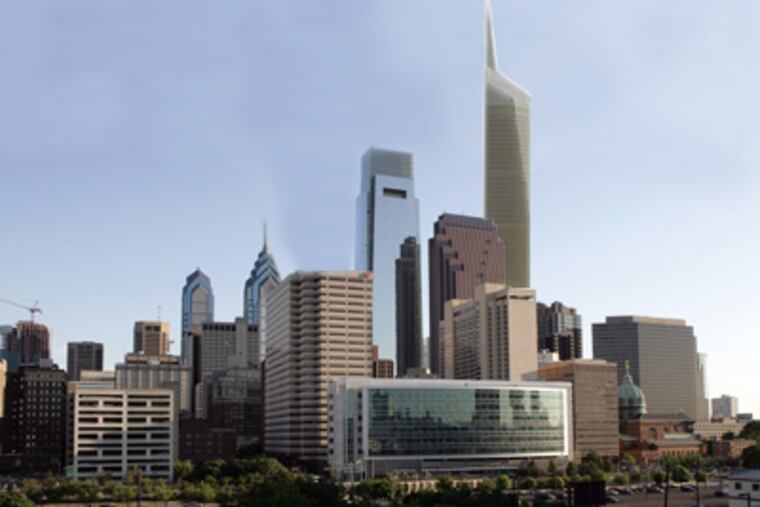
A local developer took the first step yesterday toward building the tallest skyscraper in America when City Councilman Darrell Clarke introduced legislation for zoning changes needed at the 18th and Arch streets location.
Clarke's action came on the same week that Mayor Nutter laid out his goal to restore to the City Planning Commission the power to shape such developments. The councilman and the mayor agree the commission should run the show on the proposed skyscraper, which Walnut Street Capital has named the "American Commerce Center."
At 1,500 feet, the skyscraper would be more than 50 percent taller than the Comcast Center, which recently opened one block away. The Comcast Center takes up a full city block while the American Commerce Center would be built on a 1.5-acre half-block.
Clarke said the site's narrow footprint was one reason the developer chose to build so high.
That has prompted complaints from nearby businesses and the residents of high-rise buildings on John F. Kennedy Boulevard about traffic congestion, reduced parking since the site is now a parking lot, and the shadow a 1,500-foot skyscraper might throw over the neighborhood.
"I understand that there is significant concern and, at this point, a reasonable level of opposition," Clarke said. "It's our hope that by the time of the public hearings that most of those issues will be addressed."
Clarke brought the developer to meet Nutter early this year and city planners have been working on the project since then. The mayor says the building's "size, scale and complexity" could be a test case for his goal of changing development in the city.
"This could be a wonderful opportunity to utilize this new process . . . for what could be one of the most incredible buildings built not just in Philadelphia but anywhere in the country," Nutter said after Council's meeting.
Joseph Beller, an attorney representing the residents of the nearby Kennedy House, said they don't want "canyons" of skyscrapers like New York City.
"We're not trying to be obstructionists," Beller said. "We're trying to see if something built there will be compatible and not harm what's already there."
Rob Stuart, president of the Logan Square Neighborhood Association, said the developer has been meeting almost weekly for several months about those concerns.
"When you look at the amount of square feet, it needs this legislation because it would be the densest development in the history of Philadelphia," Stuart said.
Clarke's legislation was introduced on the last day of Council before the start of the three-month summer break. While the developer can work with the city and neighbors over the summer, no action can be taken on the legislation until mid-September.
In other business:
* Council voted 15-2 to approve a plan to privatize the way the city deals with sludge from treated wastewater. The vote, which helped Nutter achieve a legislative goal, came as about 50 union members from the Philadelphia Water Department stood in opposition to the plan. Council members Jannie Blackwell and Bill Green opposed the measure.
* Council also gave final approval to placing on the November general-election ballot a question about changing the city's charter to fold the Fairmount Park Commission into the city Recreation Department. Green voted against that legislation, saying that he supported the idea but felt it should include a provision that would require a "supermajority" vote by Council to approve any future sale of park land. That would require 12 of Council's 17 votes instead of a simple majority of nine. *