Gone & forgotten: City's unknown dead
ALMOST TWO years ago, a guy walking his dog in Southwest Philadelphia stumbled upon the charred remains of a man in a vacant lot just off Lindbergh Boulevard, near the airport.
ALMOST TWO years ago, a guy walking his dog in Southwest Philadelphia stumbled upon the charred remains of a man in a vacant lot just off Lindbergh Boulevard, near the airport.
With help from a forensic anthropologist, investigators from the Medical Examiner's Office determined that he was an Asian in his 20s or 30s. He had a steel plate in his right arm and a small scar on his forehead.
But, despite nearly two years of effort, they don't know his name.
Investigators have reviewed the police missing-persons list and entered the man's DNA and fingerprints into national databases. They spoke with doctors, community leaders and funeral directors.
Nothing.
So the John Doe still lies at the Medical Examiner's Office on University Avenue in West Philadelphia, one of about 20 unclaimed bodies that the office is trying to identify.
Two years after the M.E.'s office came under scrutiny for delays in identifying bodies, investigators said that they are in closer contact with police and are consistently using technology like national DNA databases.
But they still typically have 10 to 20 cases at any given time that they're trying to identify, according to Forensic Services Manager David Quain.
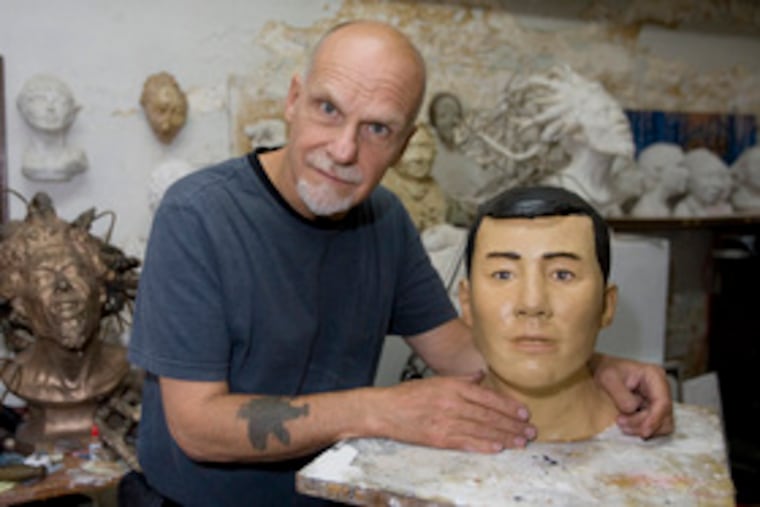
In an effort to get new information on the body found near Lindbergh Boulevard, three weeks ago the office unveiled a sculpture by renowned local forensic artist Frank Bender. It's a rendering of what the man's face may have looked like, complete with bushy brows and neatly combed dark hair.
Forensic investigator Steve Olszewski said he hoped it would jog a memory.
"It's something we want to do for all of these cases," said Olszewski, who said that the office planned to start doing sculptures or sketches for unidentified bodies. "We're going to be doing it a lot more."
Each year, about 2,500 bodies come through the Medical Examiner's Office - victims of "sudden, violent and suspicious deaths, including all homicides, suicides, accidents and drug-related deaths occurring in Philadelphia," according to the M.E.'s Web site. Most are examined and identified by relatives within a day or two. Then the bodies are sent to funeral homes for burial or cremation.
"Most cases are solved within a day, I would say," said Olszewski.
But about 300 corpses a year are not quickly identified. That's where the 10-member investigative team comes in. They use every tool in the box - dental records, fingerprints, DNA tests, neighborhood interviews, fliers - to try to get an ID.
Still, by the end of the year, they're usually left with three or four unidentified bodies. The current list of 20 bodies includes cases that date from 2003. That's a typical number to be working on, said Quain.
The morgue also stores about 2,500 cremated remains that date back to the mid-1980s. Some are unidentified cases, but many are people who have been identified but never claimed by their families, said Quain.
An identified, unclaimed body could be cremated fairly quickly, basically the next time the morgue does a mass cremation, which happens four times a year. There is no time frame on when an unidentified body gets cremated. Those decisions are made case by case, Olszewski said.
Back in 2005, the Medical Examiner's Office was criticized for delays in identifying bodies.
In one case, the body of a 38-year-old North Philadelphia woman lay in the morgue for two years, even though her family had reported her missing and repeatedly had called the morgue asking if she had been found.
After that story emerged, the M.E.'s office started holding weekly meetings with the police missing-persons unit to ensure that it was checking the bodies against the missing-persons list. And it began publicizing its list of unidentified bodies - currently available on its Web site.
City Council also held hearings to review the identification problems. The medical examiner pledged better communication with police, and said that they would use technology like DNA analysis and enter the genetic information for the unidentified in national databases.
Quain and Olszewski said that they remain in contact with police. And they enter information into the national DNA database and use other national tools, like listing cases in the Unidentified Decedent Reporting System.
But the fact that they tend to have 10 to 20 bodies without identities at any given time has not changed.
All the DNA technology in the world doesn't help if the person had no friends or family, investigators said.
"I come across a lot of homeless vagrants," said Olszewski. "I would say it's homeless vagrants, middle-aged males."
Quain cited a case from 2004 that remains unsolved, a skeleton found near Ogontz Avenue.
"He was thought to be an elderly gentleman who was living in his car in the woods," Quain said. No one has come forward to name him.
Still, sometimes the M.E.'s office gets a hit without even trying. Several weeks ago, the family of a 30-year-old man found shot to death in North Philly in June called the morgue from Atlantic City.
The man had several tattoos and was wearing a white T-shirt and jeans.
"They just called out of the blue and started describing the tattoos. I was like, 'Whoa!' " said Olszewski. "They came down the next day and ID'd him."
To see the original Daily News series of stories about unclaimed bodies in the city morgue, visit http://go.philly.com/ morgue.