For school reform to work, Ackerman must hear from stakeholders
Arlene Ackerman, superintendent of the Philadelphia School District since June, yesterday called on the city's parents, business community and other concerned adults to support the draft reform plan that she released last week.
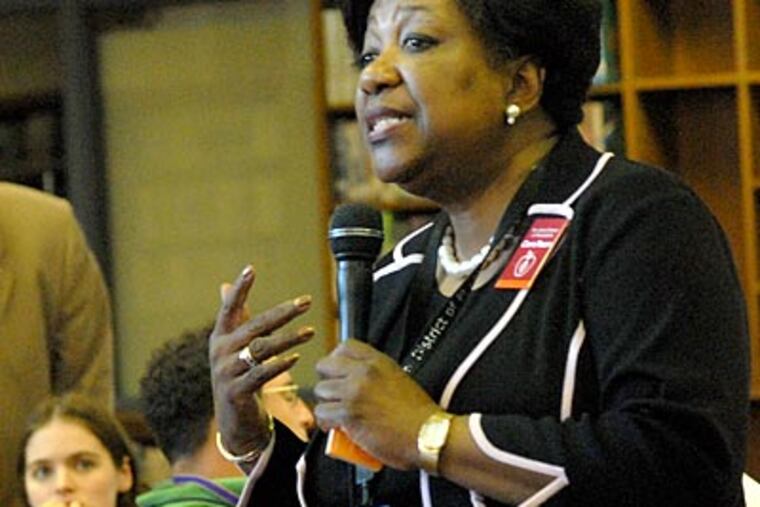
Arlene Ackerman, superintendent of the Philadelphia School District since June, yesterday called on the city's parents, business community and other concerned adults to support the draft reform plan that she released last week.
Ackerman said that the five-year, $50 million "Imagine 2014" plan will succeed only if parents and others attend community meetings to tell her how the city's most troubled schools should be turned around.
"I'm not going to impose anything on anybody," Ackerman said in her office at school district headquarters. "The only thing I'm going to impose is that it's not OK for these schools to continue. Something has to change."
Ackerman said she is most interested in parents' voices. "The bottom line is what the families have to say," she said. "I know what they don't want. They don't want to continue with a school that has failed for a decade or more."
The district released more details about the plan yesterday, including a host of recommendations for rewarding successful teachers, more effectively recruiting teachers and beefing up support for students in all grades.
The details, however, did not say which schools would get management overhauls by fall 2010.
Yesterday's report states that 29 schools are "neither making adequate yearly progress nor showing achievement growth."
Such schools, Ackerman said, would be in line to get the most jarring reforms, such as being closed and reopened as charter schools, or placed under other management arrangements.
The district has seen pricier reforms, including a five-year effort in the late '90s called "Children Achieving" that cost $150 million, partially funded by the late billionaire Walter Annenberg. Soon after that plan ended, the state took over the district. The last reform effort begun after the takeover, which involved allowing private operators and universities to manage schools, cost more than $100 million and is yielding mediocre results.
Ackerman said she hopes to work with the Philadelphia Federation of Teachers in implementing the plan.
PFT President Jerry Jordan blasted the draft last week, calling it "irresponsible" for suggesting that outside managers be given schools that have not received adequate resources.
"That is not a good policy for the children or the communities," Jordan said last night. "We know how to improve schools from within the system."
"I want them to be involved in this, I really do," Ackerman said of the union. "But I don't intend to fight them on it. I intend to engage them in this process of how do we turn around these schools?"
Ackerman also said that she did not think her public spat with two members of the School Reform Commission last Wednesday would hamper implementation of the plan. The SRC, on April 15, will vote on adopting the final version.
Ackerman quarreled with commissioners Heidi Ramirez and Martin Bednarek, who blocked approval of two teacher-recruitment resolutions she supported.
"I would hope that this city could rise above whatever disagreements that the SRC and I have," she said. "I hope what we don't lose sight of is, 47 percent of our kids drop out of school."
Ackerman said she hoped the reform plan cost would be covered by increased funding from the state, by city and foundation officials impressed by the plan, and by federal stimulus aid. Some contracts and jobs that duplicate services also would be cut, she said.
Other highlights of the plan:
* For pre-school children: Provide monthly learning packets for families of children with developmental delays; train parents how to prepare their children for pre-school.
* For elementary students: Put gifted and talented classes in all schools; reduce kindergarten classes to 20 students, and first-through-third grades to 22 students.
* For middle-school students: Allow English and math teachers to stay with their students for more than one year; provide one guidance counselor per 150 students.
* For high-school students: Open three career tech high schools and one school designed for future teachers; provide one counselor for every 200 students.
* For teachers: Create a peer assistance program for new and struggling teachers; introduce a tuition-reimbursement incentive program, start a teacher-loan-forgiveness program; create a financial-and nonfinancial-incentive system for successful teachers with five years on the job.
Jordan said he was studying the plan, which contained at least one proposal that can be changed only by the Legislature and others that are part of contract negotiations between the union and district.*