Specter's survival switch: Death knell for moderate wing of GOP?
FROM THE brass-knuckle world of Philly rowhouse politics in the Rizzo years through the Reagan revolution and into the age of Obama, from JFK to Robert Bork to Anita Hill, to holding news conferences on routine bills at the hospital where he was undergoing chemotherapy, Sen. Arlen Specter is programmed for one thing.
FROM THE brass-knuckle world of Philly rowhouse politics in the Rizzo years through the Reagan revolution and into the age of Obama, from JFK to Robert Bork to Anita Hill, to holding news conferences on routine bills at the hospital where he was undergoing chemotherapy, Sen. Arlen Specter is programmed for one thing.
Survival.
And, so, when the numbers showed no doubt that an increasingly right-wing Republican electorate was ready to dump the 79-year-old, five-term Pennsylvania senator next year for someone more conservative, Specter didn't hesitate to make a move.
Specter's stunning announcement yesterday that he is rejoining the Democratic Party that he left 44 years ago roiled Washington - where the Dems and President Obama are now poised for a critical 60-vote Senate majority - and also shook the political landscape in Pennsylvania.
But the main beneficiary of the move is clear: Arlen Specter.
With the backing of key Democrats like Gov. Rendell, the Kansas native and Penn grad is instantly an overwhelming favorite to win the nomination of his new party in 2010. But his path is now also clearer for the general election, when he'd likely face a conservative Republican like former U.S. Rep. Pat Toomey in a state that is increasingly voting blue in major elections.
"This was out-and-out a political calculation," said G. Terry Madonna, the political scientist and pollster from Franklin & Marshall College. "It's pure politics. He can make the argument that the Republican Party was leaving him, but it was clear that victory [as a Republican] was problematic for him."
Indeed, Specter was candid yesterday in conceding that a series of polls - including one by his own campaign, that showed him losing the GOP primary to Toomey, largely because of conservative anger over the incumbent's support of Obama's economic-stimulus plan - convinced him to switch.
"The shift in the approval rating made things entirely different," Specter said in a conference call with Pennsylvania journalists. He noted that only about 30 percent of state GOP voters said they now approve of him. "I've been fighting it for a long time," he said, "but the party has gone farther to the right."
Indeed, while likely ensuring his personal job survival, Specter's political defection may be long remembered as a landmark day in a long-term political trend in America: The death knell for the moderate wing of the Republican Party.
When Specter joined the GOP to run successfully for Philadelphia district attorney in 1965, he was one of a plethora of moderate or even liberal Republicans, like New York's Nelson Rockefeller or John Lindsay or Connecticut's Lowell Weicker, who fought for civil rights and took liberal stands on social issues like abortion.
Today, after a generation of rising conservative Sunbelt hegemony in the GOP, the electoral map of the Northeast is a deepening shade of blue.
Michael Smerconish, the Philadelphia radio talker who advocates for moderate Republicanism in his new book, "Morning Drive," said that bitter name-calling - like that aimed at Specter by angry GOP leaders yesterday - "has reduced the Republican Party to a hard-core constituency united by religion, frankly, and little else."
He was referring particularly to Michael Steele, chairman of the Republican National Committee, who said yesterday that Specter "left to further his personal political interests because he knew that he was going to lose a Republican primary due to his left-wing voting record."
The GOP minority leader in the Senate, Mitch McConnell, of Kentucky, took an even harder line on Specter, calling the party switch "a threat to the country." McConnell said that the switch "relates to the issue of whether or not in the United States of America our people want the majority to have whatever it wants without restraint, without a check or a balance."
Not surprisingly, Democratic Party leaders were ecstatic over the switch, all the way up to Obama, who phoned Specter yesterday and promised to raise money and to campaign for him in 2010. Rendell, who did not immediately comment, has been lobbying Specter for months, as has Vice President Joe Biden, dating back to Biden's time as a Democratic senator from neighboring Delaware who frequently commuted with the Philadelphian on Amtrak.
"Certainly, that's a personal decision he's making," Mayor Nutter told reporters yesterday. "But I think it demonstrates that the Republican Party is so out of touch that there's no room for a great moderate like Senator Specter."
In Washington, Democratic leaders and pundits say that Specter's switch - if combined, as many expect, with an eventual declaration of victory for Democrat Al Franken in the still-contested Minnesota Senate race - will give the party 60 votes. That will be enough to prevent Senate Republicans from using the tactic known as a filibuster to block legislation sought by Obama and a large Democratic House majority.
But other political experts noted that there's no promise from Specter to follow his new party's line on every issue, and, in fact, he continued to voice opposition to the union-backed Employee Free Choice Act, or EFCA, a labor-election measure that is a major Democratic agenda item.
"I will not be an automatic 60th vote," Specter told a Washington news conference yesterday, promising to vote independently on the issues.
In addition to promises of political fundraising and endorsements from top Democrats, party leaders gave Specter seniority in the party dating to his 1981 arrival in D.C., which will probably allow him to become chairman of a major appropriations subcommittee.
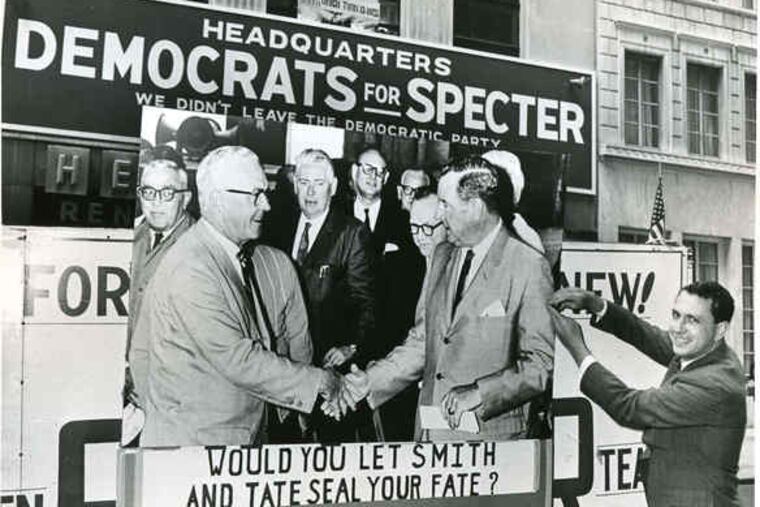
Specter was an up-and-coming Democratic lawyer during the Kennedy administration, and gained fame as a key lawyer for the Warren Commission that probed JFK's 1963 assassination. He first switched parties after Philadelphia Democrats - whom Specter claims told him he was too aggressive on corruption - refused to support his 1965 D.A. campaign.
He narrowly lost an iconic mayoral bid to James H. J. Tate in 1967, and failed in several other elections until he was swept into the Senate in Reagan's 1980 presidential landslide. Besides fighting back cancer, he almost lost the 1992 general election because of anger over his tough questioning of Anita Hill in the Justice Clarence Thomas hearings, and then Toomey almost beat him in the 2004 Republican primary.
Toomey moved toward a 2010 rematch after Republicans were outraged over Specter's vote on the $787 billion stimulus package. Now, Toomey - the former congressman from the Allentown area - is the clear frontrunner for the GOP nod, although frequent candidate Peg Luksik is also in the race.
Despite the pledges from Rendell and others, it's not clear whether Specter will now face a Democratic primary. Joe Torsella, a Rendell protegee who headed the National Constitution Center, had been raising money for that race and said yesterday that he had no plans to quit.
Madonna, the political pundit, said that he wonders whether rank-and-file liberal Democrats will be truly excited about Specter given a sometimes conservative voting record that included support for the Iraq war and the Reagan and George W. Bush tax cuts. "Specter still remains a centrist," he said. *
Staff writers Catherine Lucey and Dave Davies contributed to this report.