Dave Davies: Did the D.A.'s office play dirty politics with Seth Williams?
The day before Tuesday's primary election, District Attorney Lynne Abraham said that she thought it best to stay out of the race to nominate her successor, and so she did.
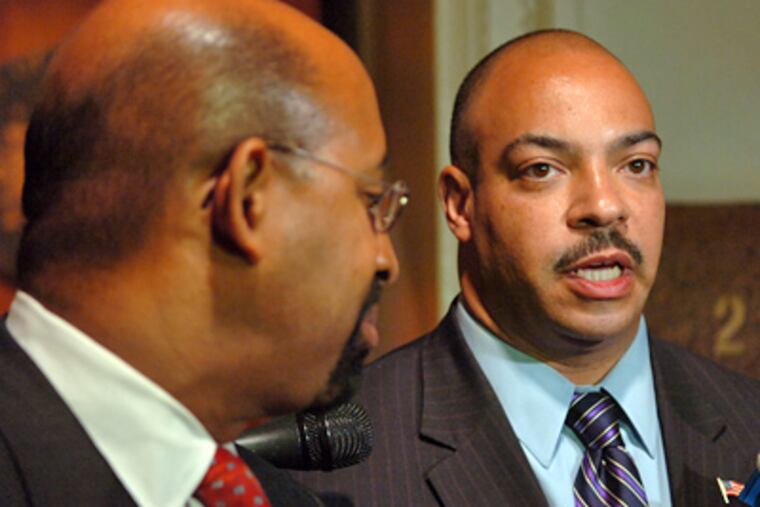
The day before Tuesday's primary election, District Attorney Lynne Abraham said that she thought it best to stay out of the race to nominate her successor, and so she did.
I'm not sure her staff stayed as neutral.
It seems to me that the D.A.'s office combed through a confidential file and put out information intended to harm Seth Williams, a former prosecutor and a candidate loathed by Abraham.
Here's what happened:
On May 13, six days before the election, candidate Dan McCaffery ran a TV ad accusing Williams of making a soft plea-deal in 2002 to spring a career criminal who went on to commit murder.
The defendant, Aaron Kelly, wasn't a career criminal back then. He was an 18-year-old who was caught driving a stolen car with two other young men. An unloaded gun was confiscated from under the driver's seat.
I wanted to figure out whether the plea agreement that Williams had signed was truly lenient by the standards of the D.A.'s office at the time.
If it was typical of the way similar cases were handled, it wasn't fair to blame Williams for failing to predict Kelly's future offenses.
About midday on the 13th, I left a voice-mail with D.A. spokeswoman Cathie Abookire, saying that while I understood they'd probably want to stay out of a political fight, I'd welcome any information about whether the terms of Williams' deal were unusual.
I spent much of the afternoon talking to present and former prosecutors and defense attorneys, all of whom said that the terms were pretty ordinary. It was Kelly's first adult offense in Philadelphia. The gun wasn't loaded or used in a crime. Probation would be typical.
I hadn't heard from the D.A.'s office. But about 6 p.m., I heard from McCaffery's campaign manager. He said that the D.A.'s office was going to issue a statement on the case.
Indeed, at 7:30 p.m., the D.A.'s office sent me a detailed chronology of the Kelly case, which seemed crafted to raise suspicions about Williams' role. I've learned since that at least two senior prosecutors in the office worked on it.
Two things about the chronology are curious:
First, it didn't answer the question I asked. There was nothing in it about whether the terms of the plea agreement were unusual. It didn't include sentencing guidelines, for example, which I got from another lawyer.
Instead, the chronology addressed a question I'd been hearing from McCaffery and his supporters that day, which was this: Why was Seth Williams involved in this case at all?
At the time, he was chief of the Repeat Offenders Unit, and wouldn't normally have handled such a matter.
Further, McCaffery noted that the defense attorney for the plea was Scott DiClaudio, a friend and contributor to Williams.
McCaffery said that I should ask Williams why he "specially assigned himself to his friend's case."
Both Williams and DiClaudio said that they have no recollection of the case. Williams said that he may have been in a courtroom when another prosecutor was busy preparing a witness and asked him to take Kelly's plea. That's not unusual, he said.
DiClaudio agreed, and called the accusation that he and Williams had done something wrong "sickening."
Here's the second curious thing: If the chronology was prepared in response to my inquiry (as the D.A.'s office assured me later), how did the McCaffery campaign know that it was coming before I did?
Abookire had no explanation for this, but it suggests, at a minimum, some contact between the D.A.'s office and the campaign that day on the subject.
It occurred to me, on the day after all this, that there were some important and unanswered questions: Does the D.A.'s office operate in such a way that a unit chief (Williams in this case) can snatch any case he wants from another unit? Would it leave a paper trail? Are there things in the case file that support or contradict Williams' explanation?
I asked Abookire if I could examine the file that the chronology was drawn from, and perhaps bring in Williams or an attorney from his camp along to look at the material.
Sorry, she said, the file isn't public.
Which brings me back to where we started: Presumably in response to a reporter's question, senior prosecutors looked through a confidential file and assembled material that didn't answer the reporter's question, but supported a political accusation against a candidate their boss didn't like.
I have no reason to doubt Abookire's assurance that Abraham wasn't involved in this episode. But her public antipathy toward Williams invites the suspicion that the office was playing politics.
You can judge the chronology yourself by going to http://go.philly.com/kellycase.
The whole thing makes we wonder if we should be electing D.A.'s at all. *
E-mail daviesd@phillynews.com.