A town-hall meeting of rare civility
Clearly, the people in Allentown are not well. About 400 of them politely packed a room at Muhlenberg College Wednesday night, listening to Senate candidates Pat Toomey and Joe Sestak talk about the incendiary issue of health-care reform. The topic has produced pitchforks and torches in some communities this summer.
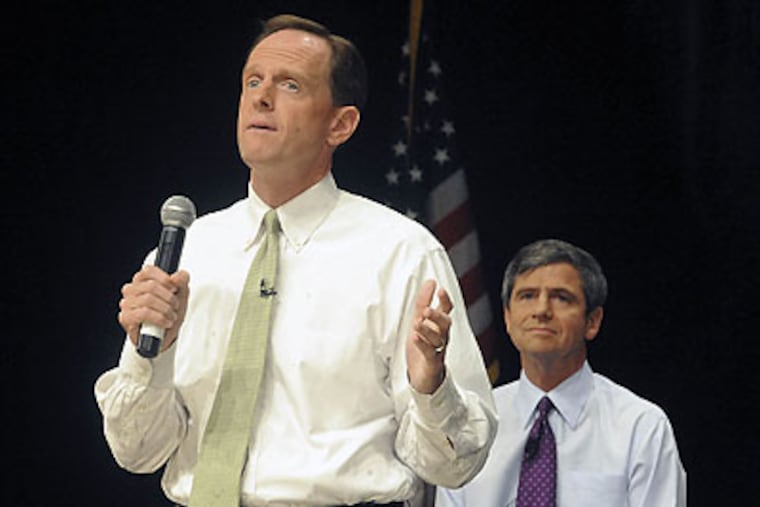
Clearly, the people in Allentown are not well.
About 400 of them politely packed a room at Muhlenberg College Wednesday night, listening to Senate candidates Pat Toomey and Joe Sestak talk about the incendiary issue of health-care reform. The topic has produced pitchforks and torches in some communities this summer.
At a town-hall meeting in Philadelphia, for example, I saw a vascular surgeon so enraged at Sestak that I thought the doctor might require his own services.
"You're lying! You're lying!" Alphonse DiGiovanni of Newtown Square screamed at Sestak, leaping to his feet and angrily jabbing a finger at the congressman.
I asked the doctor what Sestak was lying about. He said tort reform, but added, "he just opens his mouth and he lies."
Can you say "bedside manner"? Such was the general tenor of the food fight among a largely GOP audience in Philadelphia on Monday night. It took place at the Inquirer/Daily News building, moderated by talk radio host Dom Giordano.
But in Allentown, people listened patiently to the debate. They asked thoughtful questions without hurling accusations. It was believed to be the first time candidates from opposing parties had come together this year to debate health care.
Both candidates had their cheering sections, but they didn't try to shout down people with whom they disagreed. I heard only one "boo" all night, directed at Sestak.
The crowd did laugh at Sestak derisively, once, when he said something hilarious - he claimed the health-care bill would "not add a cent" to the national debt. The director of the nonpartisan Congressional Budget Office testified in July that the House plan to cover the uninsured would increase federal health spending significantly.
Overall, though, the event was civil civic engagement.
"This could be a great model for others to follow," said Christopher Borick, a political science professor who moderated the debate at Muhlenberg.
Republican Toomey and Democrat Sestak deserve credit for setting that tone. Their positions on health insurance are far apart - Sestak supports a government-run public option; Toomey said it would ruin health care as we know it. But they treated each other with respect.
Toomey wasn't as clear about how he would improve health care. He doesn't want more debt. He doesn't want government interference in markets, or big-government programs. But when confronting an oncology nurse who can't get treatment for ovarian cancer, Toomey was reduced to commenting vaguely that "we need to do something" about increasing access to health care.
The loser in this debate wasn't on stage - Sen. Arlen Specter (D., Pa.), who will face Sestak in the primary next spring. He wasn't invited. Although it was a bit presumptuous of Toomey and Sestak to hold the event before their parties choose nominees, they raised their profile and managed to inform the public as well.
I don't know what, if anything, an outbreak of civility means for President Obama's health-care agenda and the "public option." But as long as opposing sides of this white-hot issue are willing to listen to each other, there is still hope of finding meaningful solutions for a system that is failing too many people.