No law to protect vulnerable adults
Abusers can simply move on
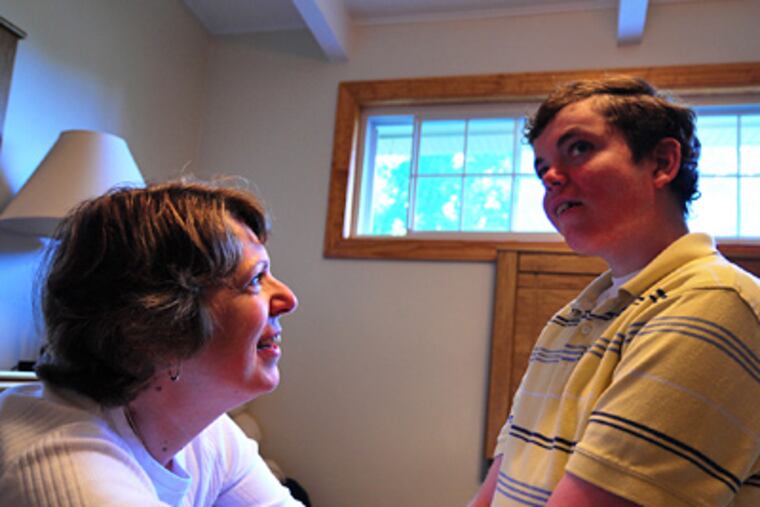
THE PHOTOGRAPHS of Michael Ferrara's face tell much of the story.
Blood pooling under his swollen eyes showed that the 25-year-old had been punched - hard. The marks around his neck were a clear sign of strangulation, his doctor said.
But Michael, who was living in a Delaware County group home for mentally handicapped adults at the time of the February 2008 assault, couldn't tell police what happened.
Born with a genetic mutation that caused severe brain damage and left him unable to speak or communicate normally, Michael can't identify his assailant.
"He can't even tell you who hurt him and what they did and how they did it," said his mother, Judi. "He's 25 years old, but he's like a child."
As a result, no charges were filed. And without a criminal conviction, whoever attacked Michael - police say most of the evidence pointed to his overnight caregiver - is free to work with similarly disabled adults.
"These people can continually work in the field," Ferrara said. "They can leave one agency and go to another agency."
That's because Pennsylvania is one of only five states in the nation without an adult-protection law that gives county or regional agencies the authority to investigate and record incidents of alleged abuse or neglect of adults with intellectual and developmental disabilities.
Children and the elderly are already covered.
In Delaware County, for example, Children and Youth Services (CYS) is the state-mandated agency that investigates child abuse. For senior citizens, there is the County Office of Services for the Aging (COSA).
But people like Michael Ferrara, as well as thousands of mentally handicapped adults between the ages of 18 and 59 who live in private residences, have no such protection in Pennsylvania.
"There are situations going on right now where advocates know there's someone in an abusive situation, and there's nothing you can do about it," said Stephen Suroviec, executive director of the Arc of Pennsylvania, an advocacy group for people with cognitive, intellectual and developmental disabilities.
Suspicions of child abuse or elder abuse can be reported to CYS or COSA, or similar agencies in other parts of the state, but mentally handicapped adults are often left to fend for themselves.
"We're concerned that someone with an intellectual disability, such as autism, or a dramatic brain injury is more vulnerable," said Doug Trout, executive director of the Arc of Delaware County.
If a neighbor calls the police on the suspicion that an adult is being abused inside the adult's home, cops cannot enter that house without probable cause, a warrant or permission from the homeowner. Agencies that provide assisted-living services to adults typically investigate their own cases of abuse, which Trout said creates a potential conflict of interest.
"It just doesn't make a whole lot of sense," he said.
Michael Ferrara, who has tuberous sclerosis, was living in a group home run by the Swarthmore-based Children and Adult Disability and Education Services (CADES) last year when he was assaulted.
The staff member who was suspected of hitting Michael said that he had a seizure and fell out of bed, but Michael's doctor said the injuries show that he had been subjected to choking and trauma to the head, face and neck.
Aston police investigated the incident and turned over the evidence to the Delaware County District Attorney's Office, but prosecutors said they could not rule out other potential culprits.
"We were not able to present enough evidence," Senior Deputy District Attorney James Mattera said this week. "There were suspicions, and the suspicion was probably accurate. It's just a matter of developing evidence."
Suspected abusers without a criminal record, therefore, can pass a background check to work in another group home or private residence.
"We find that people go from agency to agency," said Kathy Perry, an adult advocate with the Arc of Delaware County who helped Judi and Michael Ferrara after his injuries.
If a statewide Adult Protective Services system were created, cases of alleged abuse or neglect would be recorded and future employers would have access to that information, even if criminal charges weren't filed, Perry said.
"We preserve the right to privacy for the accused, yet it's the consumers every day that are being abused," she said. "Something in that doesn't seem right to me."
Adult-protective-services bills have been introduced in the state House and Senate, but both are stuck in committee. While there appears to be broad support for the legislation, the state has been unable to round up the estimated $6 million a year that it would cost to run the new system.
"Sadly enough, some of this exploitation and abuse sometimes is being done by family members," said state Sen. Patricia Vance, R-Cumberland, who chairs the Senate Aging and Youth Committee and sponsored one of the bills.
"When we talked with the administration, they have said there is absolutely no money there," Vance said.
Stacey Witalec, a spokeswoman for the state Department of Public Welfare, said her department is "100 percent supportive of the concept," but the money is unavailable.
Vance, who worked as a nurse before being elected, also introduced her bill last session with no success. "I'm going to keep going after this," Vance said.
The holdup is frustrating to Suroviec and others who say Pennsylvania's priorities are out of whack, considering that animal-cruelty laws seem to get passed "at the snap of a finger," he said.
Last month, Gov. Rendell signed a bill that set new penalties for people who steal dogs for fighting and for dog owners or breeders who crop ears and perform other types of illegal surgical procedures.
"If you have all of these laws to protect dogs, why don't you have laws to protect human beings?" Ferrara asked.
Lawmakers have known about this issue for years.
In 2003, the Legislative Budget and Finance Committee, a bipartisan agency that makes recommendations to the General Assembly, determined that there was a need for legislation to cover adults with physical or cognitive impairments.
The committee's report estimated that the new system would receive about 4,000 abuse reports a year involving people between the ages of 18 and 59, and that about 1,200 of them would be substantiated.
William Benson, executive director of CADES, which ran the group home where Michael Ferrara was assaulted, declined to comment on the employment status of the workers who were assigned to Ferrara.
But Benson said he supports the proposed legislation because it would give agencies such as CADES a clearer picture of who they are hiring - beyond a criminal-background check.
Currently, the only way to determine if someone has been suspected of abuse or neglect that did not result in criminal charges is if the prospective employee provides the information, Benson said.
Judi Ferrara said she was told that both CADES staffers who were assigned to her son the night he was beaten have been fired.
Today, Michael is living in a group home run by the Devereux Foundation. On a recent visit there, he was clearly happy with the new arrangement, smiling as he sat on his bed, with a Bullwinkle stuffed animal on his pillow.
But Ferrara, who has traveled to Harrisburg to share her son's story, doesn't know where his former caregivers are today. The one who allegedly abused him, she said, could be watching over others who, like Michael, are unable to speak up or protect themselves.
"He could be right now working at another agency because I don't have that conviction against him - and I can't get it," Ferrara said. "This population needs to be protected, and they're not being protected right now."