To fight the demons, a court of best resort
EVERY Monday afternoon, as the Delaware County courthouse is emptying out, a handful of nonviolent offenders come looking for redemption in Courtroom 7.
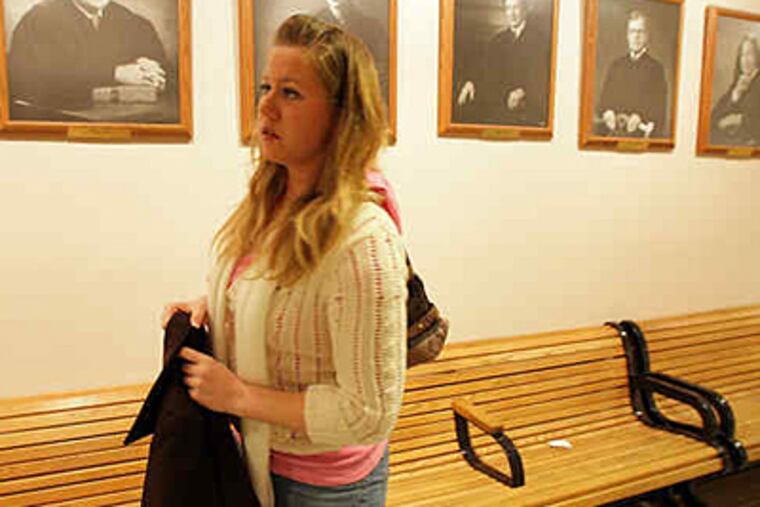
EVERY Monday afternoon, as the Delaware County courthouse is emptying out, a handful of nonviolent offenders come looking for redemption in Courtroom 7.
They pass through the metal detector at the rear entrance, quietly battling their inner demons: drug and alcohol addiction or mental illness. Or all three.
Most of them have multiple arrests. They've hit rock bottom, but are determined to rebuild their lives and become productive members of society. They just want to feel normal again.
Welcome to Delaware County's Treatment Court, one of more than 200 specialty courts that are sprouting up around the country to reduce recidivism among criminals with mental disorders and chemical dependencies.
Mental-health courts, a relatively recent phenomenon, aim to break the cycle of arrest and incarceration by enrolling nonviolent criminals in Alcoholics Anonymous or Narcotics Anonymous, hooking them up with mental-health providers and helping them find a job and pursue an education.
For some, it's working.
There's April, a 53-year-old recovering PCP addict who has been clean for more than a year. She arrived a half-hour early this week, eager to show Judge Frank Hazel a positive review from her supervisor at the Salvation Army, where she volunteers.
"That's my girl," Hazel said as he passed her in the hallway.
"He's really a great judge," April confided. "I think he's awesome."
What many of these people needed was a helping hand, someone who genuinely believes that they can change for the better - not a crotchety judge to throw the book at them.
April, who asked that her last name not be published, was busted last year for drug possession. She'd still be sitting in jail today, but she enrolled in Delaware County's 24-month treatment court, a two-track program that serves women with mental disorders and drug addiction, and higher-level offenders who are facing state prison sentences for drug convictions.
"I didn't have any chance in hell with anything else except this," April said. "It's working out well."
She did drug rehab, a stint in a halfway house and is now living with her sponsor in Allentown. On the nights when she is required to check in with Hazel, she catches a bus to Philly, then the train to Media. She doesn't get home until 11:30 p.m.
"The main thing is living life on life's terms," she said, "without getting high."
On Monday, after Hazel has cleared his day cases, he huddles with the treatment-court coordinator, caseworkers, probation officers, behavioral-health workers and a deputy district attorney to review the status of each case before the night court begins. Here, the defendants are called "clients" and they talk directly to the judge, not through a defense attorney.
"They want to help you, and they do everything they can to keep you in check and help you get your life together," April said. "They don't have to do this. They could just send us away and let us do our time."
Over the past decade, however, judges, politicians and prosecutors have realized that that approach doesn't work. Prisons are packed with inmates with "co-occurring" disorders - mental illness plus drug dependency. And treating that population in jail is expensive and largely ineffective.
"You see a deepening of the illness to the point that when they're released, they're almost certainly going to re-offend," Delaware County District Attorney G. Michael Green said. "This is a way to be proactive in preventing future criminal activity."
"Throwing them in jail is not helping anybody," said Linda Barbera, the county's treatment-court coordinator. "This is a huge opportunity for the court to do something different, because what we've been doing so far hasn't been working."
The treatment court has a group-therapy atmosphere. Hazel is not only the judge, but, in some ways, a sharp-witted father figure with an endless supply of sage advice, uplifting jokes and words of encouragement.
He knows the details of each client's case off the top of his head. If they're in school for their high-school-equivalency diploma, he wants to see report cards. He'll even visit them at work.
But Hazel can also smell a lie a mile away. A county judge since 1981, he has heard every excuse in the book, and he'll crack the whip if clients show up with hot urine samples, or if he thinks they're not dedicated to the program.
"If you don't do what you're supposed to do, we're going to be all over you," Hazel said. "This isn't some fuzzy lovefest."
Anyone who is rearrested is kicked out of the program and sentenced for his original crime. When one 22-year-old man denied Monday that he'd been smoking marijuana, despite submitting a urine sample that tested positive for THC, Hazel pounded on the bench. "I don't trust you," he said.
"It's a life-changing experience," said Kathleen Griffin, 27, a mother who suffers from postpartum depression and was facing at least two years in prison after being busted for identity theft in February.
Griffin, who grew up in Havertown, wrestled with alcohol and cocaine addiction for 13 years. Now, she goes to intensive outpatient therapy twice a week, runs Narcotics Anonymous meetings and works at a Lancaster hotel. Her charges will be expunged if she completes the program.
"The program works if you want it to work," said Griffin, who has been clean for nine months. "If you're not open to changing your life, it's not for you."
Some clients are struggling.
Kara Sheehan, 23, who was busted for calling in a bogus Vicodin prescription, relapsed Sunday night, throwing away five months of clean time by popping a Klonopin after a heated argument with her mother. She told her probation officer before court began.
"She was happy I was honest with her," Sheehan said. "She said, 'Get back on your feet and do the right thing.' "
Hazel was disappointed, but understanding, patiently explaining to Sheehan that pills aren't going to solve her problems.
"Bad stuff's going to happen in your life," he said. "I can't make that stop.
"You're 23 years old. You got your whole life ahead of you," he said. "You're not going to be a good mother unless you're a good person, and you're not going to be a good person until you kick this habit."
The nation's first mental-health court was created in Broward County, Fla., in 1997. Today, more than 200 exist nationwide, including 15 in Pennsylvania. Philadelphia launched its program in July. Delaware County recently completed its first year.
It's too early to say if mental- health courts will be successful in the long-term nationwide, but the results are encouraging so far.
Early reports have shown that people who are accepted into these courts are more likely to participate in treatment and less likely to get rearrested than those who go through traditional courts, according to a Council of State Governments study conducted for the U.S. Department of Justice.
A RAND Corporation study of Allegheny County's mental- health court showed that it did not result in additional short-term costs, and could ultimately save taxpayers money.
"Most of them, I think, have been good for patients, good for the community, good for everybody," said Mark Heyrman, a clinical-law professor at the University of Chicago Law School who sits on Mental Health America's board of directors.
The courts do have their critics, though.
"We don't see it as a panacea," said Andrew Penn, a senior staff attorney at the Bazelon Center for Mental Health Law. "Despite the good intentions, mental-health courts don't address the root of the problem, which is getting services to people before the crisis hits.
"What's needed is more community-based services, and the mental-health courts don't create those services," Penn said. "They just result in one group moving up to the head of the line for the same limited pot. The arrest should not be the primary path for receiving services."
But Hazel, a former district attorney, has "seen more signs of hope than despair" among his clients. "A lot of the people we see, this is as good as they've been for years," he said.
Delaware County officials would like to expand the program if it is shown to reduce recidivism among the first group of clients. They won't complete the program until next year at the earliest.
April, who wrestled with drug addiction for years, said that Hazel and his support staff have saved her life.
She was facing up to 16 years in prison if convicted on her latest drug charges. Instead, she's drug-free and has even been granted permission to travel to Florida for her mom's 81st birthday next month.
"When I first came here, I didn't want to do this, but the more I came, the more I realized that he cared about me," April said of Hazel. "That made me care more about me.
"I'm happy with where I am in my life," she said. "It took me 52 years to realize this is what I wanted. I just didn't know how to get it."