Trenton struggles mightily with a political and fiscal mess
If Trentonians ever needed to boost morale amid the capital city's declining population, violent crime and overall urban decay, they often looked south to Camden, where things were usually worse.
If Trentonians ever needed to boost morale amid the capital city's declining population, violent crime and overall urban decay, they often looked south to Camden, where things were usually worse.
Trenton's trying to stay focused on the mirror these days. But massive cuts in state aid, a huge budget deficit and a new mayor whose personal problems and political decisions have polarized the city after just seven weeks in office have some looking to the $175 million funneled to Camden during an eight-year state takeover, wondering if something similar might help the ailing capital.
"No matter how you slice it, it's a mess in Trenton. How could a state takeover be worse?" said Jim Carlucci, a city resident and former council candidate who runs a city civic calendar. "We can't recall the mayor yet, and the state would have to do a better job than our elected officials."
Gov. Chris Christie was no fan of the Camden state takeover, and despite a recent plan for state oversight of Atlantic City's ailing gaming district, he has no interest in taking the reins in Trenton, a spokesman said.
"What we prefer is that cities like Trenton institute the kind of best practices necessary, particularly during such dire economic times," said Christie spokesman Mike Drewniak. "Trenton is indeed a city in need of reform in its management, particularly its fiscal management. That's not a direct dig on Trenton; it's just the truth."
So, Trenton's problems must be solved by the people of Trenton, namely Tony Mack, the city's new mayor. A lifelong Trenton resident who grew up in the city's troubled Wilbur section, the former Mercer County freeholder and married father of four has been in office only since July 1. Yet one blogger who claims she voted for him thinks "Toonces the Driving Cat" from the early 1990s "Saturday Night Live" sketch would be doing a better job steering the city right now.
"I am tired of feeling embarrassed by Trenton, especially because of what the leadership does; I'm tired of feeling embarrassed by Trenton, because of what the leadership DOESN'T do," Christine Ott, a local political blogger, wrote earlier this month.
Details about Mack's personal financial troubles and questionable hirings and firings have led to questions, including from some supporters, of whether he's qualified to lead Trenton. According to various published reports in The Times of Trenton and The Trentonian, Mack's Victorian home was in foreclosure and up for sheriff's sale.
He allegedly made donations to his own campaign, despite the foreclosure and thousands of dollars in other outstanding liens and consumer credit bills. Reports alleged that Mack took campaign donations from a convicted child molester and later tried to appoint a felon as the director of housing and economic development.
Some of his detractors, like Ott, want him to resign, and others are hoping he can right the ship.
"I've got to be willing to give a chance, right? He's the only mayor we have right now," said Dan Dodson, a city developer and former mayoral candidate.
Baye Kemit, a city resident who hosted a mayoral debate at his private school, said he grew up with Mack and considers him a friend but doesn't believe the mayor is considering community input while staffing his administration. Kemit doesn't believe Mack's financial issues reflect poorly on the city, but are proof that the mayor deals with the same issues with which the rest of the country has struggled.
"It's been a bit unfair," he said. "Everyone in America has been hit with some financial issues recently."
Mack's spokeswoman, Lauren Ira, stressed that the election was not a close one.
"The public overwhelmingly voted him in," she said.
Former Mayor Douglas Palmer left Mack a $60 million budget deficit and the "tough decisions" he couldn't make himself during his 20 years in office, Ira said.
"Some of his greatest obstacles as a new mayor are looking at the past practices and the past policies that have been in effect for 20 years," Ira said. "Mayor Mack is devoting 99 percent of his time to what happened, what worked and what we can do to fill the $60 million budget deficit."
Nothing has been ruled out to slash the budget, Ira said, including police layoffs, cutbacks on city pools and libraries, and renegotiating city contracts.
"The last mayor had a 20-year chance. Our mayor will have much longer than a 40-day chance," she said.
Drewniak declined to comment specifically on Mack but said Christie is "fully and acutely aware" of what's going on in the capital.
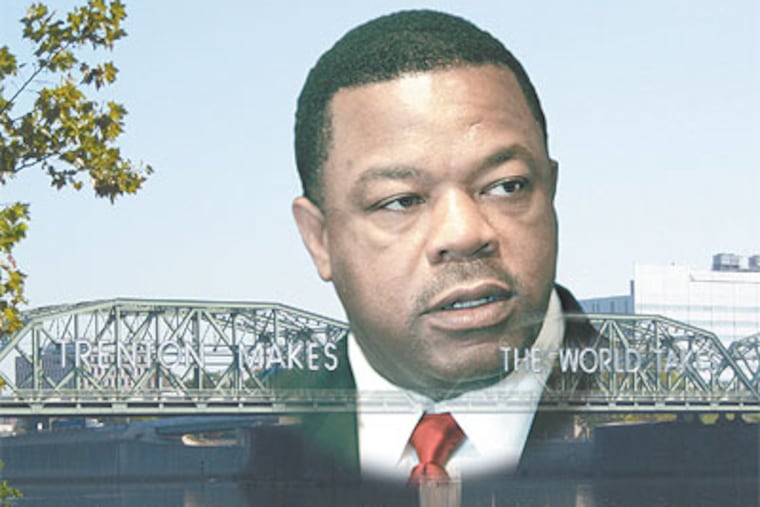
Trenton's problems began long before Palmer took office in 1990 and aren't much different from those in many postindustrial cities in the United States, including Camden. The city's most famous landmark, the neon "Trenton Makes/The World Takes" sign on the Lower Trenton Bridge, is often a painful reminder of a bygone era when Trenton was a world leader in the steel, pottery and rubber industries.
Today, the city's largest employer is the State of New Jersey, whose government buildings and parking lots rule the downtown area. Kemit said few state workers actually live in Trenton, and they rarely spend time outside their cubicles at city businesses.
"You come here any weekday after 5 p.m. and downtown is a ghost town," he said. "Everyone's gone."
Like Philadelphia, the city's Delaware River waterfront is cut off from the population by major highways. Like Camden, the city tried to draw tourists there with a minor-league baseball stadium. Old industrial sites lie idle.
Located between Philadelphia and New York City and directly across the bridge from Bucks County, Trenton has struggled with its own identity, a place that desperately needs a stronger sense of place.
"We're the capital city, yet we're suffering from major structural deficits. It's some real serious stuff," Taneshia Nash Laird, executive director of the Trenton Downtown Association. "If all this negative attention is what it takes to get people's attention, maybe it's a good thing."