Kids with special needs get hope, care and a chance to live
Cristina, a high-motor 6-year-old with a transplanted heart and a transcendent smile, flung herself onto the sofa, cuddled up to Michelle Roberts-Edwards like a kitten, and said, "I was up with God, and then God sent me to a new mommy, and then I stayed with you here when I was a little girl, and then you kept me."
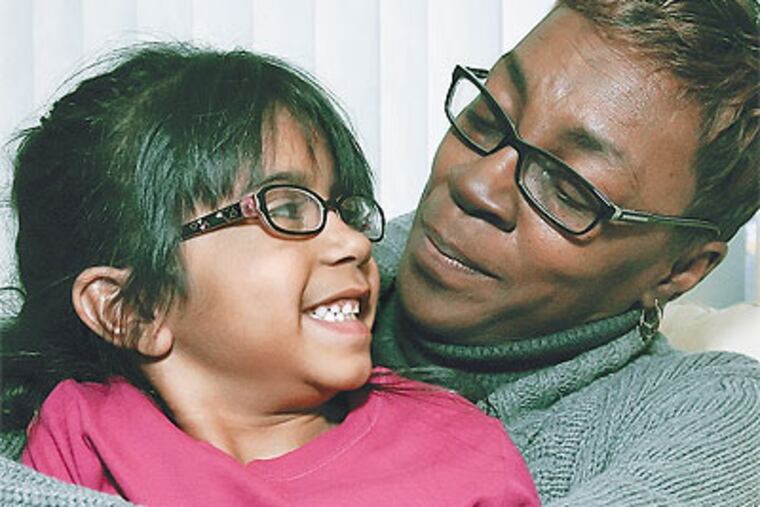
CRISTINA, a high-motor 6-year-old with a transplanted heart and a transcendent smile, flung herself onto the sofa, cuddled up to Michelle Roberts-Edwards like a kitten, and said, "I was up with God, and then God sent me to a new mommy, and then I stayed with you here when I was a little girl, and then you kept me."
"Yes," said Roberts-Edwards, who has been Cristina's "new mommy" for more than three years. She returned her formerly foster, recently adopted daughter's smile. "Yes, I did."
"This home is the best home," Cristina informed this Daily News reporter, looking around her cozy living room in East Oak Lane. "I like this whole house and I like my big sister, Shanice, and my mommy, Michelle, and my cat, Gato."
The cat was named Shane for years until Cristina, who is Hispanic, arrived in summer 2007, took one look at him and said, "His name is Gato," which is Spanish for "cat."
As of that moment, the cat was Gato for keeps. And Cristina, who came to the Roberts-Edwards household as a medically fragile, 2 1/2-year-old foster child after living at Children's Hospital of Philadelphia for months, looked around and said, "I'm staying here forever."
Cristina, whose heart transplant requires lifelong medication and constant vigilance, is one of Philadelphia's children with a life-threatening condition whose birth parents are unable to care for them for reasons ranging from drug addiction to - in Cristina's mom's case - being overwhelmed by the daily stress of the child's crucial needs.
Roberts-Edwards and Cristina connected through Best Nest Inc., a nonprofit agency that finds foster and adoptive homes for medically fragile children in the Philadelphia area.
Created in 1987 to help HIV-positive and crack-cocaine babies whose birth parents could no longer care for them, Best Nest - funded through the Public Health Management Corp. - places 100 children a year in foster or adoptive homes, and provides 150 others with in-home protective services.
Cristina's body had rejected her heart transplant twice because her birth mother did not follow the strict regimen of daily medication and frequent hospital visits.
The city's Department of Human Services removed Cristina from her home and placed her in Children's Hospital of Philadelphia. Roberts-Edwards had recently suffered the loss of her youngest daughter, Shania, a 9-year-old whose heart/lung transplant failed, and was volunteering at CHOP, counseling parents whose children were receiving organ transplants.
Roberts-Edwards, an early- childhood-education teacher at Childspace Too in Germantown for 17 years, did not hesitate to foster-parent, and then adopt, Cristina.
"My reality is that I probably never would have adopted a healthy child," Roberts-Edwards said. "If somebody makes the sacrifice to donate an organ to another child, I feel a responsibility to make sure that organ is not thrown away because the child's parent is not being compliant with the medication. My reality is to pass on that [donor] child's legacy, to celebrate it."
Shania's smiling presence embraces the family from framed photos all over the living room. She was born with a heart that was missing a chamber, received a heart-lung transplant when she was 7, and had two more good years.
"When we found out that her lungs were failing and she would need another transplant," Roberts-Edwards said, "we sat down and talked, not hiding anything, being honest. Shania decided she did not want to be transplanted again.
"She was tired of being stuck and poked and prodded," Roberts-Edwards said. "She had done everything she wanted to do. She was happy.
"The miraculous thing with most kids who have life-threatening diseases is, they know when they're ready. They hold on because their parents aren't ready to let go. Shania knew she didn't want to go through it anymore. I had to respect that.
"The night she passed, she had gotten sick and was having a hard time breathing. We were all at the hospital with her. She said, 'Mommy, I think I'm ready to go.' And it was very peaceful. She just went to sleep."
To honor her daughter's memory, Roberts-Edwards decided to nurture another little girl whose survival depends on a transplanted heart.
"Sometimes I think, 'Look at how old I am. Why am I doing this again?' said Roberts-Edwards, 56. "But it feels like this is what I am supposed to be doing."
Cristina has shown no signs of rejecting her new heart since Roberts-Edwards began parenting her and overseeing her medication.
"Cristina is 6 going on 60; very smart," Roberts-Edwards said. "She will announce, 'It's Michael Jackson time,' and start dancing. She is a girly-girl who likes dolls and dresses, getting her nails done, trying on makeup with her big sister Shanice - who can do no wrong. Most of all, Cristina knows she is loved."
So does a vulnerable little boy named Amari, who went from an institution to his first real home through a Best Nest placement.
Rita Hubbard, who has been a pediatric nurse for 30 years, remembers the day in May 2009 when she and her daughter, Audra, drove to a Bucks County residential facility and got their first look at Amari, who had lived most of his three years there.
"He must have weighed all of 18 pounds," Hubbard said. "When they care for minority children out in the suburbs, I think they don't really know how to handle their hair. Amari's hair came to a point."
Because of his birth mother's crack addiction, Amari was developmentally delayed, Hubbard said. He is legally blind. He has a problem swallowing so he is fed through an IV tube. He did not walk until he was 3, and he still has gait issues.
"His nose was running so bad that his whole face was caked with mucus," Audra said.
"His teeth were dark green from the medicine he took for his endocrine issues," Hubbard said.
"He had one eye going in one direction, and the other eye going in the other direction," Audra said. "But he had the winningest smile."
"It was the smile that won me over," Hubbard said. "He had a look on his face, like, 'OK, why did it take you guys so long to get here?' I fell in love with him right away. I said, 'Hey, you coming home with us, Buddy?' "
"I love kids," said Audra, 29. "I didn't have any of my own. Since I was born, I was always around special-needs kids because my mom took care of them, so I'm used to them."
Audra wanted to be Amari's foster mom. Hubbard, who lives with her daughter in Mount Airy, wanted to be his foster grandmother who would supervise his complex medical needs.
After months of rigorous training at Best Nest that all prospective foster parents complete, they took the little boy home.
"Today, he's a whole different Amari," Audra said. "He can spell his name. He knows his numbers, his colors, his letters. He speaks in full sentences now. I waited so long to have a conversation with him. Now, we can talk about everything."
Audra adopted Amari last June, she said, "because I love him and there was no way I was giving him up. No way.
"I've grown a lot," she said. "I used to have 9-to-5 jobs at places like Pathmark and Walmart. After work, I did whatever I wanted to do whenever I wanted to do it. Now, every move I make, I think about how it's going to affect Amari. That's my baby."