Shops serving breast cancer survivors are struggling under rules changes
The timing may have been a coincidence, but the announcement during National Breast Cancer Awareness Month that a Jenkintown lingerie shop would stop selling specially made bras and prostheses to survivors of the second-most-common cancer among women in the United States seemed an unfortunate juxtaposition.
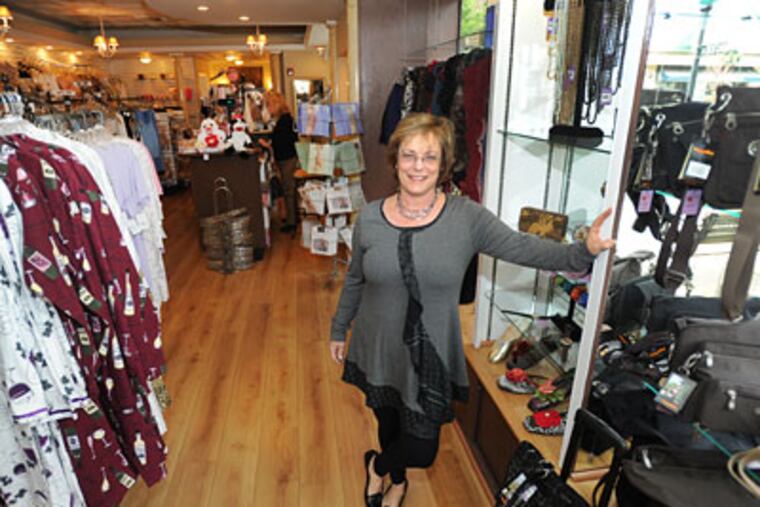
The timing may have been a coincidence, but the announcement during National Breast Cancer Awareness Month that a Jenkintown lingerie shop would stop selling specially made bras and prostheses to survivors of the second-most-common cancer among women in the United States seemed an unfortunate juxtaposition.
Tulips Lingerie & Intimate Apparel will no longer carry the products. The shop fell victim to what owner Fran Dratch calls a complex and expensive accreditation process that she says amounts to a smackdown of such small boutiques.
"I'm losing money," Dratch said. "I gave it a real good try. I'd love to do it, but in order to survive, I've got to change my business."
Among the least surprised by Dratch's predicament are the boutique owner's fellow merchants. Many who offer lingerie-oriented products and services for breast cancer survivors say the requirements begun in 2009 have drowned them in paperwork and fees that can reach into the thousands of dollars.
That, coupled with lagging reimbursement rates from insurance companies and a struggling economy, makes it very difficult for the boutiques that specialize in personalized service to stay in the business, shop owners say.
The number of mastectomy-bra suppliers reimbursed by Medicare decreased from 4,201 in 2008 to 3,599 in 2010, according to Medicare records. Some categories of prostheses suppliers also have decreased. Pennsylvania is one of five states that have the lowest bra reimbursement rates in the nation at $32.90, the records say.
Jack Lewis, president of Florida-based Classiques, a major manufacturer of post-breast cancer surgery clothing items, estimates 20 percent of the shops have closed or merged across the country.
In addition to the changes at Tulips, which will continue to sell conventional and custom-made lingerie, Shapes & Lace in Springfield, Delaware County, has closed, and several shops have stopped participating in insurance plans, now requiring customers to pay up front.
Catherine Carter, executive director of an agency that accredits boutiques and other suppliers of the bras and prostheses, says accreditation requirements are intended to ensure the highest quality of patient care.
"We feel strongly about our standards, and we have a lot of them," said Carter, of the American Board for Certification in Orthotics, Prosthetics & Pedorthics (ABC). "But we do look for ways to assist the facility as they go through the process."
The issue is the talk of industry conferences, said breast cancer survivors Diane Gesualdi and Heather McClure, owners of the Profile Shop, which offers postsurgery products in two locations in Huntingdon Valley.
"All we wanted to do was provide women with a comfortable, welcoming place," said Gesualdi, who shopped for bras in the small, cluttered back room of a medical supply store when she had surgery nearly 20 years ago.
Regulation is necessary, McClure said. The rules make merchants accountable and aware of the needs of the patient, but in the case of small shops, McClure said, "it's overdone."
Medicare mandated accreditation in 2009. Most private insurers also call for Medicare accreditation.
The requirements threw the small-staff, mom-and-pop boutiques who know their customers by name into an accreditation whirlwind.
Fire drill logs, staff meeting minutes, disaster plans, employee evaluations, patient audit charts, and performance management plans were suddenly required.
"We had to hire a compliance team, and we've been working on [accreditation] since April," said Pat Moore, owner of a wig salon formerly in Dublin, Bucks County, that recently moved into the new Cancer Institute of Doylestown Hospital. Moore's new Ribbons Studio will include an expanded list of products including bras and prostheses.
"It's so unbelievably difficult and technical," Moore said.
Officials at ABC have heard the boutique owners' concerns loud and clear, Carter said. Requirements are constantly evolving and ABC has created special materials such as an accreditation checklist to help boutiques with the process. Often, requirements that sound complicated for small shops can be met in simple ways that consider the boutiques' size, Carter said.
Fees present an additional challenge, shop owners say.
First-time accreditation fees can range from $1,200 to $4,000, Carter said. ABC, which boutique owners say is on the low end of the pay scale, charges $1,225 for a first-time application. Addition renewal fees and annual dues reach into the hundreds of dollars.
These circumstances, coupled with the economy and reimbursement, could help to weed out smaller shops that offer the personal service that survivors value, said Farrell Friedenberg, co-owner of Jay Ann Intimates in Huntingdon Valley.
Survivor Linda Thayres doesn't know what she would do without Jay Ann Intimates.
"They make what is not a pleasant experience a pleasant experience," Thayres said.
When word began to spread about Tulips, some customers asked Friedenberg if Jay Ann would follow suit.
"I said no, we're staying," Friedenberg said, "but I really understand what [Dratch] is going through."