Return of The Dead
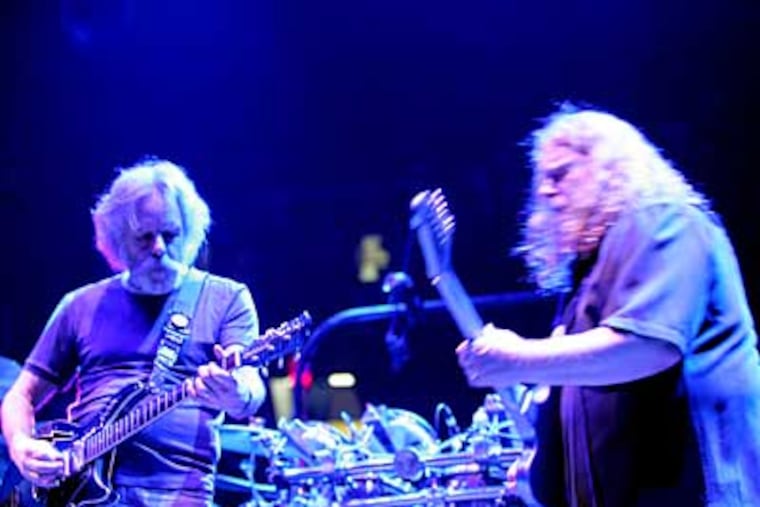
Only Philadelphia sports teams have played the Spectrum more than the Grateful Dead.
Back before Jerry Garcia died in 1995, the prototypical jam band sold-out the slated-for-demolition arena a whopping 53 times, then did two more shows in their post-Garcia incarnation as The Other Ones in 2002.
And last night, the band now known as The Dead, who reformed for an Obama benefit in State College last fall, opened another two night sold-out stand in South Philadelphia.
Frosty haired frontman Bob Weir kicked off the three hour show with "Playing In The Band," which is pretty much what the 61 year old mellow voiced singer has been doing since he met Garcia on a fateful New Year's Eve in Palo Alto in 1963.
Along with Weir, the current Dead lineup includes core members Mickey Hart and Bill Kreutzmann on drums, and bass player Phil Lesh, who sang his "Box Of Rain" as an encore, and was the only member of the band to utter an unsung word. The beneficiary of a 1998 liver transplant, he urged audience members to become organ donors and told the Spectrum crowd: "I forgot how intense it was here."
The legendarily cursed role as Dead keyboard player (four have died over the years) is played this go round by Jeff Chimenti. And more crucial to The Dead's success than any of them, in a way, is the band's sixth man: Gov't Mule and Allman Brothers guitarist Warren Haynes, who stands stage left, gamely taking on the impossible role of replacing Jerry Garcia.
The Dead, of course, have been a pop cultural phenomenon for decades, and since they haven't toured since 2004, the Spectrum shows are a rare opportunity for a gathering of the tribe.
And it also marked a sharp contrast with the audience assembled for the Bruce Springsteen shows at the Spectrum earlier this week.
The differences? The Dead crowd was similarly almost exclusively white, while being much younger and crustier, and more wasted. (Though the only fight I saw was at Springsteen on Tuesday night -- the Dead crowd, as far as I could see, was far too relaxed, chemically or otherwise, to indulge in any altercations.)
But while Dead fans wouldn't miss the opportunity to commune with other Dead fans, that doesn't mean that they're under the false impression that the band they're seeing is the actual Grateful Dead.
"As long as Jerry Garcia is dead, no band is the Grateful Dead," said my friend Jake, who should know, since he's seen over 300 shows. Still, he came to this one -- and in a Disney-meets-the-Dead "Keep On Grumpin'" tie dyed T-shirt, no less -- while expressing his preference, at this stage of the Dead's career, for seeing a Grateful Dead cover band like Dark Star Orchestra.
Wisely, Haynes, who's a muscular guitarist and a vocalist whose style bears little resemblance to Garcia's, never slavishly attempts to imitate the countercultural icon who preceded him in the spot to Weir's left on stage. Instead, he tries, with some success, to delicately balance putting his own stamp on the band's repertoire without projecting himself too loudly on Garcia's legacy.
In the first set, he enlivened "New Speedway Boogie" with beefy, staccato riffing, and in the second, he played weeping, sorrowful lines in "Comes A Time," which is a Garcia/Robert Hunter composition, not the Neil Young song.
Vocally, Haynes recalled not Garcia, but the first of those Dead keyboard players: The gruff voiced Ron "Pigpen" McKernan, who died in 1973, and whose version of Otis Redding's "Hard to Handle" was the starting point for Haynes' last night.
The Dead have always mixed blues, folk, bluegrass and other strands of Americana into a careworn rock sound that rolls along effortlessly -- and often, endlessly. Among the jammy highlights of Friday's show was "Alligator," with a loping gait that kept accelerating, while Lesh played a contrapuntal bass line straight out of a spy movie.
And the tighter, effective moments included a spry "Friend of the Devil," with Weir, Haynes and Lesh taking turns on verses, as well as the one-two punch of the traditional "Cold Rain and Snow" and Weir's "Sugar Magnolia," which roused the crowd to stand up and sing and clap along, nearly three hours into a show that got snappier as it came to a close.
What made those songs work so well was the discipline with which they were delivered. But economy of expression is not the Dead's strong point, nor their goal. The nightly second set interludes known as "Drums" and " Space" are more like it, and both were enervating on Friday, though Hart and Kreutzmann did unleash some intriguingly exotic sounds.
But it's a given that those two interludes will function almost like a second intermission at a Dead show: If you time your drugs right, it's a trip; if not, it's a good time to check your e-mail or update your Facebook status.
More dismaying were the formless jams of the first set, such as "Shakedown Street," which was pointlessly stretched out on an improvisational journey that went nowhere before petering out on the side of the road.
For the Grateful Dead's Philadelphia set-list, click here.