The long battle to reclassify marijuana
Pot for strictly medicinal purposes has a growing fan base. A Rutgers-Eagleton poll released Wednesday found that in a survey of 753 New Jersey registered voters, 86 percent believed the drug should be available by prescription.
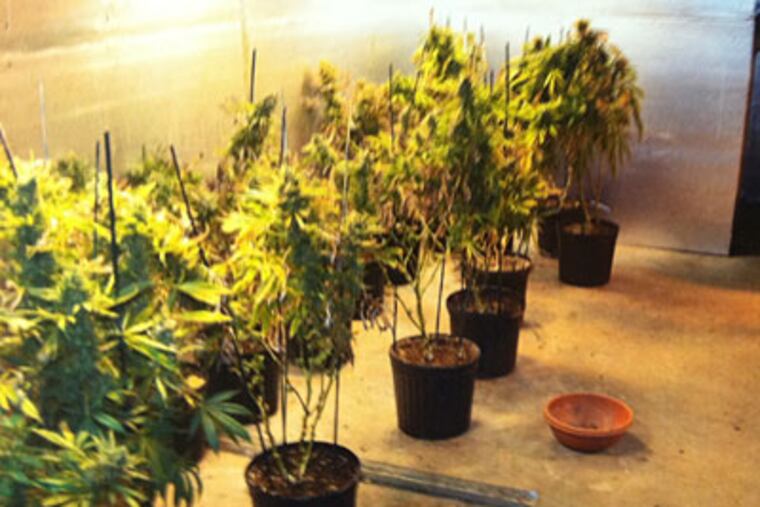
Pot for strictly medicinal purposes has a growing fan base. A Rutgers-Eagleton poll released Wednesday found that in a survey of 753 New Jersey registered voters, 86 percent believed the drug should be available by prescription.
The same day, two governors, Chris Gregoire of Washington and Lincoln Chafee of Rhode Island, petitioned the Drug Enforcement Administration to reclassify marijuana, acknowledging its therapeutic benefits.
Currently, 16 states and the District of Columbia allow doctors to prescribe the drug and pharmacists to dispense it.
Staff writer Melissa Dribben spoke with Julie Holland, a clinical assistant professor of psychiatry at New York University School of Medicine and editor of "The Pot Book: A Complete Guide to Cannabis," about the history, politics, and medical value of the well-known weed. This is an edited version of their conversation.
Question: Why do the governors believe the drug needs to be reclassified from a Schedule 1 to a Schedule 2 controlled substance, and what does that mean?
Julie Holland: To classify cannabis as a Schedule 1 drug means it has no therapeutic value and cannot be used safely. Reclassifying it as a Schedule 2 drug would allow doctors to prescribe it and would expand the opportunities for American researchers to study its effects.
Everybody has been calling for rescheduling for years. Both the American Medical Association and the American College of Physicians have come out in favor of rescheduling. But the DEA has ignored the recommendations of its own judge.
So the government is saying it's not a medicine, even though THC pills are classified as Schedule 3.
How can they say the main active ingredient is Schedule 3 when the plant is Schedule 1? It makes no sense.
Q: I always thought all pot did was make you hungry and self-conscious and enhance your appreciation for Three Stooges movies.
Holland: There are all different kinds of pot. With the indica you may have trouble getting off the couch, while sativa is energizing. Most strains are a mix. But what's great about medicinal cannabis is that you can recommend a specific strain which has a predominance of certain chemical components.
Q: The American College of Physicians reports that marijuana may help treat symptoms from a long list of illnesses including glaucoma, multiple sclerosis, spinal cord injuries, even cancer. But there doesn't seem to be much research to prove it. Why?
Holland: The reason there isn't enough data in this country is that the DEA and the National Institute on Drug Abuse block the research. I am a medical monitor for a clinical study that the Food and Drug Administration has approved to use cannabis to treat post-traumatic stress disorder in veterans. But the NIDA has refused to sign off on it.
If they really want data, they should allow the studies to go forth.
Q: Why has the debate over what appears to be a good drug become so politically charged?
Holland: It's an ancient medicinal plant that has been around for millennia. It's only been illegal since 1937, right after Prohibition ended. Before that, it was a very popular prescription medicine, and it remained in the pharmacopia until 1942.
There are a lot of vested interests keeping it from being legal, Big Pharma and the alcohol industries, for example. Hemp is also a fuel; it can be used to make paper and fabric. So the oil industry, the paper industry, and the cotton industry [would be facing competition].
The other thing that is keeping it illegal is fear. Fear of something that makes you laugh and giddy and lose control.
Q: Are you saying there are no downsides? Some studies say it is carcinogenic. That it causes memory loss, poor decision-making, and addiction.
Holland: Cannabis is not toxic. Smoking isn't necessarily the best form of delivery. . . . And acutely, it does have an effect on working memory. But "acutely altered" does not mean "permanently impaired."
Q: I assume you have inhaled?
Holland: I am a psychiatrist. In the interest of my patients, I don't answer that question in interviews.