Tom Ferrick: Regretfully disappointed in Nutter
A year into Michael Nutter's first term, I interviewed several dozen civic leaders as part of a project I was working on. These were people with serious bona fides in government, politics, and public policy in Philadelphia.
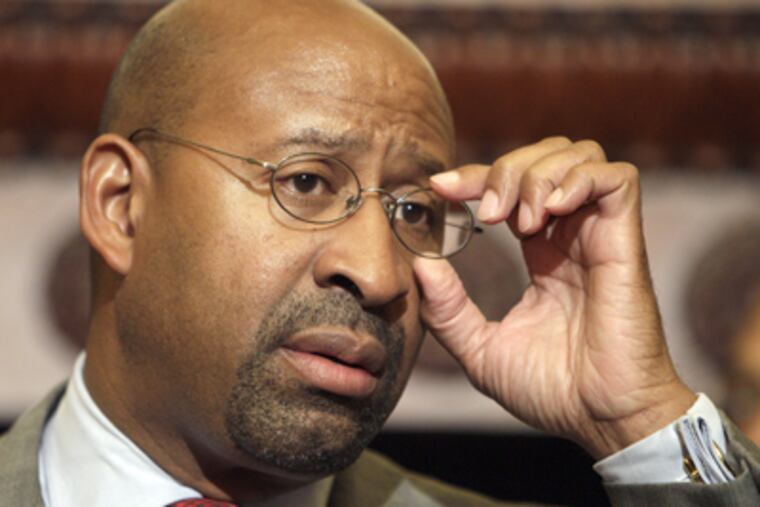
A year into Michael Nutter's first term, I interviewed several dozen civic leaders as part of a project I was working on. These were people with serious bona fides in government, politics, and public policy in Philadelphia.
Nutter wasn't the subject of the project, but at the end of each interview, I would turn off my recorder and ask this additional question: What do you think of the job Nutter has done so far?
Some sighed. Others rolled their eyes. Some sadly shook their heads. A few did all three.
Keep in mind that none of these folks were Nutter enemies. Many enthusiastically supported him in the 2007 election. All of them wanted him to succeed.
Yet they were disappointed - maybe a better word is frustrated - with Michael Nutter.
And that disappointment and frustration remain today.
Monday, the mayor will be sworn in to a second term in office. In some ways, he is the picture of success, coming off a reelection campaign in which he won 75 percent of the vote. But that number camouflages real discontent.
To summarize the case against Michael Nutter: He was elected as a change agent, but declined to seek change. He was sent to City Hall to be a strong leader, but is seen as weak. He ran as an unconventional politician, but has turned out to be all too conventional - a tax-and-spend Democrat unwilling to confront the most serious issues facing government. The phrase I've heard used for Nutter's first term was that it was all about "process and press releases."
To distill those sentences: The mayor lacks moxie.
It's a word, taken from a 1920s soft drink of the same name, that my dictionary defines as "courage, daring and energy."
In government, I would define moxie as the willingness to employ a combination of vigor, determination, and political skills to make serious change, without caring whether it disturbs the status quo.
Politicians with moxie aren't simply warriors. They are happy warriors.
I don't want to make politics sound too much like war. But there are times when governance requires confrontation to overcome barriers to change. You can do it by schmoozing (Ed Rendell), by brute force (Gov. Christie), or by finesse (Gov. Andrew Cuomo of New York), or a combination of all three, but you do it.
As mayor, Michael Nutter is anti-confrontation. He doesn't like to make enemies. He is more a conventional feel-good politician who wants everyone to leave the table happy.
Michael Nutter is also a smart, hardworking, charming, and decent man. That is why criticism of the mayor is usually made more in sorrow than anger.
You cannot criticize Nutter for what he has done as mayor. You can only criticize him for what he has not done.
He has not confronted in any significant way the major problem facing Philadelphia and many other local governments - legacy fringe-benefits costs that exceed natural growth in revenue from taxes. These costs are becoming an increasingly large slice of city spending. In 2001, for instance, for every dollar the city spent, 17 cents went to pay employee benefits. Today, the figure is 29 cents.
Even in the last two years, while the city had austerity budgets, these costs continued to climb. Take pensions, please. In 2000, the city paid $220 million to its employee pension fund. Next year, it will pay $660 million. Still, it is not enough. The pension fund has a long-term deficit in excess of $4 billion.
In 2008, Nutter had an opportunity to attack this problem. With the recession eating at city tax revenues, he could have gone to the unions and sought wage and benefits concessions to help ease the pain on the budget. Instead, he punted. He did not use the crisis to reshape the city's relationship with its employees. He cut city spending (other than on fringe benefits). He raised taxes. Non-uniformed city employees still do not have a new contract.
Dealing with these issues is not a walk in the park. But to do nothing will mean that the principal purpose of government will continue its shift from delivery of services to citizens to meeting the bill for fringe benefits for city employees. That is not what government should be about.
Beginning Monday, Mayor Nutter will have four years to change the arc of that trend.
I wonder if he will have the moxie.
