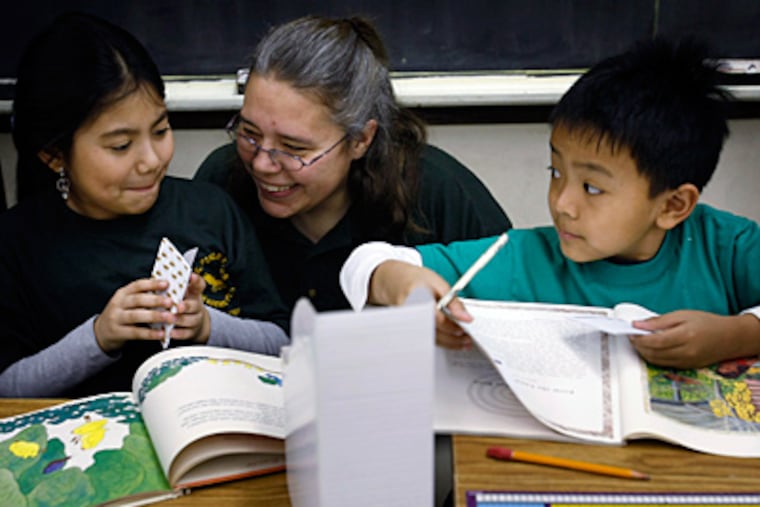
In Sherry Longstreth's third-grade classroom at the Thomas K. Finletter Academics Plus School in Philadelphia's Olney neighborhood, reading takes center stage.
Around the room, shelves of books are displayed full cover to encourage children to pick them up and explore them. Beneath a word wall for vocabulary lessons is a large rug that the children crowded onto Friday as Longstreth led a discussion on folktales.
Later, during a break, 8-year-old Mecca Taylor said the words all teachers - and parents - want to hear.
"I love to read," she said. "When you read, it brings you into a whole different world."
Longstreth's classroom could be a launching pad for the day when all children get the instruction and resources they need to thoroughly master reading skills by the time they leave third grade.
At Finletter and nine other Philadelphia schools, a multimillion-dollar federal grant is giving a Philadelphia nonprofit, the Children's Literacy Initiative (CLI), a chance to show that it can help achieve that goal.
Teachers in the lower grades will get extensive training from CLI in how to teach reading. They also get extra classroom materials.
CLI was one of 49 organizations nationwide to get an Investing in Innovation Fund grant last summer, paid for with federal stimulus dollars. It received $21.7 million, plus $4.3 million in private matching funds.
The grant has allowed CLI to take its program to 39 schools in Philadelphia, Camden, Newark, and Chicago. The program covers only third grade this school year but, over five years, will expand to include kindergarten and first and second grades as well.
CLI was already working in about 20 other Philadelphia schools, mostly in kindergarten and first grade. Research has shown that the program improved reading proficiency by 11 percent in the targeted classrooms.
The plan is to reach a total of 45,600 students in the four cities.
If the program gets the hoped-for results, said CLI executive director and founder Linda Katz, CLI wants to widely disseminate its methods. "We expect our results to inform national policy - to change the way things are done on the ground, in the classroom," Katz said.
Reading well by the end of third grade is a key academic achievement. A report last year from the Annie E. Casey Foundation, for example, stated that after third grade, children should be "reading to learn" rather than "learning to read" and that mastering the skill by then "can be a make-or-break benchmark."
Last year, however, only 47 percent of third graders at Finletter scored proficient or above in reading on the state PSSA reading test. In the Philadelphia district as a whole, 52 percent of third graders met that mark.
In 11th grade, just one year away from graduation, 42.5 percent of city students were proficient readers. Statewide, just 54 percent met that standard.
There's widespread evidence, Katz said, that much of the deficit in reading skills comes because many teachers haven't been given the full complement of resources they need to ensure success.
To rectify that, Longstreth and other third-grade teachers at Finletter went last fall to a three-day training session, where they learned a range of research-tested techniques for teaching reading.
Her classroom was set up as a model, arranged to encourage children to get into books. A CLI coach assists in planning lessons, helping the teachers present them in a way that engages the students. CLI provided extra books that were carefully picked to match the reading level of the students and for their rich content. And it trained the teachers on how to match students with the appropriate material.
Already, Longstreth said, she has witnessed results. "I've seen a major difference in my kids," she said. "Some of those that wouldn't pick up a book are now reading diligently on a daily basis. . . . The kids feel like I'm getting to them on their level, and pulling them up."
Principal Joanne Beaver agreed. The CLI program "infuses their tool kits with more things," she said. "These are the best practices" in how to teach reading. "It takes it to another level."
Children's Literacy Initiative grew out of Rainbow Readers, an early 1980s company that sold quality children's books to families using the Tupperware home-party model.
In the late 1980s, it morphed into a nonprofit that held workshops for teachers, helping them find good books for their classrooms.
However, "what we realized was, it wasn't just giving teachers books" that was needed, Katz said. "They didn't know what to do with them."
So an in-class training component was added.
"We know that in sports, you don't just teach someone how to take a swing and then walk away," she said. "You watch and see them do it, then work with them to help them improve."
A problem in elementary education, Katz said, is that colleges and universities do not train teachers well in reading instruction. Nor are teachers adequately tested in many states (including Pennsylvania) to make sure they have mastered the basics of how to teach reading before being certified. Finally, there is little mentoring during student teaching or in their first few years on the job.
Teachers eagerly embrace the help they get from CLI, Katz said.
"They love us," she said. "It's key to us that good teachers are developed, not identified."
Indeed, said Melissa Barrett, the CLI coach for Finletter, the program has helped the third-grade teachers there "focus on a common mission. They know it's going to make a difference in the classroom. They're excited."