Girard College aims to graduate those who can graduate from college
Despite a declining budget and reductions in enrollment at Girard College, Autumn Graves, the first black and first female president of the private North Philadelphia boarding school for boys and girls from low-income families, is pushing to boost academics and better prepare her students for college.
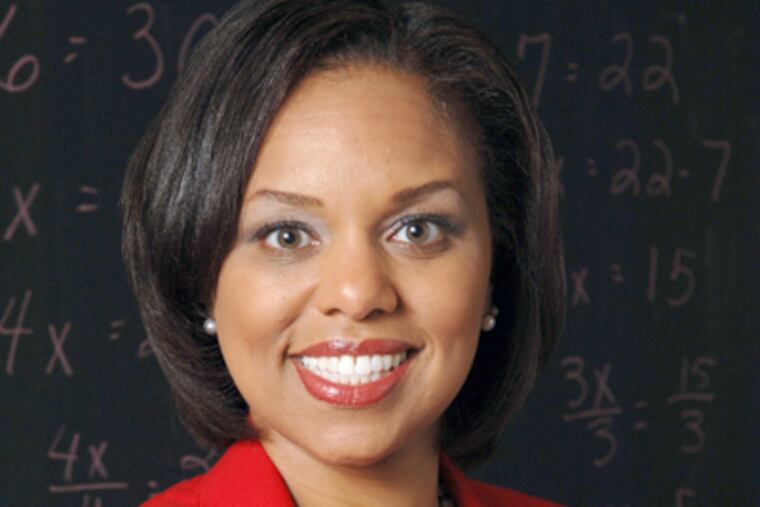
Despite a declining budget and reductions in enrollment at Girard College, Autumn Graves, the first black and first female president of the private North Philadelphia boarding school for boys and girls from low-income families, is pushing to boost academics and better prepare her students for college.
The goal is to have them ready "to complete college, not just get admitted to college," Graves said. "There's a big difference."
Nearly 100 percent of the students at the school, which 19th-century merchant-banker Stephen Girard established to educate poor orphaned white boys, are admitted to college, Graves said in an interview.
The school's mission now is to prepare "academically capable" boys and girls of all races "for advanced education and life as informed, ethical, and productive citizens through a rigorous education program that promotes intellectual, social, and emotional growth."
For the last two years, Graves, 39, who has extensive experience in private-school education, has been at the helm of Girard College, which has had a turbulent racial history. Two trips to the U.S. Supreme Court and seven months of vigorous picketing by civil-rights activists forced its racial integration in 1965. Girls were admitted in 1985.
Last year, there were 518 students, about 77 percent from Philadelphia and 87 percent from Pennsylvania. The rest were from New York, New Jersey, Delaware, and other places.
The lower school (grades one to six) had 176 students and the upper school (grades seven to 12) 342. Fifty-five percent were girls.
This fall, the school, at 2101 S. College Ave., which opened in 1848, will put increased emphasis on math and sciences, Graves said.
"We're intensifying those programs and attention to those programs," she said, "so that our students really do have the skills they need to have career choices when they leave us. We're trying to have an equal emphasis on math and science as with the humanities."
Graves said the school was also increasing the focus on foreign languages.
"We have real concerns about the need for our children to be able to communicate with those who may not be English-speakers," she said.
For the first time this fall, the school will offer French and Spanish in fifth and sixth grades. The languages were previously offered beginning in seventh grade.
In seventh grade, students will have an introduction to Latin as well as French and Spanish. They will then be able to choose which languages they want to study in depth in their upper-class years, Graves said.
"With the introduction of Latin, which started last year, we're really putting more emphasis on preparing students to take the SAT," she said. "Most academics have an awareness that Latin is a real fundamental skill-building language that really helps with the fluency of English."
Amid this academics push, the school has had tougher-than-normal financial times.
Because of the weakened U.S. economy, Graves said, the school has received less and less money from returns from the estate of Girard, one of the richest Americans in his day. The school's website posts the Girard Estate's assets at $487 million.
Before coming to Girard College, Graves was assistant principal at Friends Seminary, a Quaker school in New York City, for six years. Before that she was dean of the upper school at Sidwell Friends, a Quaker day school in Washington.
Graves has also held positions at Mercersburg Academy, a college-prep boarding school in south-central Pennsylvania, and Breck School, an Episcopal prep school in Minneapolis.
She has a bachelor's degree in rhetoric and communications from the University of Virginia and a master's degree in education administration from Columbia University's Teachers College.
Graves said the biggest challenge at Girard College had been grappling with declining finances.
This year's operating budget for the school, where each student comes from a single-parent home and receives a full scholarship, is about $25 million.
"Each year since I've been at the school, our annual budget has had to be cut by about $1 million per year," Graves said. "That is quite challenging when you're trying to improve programs and results for kids."
She said the perception among outsiders was that the school - with its 43-acre campus, grand buildings, and 10-foot stone walls separating it from North Philadelphia - had lots of money to spend.
"That perception is filled with misunderstanding about how we are funded," she said.
Graves cited the rising costs of health care, utilities, and expenses as adding to the school's financial burdens.
During the last two years, the school has worked to reduce enrollment amid the tight economy.
"When I came to the school, the decision had been made to only accept a first-grade class in an effort to slowly, but surely, bring down enrollment," Graves said. "We did that for two years."
This fall, she said, the school will bring in 45 new students in grades one to six.
"We will open this year with 475 students," said Graves. "When I started in 2009, we opened with 625. So we've seen a decline in our enrollment, and that's all budget-based."
In June 2010, the school decided to suspend its weekend program for two years, Graves said, noting that before that, about 6 percent of students stayed on campus during weekends. The change has saved the school about $500,000 so far, Graves said.
"One of the things you will notice about the school is that usually any programmatic change - except the desegregation - coincided with some kind of decline in the economy," Graves said. "We're a very economy-sensitive school. We can't raise taxes, and we can't raise tuition. We have no tuition."