Doctor's orders: Read to baby
Reach Out and Read program encourages early literacy and school readiness.
When Tamia Howard's twin daughters were born premature, at just 28 weeks, she feared they would have learning deficits all their lives.
But Trude Haecker, the girls' pediatrician at Children's Hospital of Philadelphia, had a suggestion:
"Keep reading to them. Read aloud. Read every day," Howard recalled the doctor advising.
Now 15, Tiarra and Tamairra Ferguson are high school freshmen - strong students in Philadelphia School District magnet schools, high-achieving girls with a deep affection for reading.
Their mother credits Reach Out and Read as a reason for their success. The organization promotes early literacy and school-readiness through pediatricians.
Haecker started a branch of the national nonprofit at Children's Hospital in 1996. Tiarra and Tamairra were among the first participants.
Today, Haecker is medical director of both the hospital's program and the Greater Philadelphia Reach Out and Read Chapter, which has 45 programs in 19 local health-care organizations.
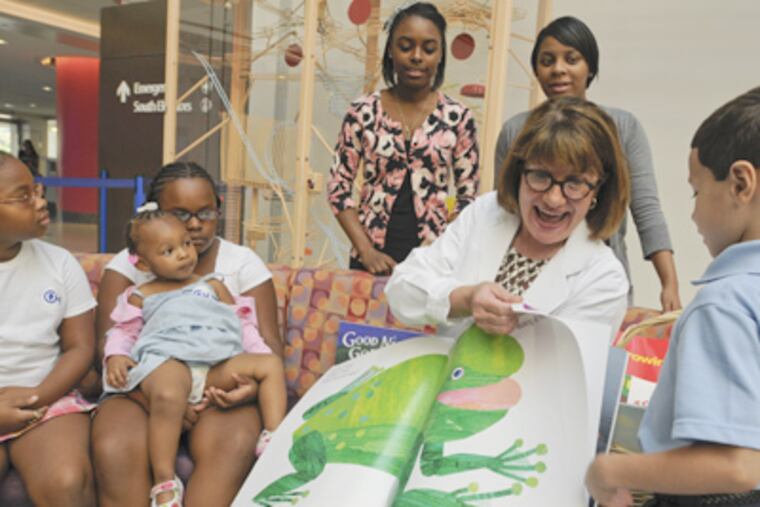
Doctors, nurses, and volunteers trained in the Reach Out and Read program read to children in waiting rooms. In doing so, they model that skill for parents and stress the importance of reading aloud every day.
Beginning at the six-month checkup and continuing through age 5, children receive one new book at every well visit. Siblings and children in for sick visits get used books.
Children's Hospital primary-care practices distributed more than 26,000 new books and 45,000 used books to children last year.
Nationally, the program reaches 3.9 families a year.
When her own children were young, Haecker read to them every night, no matter how busy or exhausted she was. Research shows that many children - especially those in low-income families - do not have anyone reading to them daily.
"Those first five years, when speech-language skills are burgeoning, we have such an opportunity," Haecker said at a 15th anniversary celebration of the Children's Hospital program last week. "Poor reading performance as early as first grade will lead to later difficulties. Those difficulties may not be overcome."
Children who struggle to read are at greater risk of juvenile delinquency, dropping out of school, truancy, and other problems.
Tiarra, who attends Swenson Arts and Technical High, vividly remembers her favorite Reach Out and Read book.
"It was Brown Bear, Brown Bear, What Do You See?" she said. "I would read with Dr. Haecker and my mom."
The twins always donated back the books they had outgrown. In middle school, they organized a fund-raiser that raised $2,200 for the program. Tamairra plans to hold another this year at her new school, the Arts Academy at Rush.
Some parents are skeptical when Children's Hospital pediatrician Colette Desrochers, who works at a practice in Cobbs Creek, advises them to read to their babies.
"At six months, they look at it, they chew on it, and the parents say, 'Aren't they too young?' " Desrochers said.
Desrochers urges them to keep going. And many have embraced the program's lessons, even if the books they receive through Reach Out and Read are the only books in their children's libraries.
Seven-year-old Milana Abubaker said the books she gets at Desrochers' office are "funny" and "nice." The second grader at Mastery Charter-Mann recently picked up Snow White at Desrochers' office. She wanted to take it to school so her teacher could share the book with other children.
"I like to get big books that I read to my little sister," Milana said.
Local philanthropist David Rosenberg is a big believer in putting books in young children's hands. Years ago, Rosenberg and his wife, Marjorie, wanted to help a Children's Hospital cause that their children could understand.
They chose Reach Out and Read, and Rosenberg said the investment has paid dividends.
"It's a really great payback," he said. "We change lives."