Local leaders' views on jobs illustrate Obama's challenge
Although local lawmakers share strong views on how the nation can find jobs for the millions of unemployed Americans, the diversity of their focus highlights the challenge President Obama faces in his address to Congress on Thursday night.
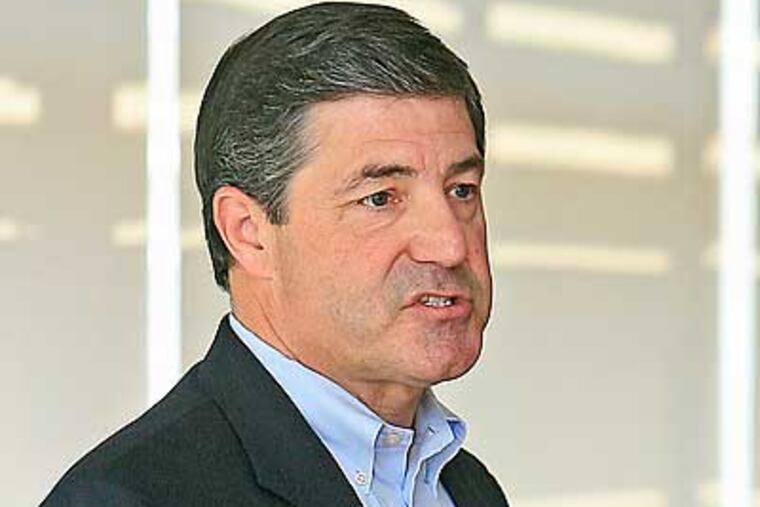
Although local lawmakers share strong views on how the nation can find jobs for the millions of unemployed Americans, the diversity of their focus highlights the challenge President Obama faces in his address to Congress on Thursday night.
"He's got his work cut out for him," said U.S. Rep. Mike Fitzpatrick, a Republican from Bucks County. "The American people are looking for a bold vision that will take us in a new direction."
Obama's jobs-creation proposal will come as he and Congress face a public that is both angry and frustrated. More than two years after the recession officially ended, 14 million Americans still can't find work - more than double the number unemployed when the downturn began in December 2007.
Stressing that the public realizes "the ways of Washington are not working," Fitzpatrick said he hoped Obama would propose "serious reform" of the tax code, broadening the base of taxpayers to "alleviate the burden on those who play by the rules."
He said he would also like to see a moratorium on the "type of regulations that have been crushing the will and the spirit of the American small-business person."
Rep. Jim Gerlach, a Republican from Chester County, echoed Fitzpatrick's themes of business and tax-code change.
"Employers in my district tell me that uncertainty is the chief obstacle to hiring and growing their businesses," Gerlach said. "Employers I have talked with want the president to get serious about eliminating unreasonable regulations and expensive mandates that hamper job creation."
Gerlach said that the threat of tax increases will not work, and that "the excessively complicated" tax code needs to be revamped to make it simpler and fairer.
"Ultimately, workers and employers will judge the president's effectiveness based on his actions rather than his speech," Gerlach said.
Sen. Bob Casey, a Democrat, said he wanted Obama to focus not only on what would work but also "what will pass."
He said a sweeping jobs bill with "a lot of pieces" would make it easier for Republicans to reject it. He would prefer a series of small, "very focused" proposals, possibly tackling different options each week.
Casey said his wish list included tax breaks for life-science companies, for firms that move their foreign operations back to the United States, and for businesses that increase their workforces.
Democratic Rep. Allyson Y. Schwartz, whose 13th District represents parts of Philadelphia and Montgomery County, said she wass particularly supportive of initiatives that are in place but need to be intensified.
"While we are working to reduce the deficit - as we must - we should also be taking action to accelerate job growth and economic growth," she said.
Among her priorities is returning veterans to the workforce, legislation she first advanced in 2007 when President George W. Bush signed the Veterans Employment and Respect Act.
Schwartz said she also supported efforts to improve the country's infrastructure and provide incentives to biotech companies that are creating lifesaving devices.
"I'm willing to reach across the aisle for any good idea that puts people back to work," said Fitzpatrick. "I'm looking forward to the speech; I hope it does not disappoint."
Rep. Robert E. Andrews, a Democrat from Camden County, said he was hoping to see several key elements in the speech, including "tax cuts for small businesses. I think we ought to say, if you form a business and hire people, give that small business a two- or three-year tax holiday. Let them operate tax-free to get off the ground."
He also wanted Obama to call for "an Apollo-type project for medical research." Investing in that area, he said, will lead not only to major medical breakthroughs, but an increase in jobs and exports.
Andrews wants the United States to borrow $1 trillion and "have a competition to put people to work" finding new treatments for cancer, dementia, AIDS, and heart disease.
Andrews said the $1 trillion could be borrowed at 2 percent, and the annual cost would be about $20 billion to $25 billion a year, easily paid for by cutting taxpayer subsidies to oil companies.
"Get rid of them," he said. "Let's do something big."
Sister Mary Scullion, cofounder of Project HOME in Philadelphia, said she hoped the president would propose a program to create affordable housing. It is a critical need in America, she said, and new housing can be a huge economic multiplier, creating jobs and stimulating the economy.
Scullion also said Obama needed to develop a strategy and get U.S. businesses to buy into that strategy, and "hopefully he has developed a choir to support that vision."
If the only voices Americans hear are those of partisan politicians, she said, "we're never going to get anywhere."