Art exhibit highlights abilities of people with disabilities
Their sculptures flow with an emotional grace that illustrates life's joys and sorrows. There's one of a long-haired woman arched upward, pleadingly, toward the sky. In another, a mother lies on her back with her knees up, her child sliding down her legs.
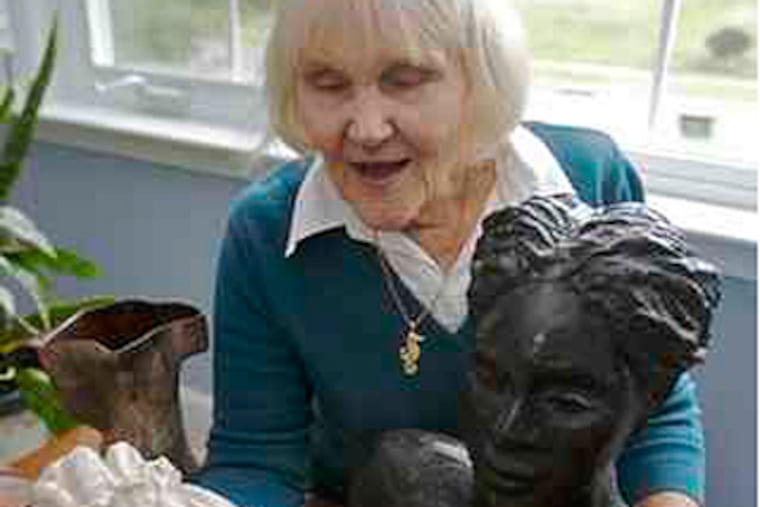
Their sculptures flow with an emotional grace that illustrates life's joys and sorrows.
There's one of a long-haired woman arched upward, pleadingly, toward the sky. In another, a mother lies on her back with her knees up, her child sliding down her legs.
Betsy Clayton, 68, and Carol Saylor, 72, know their work is good - they can feel it. Feeling their way through the creation of artwork is these sisters' forte. They have almost no eyesight left.
Others need only look at their sculptures, which are on display through June 21 as part of an Elkins Park exhibition of works by artists with disabilities.
"I think they are very evocative sculptures, very graceful, tender sculptures," says Deborah Krupp, chairwoman of the annual show, "All About Art at MossRehab," which offers entries from across the country and abroad.
"The purpose of it really is to highlight or make visible the abilities of people with disabilities," Krupp says. "When you see people with disabilities, you don't know the whole story."
The exhibition's paintings, sculptures, and crafts belie the notion that a disability is an insurmountable disadvantage.
The polio that Broomall's Clifton Anderson, 63, suffered when he was 8 forces him to use a wheelchair, crutch, or cane to move about. But that hasn't affected his oil paintings, including two, a nude study and a white rose, that are in the MossRehab show.
Beverly Erskine, 56, of Swarthmore, has a neurological disorder that limits her fine motor skills and causes her hands to shake, her speech to slur, her eyes to flitter in small, rapid movements, her balance to be shaky. The art of paper-folding that she practices, examples of which are in the exhibition, helped her accept her condition.
But among the most unusual artists in the show are the sculpting sisters - Saylor, of Roslyn, and Clayton, of Dresher - who are as bound to each other as they are to their art.
One of Saylor's pieces is of a mother sitting cross-legged, holding a baby to her chest. A Clayton sculpture shows a couple dancing at their prom.
Their art often features children. Saylor also likes to create scenes within what looks like an oyster shell - forcing people to use touch as well as sight to appreciate her works fully.
The emphasis on young people is not surprising: The duo has used art to cope with hardships and to honor family.
Clayton, 68, has been diagnosed with macular degeneration. The 72-year-old Saylor has nerve deafness and retinitis pigmentosa, a disease of the retina. The nerve deafness runs in the family: Their mother had it, as does one of Saylor's sons.
Saylor is now three-quarters deaf and almost fully blind, seeing only "fuzzy lights." Clayton has a little peripheral vision left.
The sisters' creative tendencies were apparent when they were young and full of dreams and daring, able to see and hear.
Their parents were artistic themselves and urged their daughters to flex their imaginations. The girls' first ceramics were born of youthful ingenuity, using clay they dug out of creek walls to make pots, which they dried in the sun.
As they became older, they turned toward painting. Saylor received her fine arts degree, focused on painting, from Temple University's Tyler School of Art. She was about 39 and had just graduated when she began having trouble with her hearing and vision.
As those senses worsened, Saylor recalls, a relative told her she had wasted her time at art school. "I thought, 'The hell I did,' " Saylor says.
It is in character, according to Clayton, for Saylor to find opportunities and bull ahead.
Saylor made sure her sister was with her for the bulling. She cajoled Clayton into joining her in art classes and in entering shows. Saylor also began making presentations around the area on art and blindness.
The two went to a program for the visually impaired called Vision Through Art at Allens Lane Art Center in West Mount Airy, and studied at the Philadelphia Museum of Art.
When painting became too difficult, the sisters found joy in the tactile art of sculpture.
"I don't know, I feel more secure. You're touching it. All of a sudden, you have another sense," Clayton says of working with clay.
Clayton acknowledges her sister's influence: "I've benefitted 1,000 times from having her as a sister. Vice versa? I don't think so."
Others see them as equally lovely.
Saylor and Clayton have mastered the form, structure, and emotion inherent in good sculptures, says Bob Fluhr, who leads the Vision Through Art program.
Willow Grove's Jeanne Shepherd, Clayton's daughter, admires her mother and aunt: "Their love of the arts is amazing to me."
It does not equal their love of family.
Clayton gave birth eight times. Saylor had six children. Her husband is deceased. Clayton has seven children living, Saylor has four. They share the sorrow of having buried children.
Saylor had a son who died of unknown causes when he was 2. Her daughter Alice died from esophageal cancer in 2002 at 34. Alice's death, a gnawing loss, inspires her. "All my artwork is Alice," she says. "Everything I do has Alice in it."
The loss was, unfortunately, preparation for helping her sister when Clayton's oldest son, Roy, a retired Air Force lieutenant colonel, died in a car accident a year later.
When a parent buries a child, "no one else can know how it feels, but she did," Clayton says. "All of these things come out in your art."
All About Art At MossRehab
The exhibition and sale includes watercolors, oil paintings, sculptures, collages, jewelry, and needlepoint by 78 professional and amateur artists with physical disabilities. The free show is open from 10 a.m. to 8 p.m. at MossRehab, 60 Township Line Rd., Elkins Park, through June 21. Valet and self-parking are free of charge. Guided tours can be arranged. To schedule a tour or for more information, call Julie Hensler-Cullen at MossRehab, 215-663-6100. EndText