Chesco sheriff breaks gender barriers
Gender barriers lie in smithereens around her, but Chester County's first female sheriff said she has never focused on smashing them.
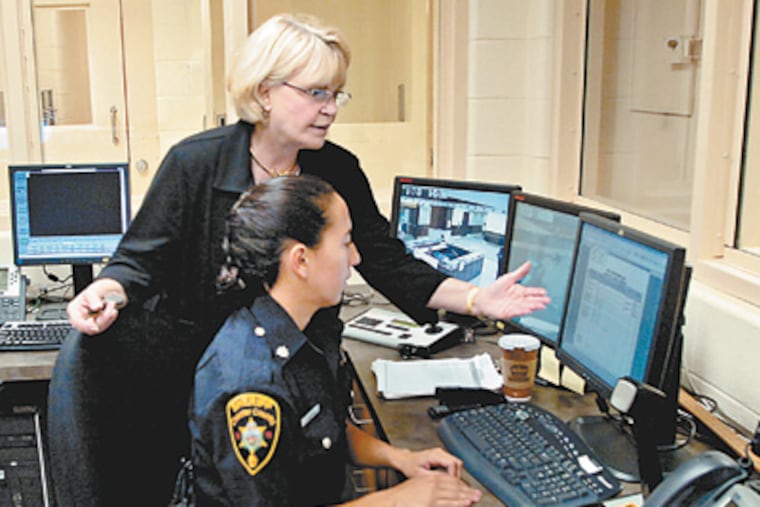
Gender barriers lie in smithereens around her, but Chester County's first female sheriff said she has never focused on smashing them.
Still, Carolyn "Bunny" Welsh's resumé reads like a demolition derby of male bastions.
After her election in November 1999, Welsh, currently the only female sheriff in Pennsylvania, attended a national training class in Colorado for first-year sheriffs - mainly men - and became the first woman to be elected class president. At the time, she was one of 30 female U.S. sheriffs; today, 40 of the country's 3,000-plus sheriffs are women.
Last month, the Chadds Ford resident broke another barrier, as the first woman to take the helm of the 90-year-old Pennsylvania Sheriffs' Association. The group represents sheriffs and provides education and training programs, and Welsh was elected by the board to a one-year term.
"I don't see any of it as a gender issue," said Welsh, an Upper Darby native. "You just get in and do the best job you can."
Welsh, 65, acknowledged that being dissuaded from pursuing a goal energizes her.
When she first expressed interest in running for sheriff, she said, Republican officials questioned whether Chester County was ready for a woman in that position.
"Why not?" she remembered asking.
Joseph "Skip" Brion, who heads the county Republican Party and served as its solicitor during Welsh's campaign, said Welsh had gone far beyond silencing naysayers.
"Not only has she shown that a woman can do the job and that Chester County voters accepted that fact, but she's also been a real asset to the county" in showcasing her accomplishments statewide, he said.
State Sen. Andrew E. Dinniman, a Democrat, agreed, saying Welsh had been "in the forefront of a change in the role of women in law enforcement."
Some of Welsh's law enforcement challenges are chronicled in a 2004 book titled Breaking the Brass Ceiling, by Dorothy Moses Schulz, a City University of New York law professor and former police officer.
But Welsh's inroads into male-dominated arenas preceded her political career.
In 1982, after stints in the music industry, she created a company called Hercon, short for her construction. Two years later, Hercon became the first female-owned construction firm to receive a major contract with the Pennsylvania Department of Transportation, completing a $700,000 pedestrian overpass in Chester City that spans I-95 near the Commodore Barry Bridge.
In 1995, Welsh assumed the top post of the Chester/Delaware Homebuilders Association, becoming its first woman president, she said.
By then, her late father, John R. Welsh - "my hero, my role model," she said - had thoroughly schooled her in politics. He served as a Republican committeeman and councilman in the 1970s and '80s in Upper Darby, where the John R. Welsh library commemorates his civic contributions.
"He told me I could do anything I wanted and be anything I wanted to be," Welsh said.
By the time Welsh, a graduate of Wesley College in Dover, Del., eyed the sheriff's position in Chester County, she had been certified as a constable, taken postgraduate business law classes, earned numerous business awards, and been active in groups such as the Rotary Club.
Chester County's GOP hierarchy conceded that she was qualified, but urged her to lose her "fluffy" nickname. She refused, explaining that ditching her childhood moniker would make her less recognizable. Besides, she reasoned, a man known as "Peanuts" headed the National Sheriffs' Association at the time.
Welsh, who often praises her "extraordinary deputies and staff," says she welcomes any chance to educate others about her job.
"Many people have no idea what a sheriff does. It's the enforcement arm of the county court," she said.
Stressing that no day is typical, Welsh said one common denominator is an 8 a.m. roll call, when deputies learn their assignments for the day. Those duties reflect her office's responsibilities: maintaining courthouse security, transporting prisoners, serving court papers, and licensing firearms.
Welsh, a mother of four and grandmother of eight, needs no license for her weapon of choice: a disarming sense of humor.
"You can't take yourself too seriously," she insisted.
That tone can prove contagious, evident by a framed caricature of Welsh that was commissioned by her deputies and hangs in her office.
It features a beaming Welsh with a revolver in one hand and a hobby horse in the other, surrounded by photo albums and a bunny behind the wheel of a spiffy sheriff's convertible. The caption: "The 'real' sheriff of Nottingham wears high heels" - a reference to Welsh's jurisdiction in Nottingham Township, Chester County.
Despite a penchant for levity, Welsh turns serious when discussing the dangers that sheriffs' deputies face. She has indelible memories of July 24, 2003, when she received a call that "an officer was down."
Rushing from a meeting to her office, she said, she "actually heard some of the gunfire on the radio" through an open phone line before learning that a second deputy had been hit. While being served eviction papers, an East Marlborough Township man shot one deputy in a hand and the other in the nose and one cheek.
"It still chills me," she said. "Police officers always say there's no such thing as a routine car stop; well, the same level of danger exists when deputies pull up to a residence."
In her part-time position on the state level, Welsh said, she plans to tackle a February 2006 state Supreme Court ruling that stated that deputy sheriffs were not "investigative or law enforcement officers," a decision that has generated confusion and court challenges to deputies' authority.
"A deputy who has the same training as a police officer should be able to make an arrest without having it challenged in court," said Welsh, pointing out that many of her deputies work part time as police officers. "Should their authority change when they change uniforms?"
Whatever the outcome, Welsh predicts she'll remain in public service.
"I like county government, and I like politics," she said.
Maureen Beitler, Welsh's longtime administrative assistant, suggested a broader quest: "She needs to run for president."