A full-tilt love affair with pinball machines
David Silverman owns about 800 of the arcade favorites.
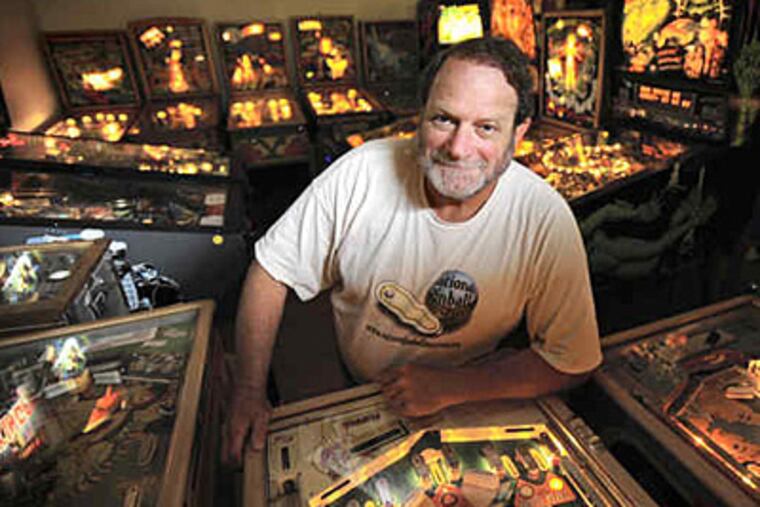
BALTIMORE - The quarter goes in, and then the magic begins. Lights flash, bells ring, balls roll, flippers flip.
David Silverman is in pinball heaven. And he barely had to walk out his backdoor.
For 25 years, Silverman has been buying arcade pinball machines, those gaudily colored, delightfully cacophonic games of skill that involve a steel ball, a bunch of rubber bumpers amid a sea of flashing lights, and a pair of electronic flippers that serve as the only thing between million-point success and hole-in-the-floor oblivion. Staples at amusement arcades, their pinging bells have provided the soundtrack for many a summer night at arcades and amusement centers from Ocean City to Coney Island, Virginia Beach to Las Vegas. The Who even recorded a rock opera about a deaf, dumb, and blind boy named Tommy, whose senses came alive only when he played pinball.
Silverman owns about 800 of these machines. And if a roomful of these babies doesn't constitute pop-culture heaven, then nothing does.
"Even as a kid, I was fascinated," says Silverman, a landscape designer by day whose house in Silver Spring, Md. - or, more specifically, several outbuildings in back of the home - serves as the temporary quarters for his National Pinball Museum. He hopes to expand it into a facility complete with a research library, themed restaurant (he even has a name for it, The Flipper), and gift shop.
"There was just something about the games," he says. "They've always been a fascination to me, and not just to get the high scores. I can remember, as a child, looking at the letters, at the artwork, at the flashing lights."
Inside Silverman's showplace, about 50 machines are displayed, nearly all of them operational. If someone is playing, the ping-ping of steel ball bouncing against rubber bumpers, amassing 10 points for each bounce (100 when lit), is downright intoxicating.
Earlier this summer, Silverman took nine of his pinball machines, all with music themes, to the Merriweather Post Pavilion in Columbia, Md. There, the newly opened Music Pinball Hall of Fame - the nine machines, lined up in part of a building off to the side of the pavilion - offers concertgoers the chance to slip a quarter into some vintage games from the 1960s, 1970s, and 1980s and get some idea of what got Tommy so excited.
There's a 1980 Rolling Stones game, a 1976 Captain Fantastic game (inspired by Elton John's appearance in the movie version of Tommy), even a coveted 1967 Beat Time game, featuring The Bootles, so named to avoid paying royalties to a certain Fab Four hailing from Liverpool.
Lording over it all - and he makes it a point to attend every Merriweather concert, so he can baby-sit his games and explain something about their history - is Silverman, 61. When he talks about pinball, his eyes tend to light up in ways not unlike his beloved machines. He's a man with a passion, one requiring four storage buildings just to hold it all.
Silverman wasn't always a pinball junkie. Sure, he played the machines as a kid, even had one in the apartment he shared with two roommates while teaching at Ohio University in the early 1970s.
"I literally had to sleep underneath it," he says with a longing smile. "I learned really quickly not to get up fast, or I'd bang my head."
But he sold that machine after school was over (for $200, the same sum he had paid for it) and managed to keep his passion at bay for several years. He eventually earned a master of fine arts degree (in ceramics) from Alfred University in New York and a landscape-design degree from George Washington University in Washington, D.C. Pinball was a pleasant memory, an occasional diversion, nothing more.
Then, around 1975, shortly after moving to Silver Spring, he made a stop at a business called Rockville Home Amusements. Things would never be the same.
He looked around and soon spied an old friend: a Fireball machine from 1972, just like one he had become attached to during a trip to Spain. He never had forgotten the game or that glorious graphic of a flaming, fireball-hurling red devil.
"That game blew my mind!" he says. "And here I was seeing it again. I was like, 'Oh, my God!' So I bought that game."
Thus was a passion rekindled, a mission born.
Strangely, Silverman confesses to not being much of a pinball wizard himself.
"I'm an actually mediocre player, and I hate that," he says. "I have done everything to try to become a better pinball player. I practice all the time. I just don't get any better."
To prove the point, Silverman approaches his favorite game, a 1996 whirling dervish of a machine called Big Bang Bar, from the Japanese company Capcom. One of only 15 prototype machines made (it was never mass-produced), this is Silverman's pride and joy - a pinball version of the interstellar-bar scene from Star Wars, complete with exotic dancing aliens, wide-mouthed frog creatures, and a computer-generated voice box that can be pretty insulting when it wants to be. He was once offered $40,000 for it but refused to sell.
Silverman slips a quarter into the coin slot.
"Player one," the machine asks, "didn't I see you in a lockup?"
He pulls back on a spring mechanism and shoots his first ball into the game. It bounces about harmlessly for a few seconds, amassing just enough points to be embarrassing, before heading straight down the middle of the play field, just out of reach of the two flippers.
"Wow, that didn't last long," says Silverman, as the machine makes the sound of a toilet flushing.
Of such abuse and frustration is pinball love born.