Springdale Farms adapts with the changing times
On his way in from the fields, a woman in a windbreaker stopped Tom Jarvis to inquire about the rabbits. His farm keeps four black-and-white floppy-eared rabbits in a hutch out back, and didn't Jarvis think, the woman asked hesitantly, that their algae-stained water bottles could do with a cleaning?
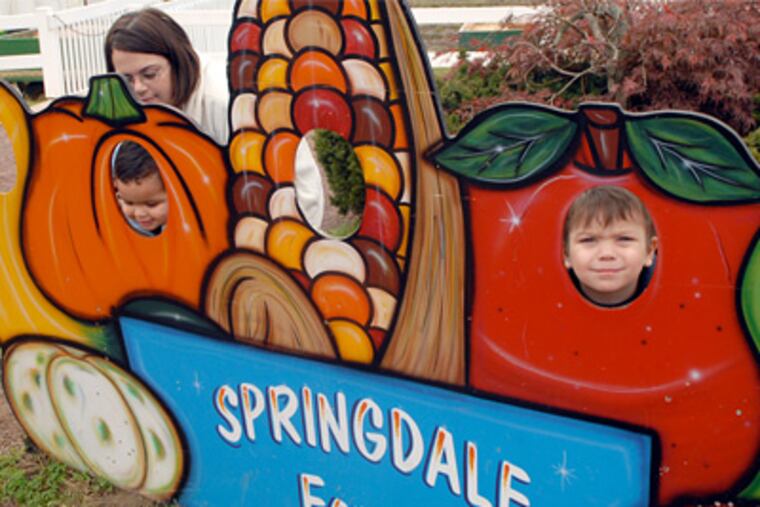
On his way in from the fields, a woman in a windbreaker stopped Tom Jarvis to inquire about the rabbits. His farm keeps four black-and-white floppy-eared rabbits in a hutch out back, and didn't Jarvis think, the woman asked hesitantly, that their algae-stained water bottles could do with a cleaning?
"They're refilled every day, but we'll take a look," Jarvis replied.
Once inside, he tugged on his baseball cap and shrugged. "Algae? What does she think's in the water they drink out of in the wild?"
Springdale Farm - once one among many agricultural concerns in Cherry Hill - is the last of its kind in the sprawling retail mecca, a title it's held since the early 1990s. Like numerous farms in the Northeast that watched suburbia grow up around them, Springdale opted not to shut down but to adapt.
Across its 92 acres of tomato, squash, cabbage, and bell-pepper fields, the day-to-day business of agriculture - keeping foraging animals at bay, irrigating crops, and selling vegetables on the roadside - runs up against township laws that regulate fence construction and hunting, and a four-lane thoroughfare great for drivers in a rush but bad for hawking produce.
"If your farm is 10 to 15 acres in the middle of tract housing," the surrounding wildlife thinks "they sat down at the smorgasbord," said Peter Furey, executive director of the New Jersey Farm Bureau.
"Lands that were once farmed have been eclipsed," he said, though "there are enterprises that are very stubborn in continuing to farm."
On a recent weekday morning, Jarvis, 68, was doing what he devotes more and more of his time to - hayrides.
He has tailored the excursions into educational experiences, where, for a fee, he shows off the fruit of his labor and explains the ins and outs of agriculture to suburbanites - like the woman who asked about the rabbits' water.
Discussing the drastic reduction in the world's bee population, he explained that farmers in China now pollinate apple trees by hand. He moved on to the difference between tomatoes allowed to ripen on the vine and those picked green, stored, and then sprayed with a naturally occurring gas to speed ripening.
"It looks like a tomato and tastes like cardboard," Jarvis said of the latter, addressing teachers and students from a Pennsauken school for the developmentally challenged. A ripe tomato is more perishable, he said: "We could never ship ours to California, and we don't care."
Jarvis, who sometimes does 10 tours a day, has perfected his routine of did-you-know factoids and self-deprecating one-liners ("The only thing older than that tractor is me").
Alan Ebert, founder of the farm and Jarvis' father-in-law, started the hayride tradition, with area churches.
But Jarvis has taken what he calls the "entertainment" at Springdale to a different level, with nighttime rides and bonfires, a glass conservatory he rents out for parties, and a modern roadside market that sells everything from produce to popping corn on the cob and cookbooks.
Springdale, which happily advertises its status as Cherry Hill's last working farm, has evolved into a South Jersey institution that recently was recognized by the Camden County Historical Society for "preserving a way of life."
"It sounds pretty ominous to be the only one, but if you flip that around, there's no competition," Furey said. "These farms are adapting very cleverly to tourists, who just want to come on the farm for experience."
To Mary Ann Ebert Jarvis, who has spent her entire life on the farm her father started in 1949, people in Cherry Hill enjoy the farm's aesthetic qualities, but many are clueless as to its demands and not always willing to support it.
"People like to have a farm in their neighborhood, but they still go to Wegmans," said Jarvis, who manages Springdale's market.
The Jarvises have butted against Cherry Hill officials repeatedly, on everything from construction of a deer fence to the township's desire to preserve the farm as parkland should the Jarvises ever sell. Officials once proposed adding a clause to the farm's lease on 30 acres of town land across the road that could make the farm undesirable to developers.
Cherry Hill spokesman Dan Keashen said that for now, the township has backed off that issue.
"We're not looking to pressure the farm," he said. "The mayor wants to do what's right and work with the farmers."
After decades on the decline - agricultural land in New Jersey and Pennsylvania dropped from 33.6 million acres in 1950 to 8.5 million acres in 2007, according to census data - farms in South Jersey have benefited from food's locavore movement. Instead of selling to produce wholesalers, more owners interact directly with consumers.
"There's a big move for local-grown produce," said John Hurff, owner of William Schober Sons in Monroeville, Gloucester County. "If it weren't for our market here at home and the farmers' markets, I would have been out of business."
Where Hurff might sell a pound of apples to a wholesaler for 65 cents a pound, he can sell it himself for about double that.
Even with the recent surge in business, farmers face the uncertain future they have for decades - namely, who will take over when the current generation is gone.
Those such as Hurff, who has three children, don't enjoy any confidence that their offspring will want to continue in a labor-intensive industry that operates on such a thin margin.
Tom and Mary Ann Jarvis have two sons and a daughter who range in age from 8 to 13. While neither parent is counting on anything, there's a sense that their son Clayton - "it means 'farm over clay' " in Old English, Mary Ann explained - might one day take over Springdale.
"It's always been our hope that one of them would, but there are certainly easier ways to make a living," she said.
Tom Jarvis, who didn't take up farming until he was almost 50, nods his head.
A Coast Guard veteran who grew up in Camden, Jarvis bounced from job to job as a young man, fixing everything from race cars to houses until he caught his break building decontamination devices for nuclear power plants.
He went to work for Springdale fulltime in 1988 after Mary Ann's father died, and applied his natural mechanical ability to building custom farm equipment and improving crop outputs.
Whatever the troubles he encounters trying to grow crops around the corner from housing developments and shopping malls, Jarvis acknowledged it's nothing compared to the inherent challenges of farming itself.
"Farming is completely dependent on the weather," he said. "This is the most frustrating industry I've ever worked in. You have no control over production."