In Kensington, a store neighbors believe in
Angel Perez leans on the counter in his botanica and listens intently as a tall blond woman tells him how she just lost her job - and her sense of purpose.
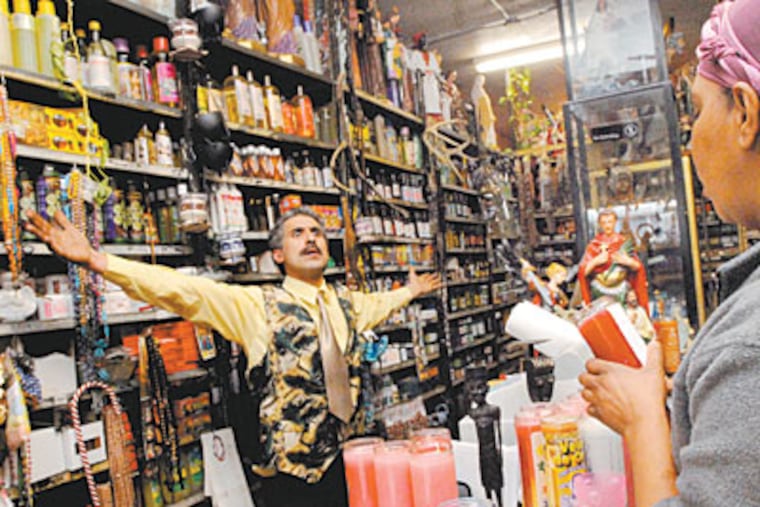
Angel Perez leans on the counter in his botanica and listens intently as a tall blond woman tells him how she just lost her job - and her sense of purpose.
Perez's Botanica Maria sits on Fifth Street in the Fairhill section of North Philadelphia, between a laundromat and a pizza shop. The narrow, dimly lit store is stuffed with candles of various colors for various things, like red for love, yellow for good fortune, and green for money. There are candles dedicated to patron saints and candles for remedies, such as a "shut up" candle to stop people from slandering you.
In the shop of Santeria wares, there are also beads, crucifixes, holy water, soaps, oils, and sprays such as Go Away Evil; porcelain statues of Jesus Christ, the Blessed Mother, St. Lazarus, a sitting Indian, and La Madama, a former slave who resembles Aunt Jemima; and ornate horseshoes decorated with gold mini-saints, cowrie shells, and flowers, which Perez makes in a workroom behind the store.
For the unemployed woman, Holly Ortiz, 21, Perez places an 8-ounce lavender-colored bottle on the counter, above the display of rosaries.
The label reads: "Baño Despojo. Santa Clara."
Instructions: Pour contents into half a tub of water. Stay in bathtub six minutes while bathing.
"It will help you clear your mind," says Perez, 41, a slight man with silver streaks in his dark hair. "And focus on the good things, on your new job you're getting very soon."
The cost for such clarity is $2.
Botanicas are prominent in most Latino neighborhoods. Amid the crush of wares are items used in Santeria, a religious and healing practice common in the Latino community, with African, American Indian, and Roman Catholic roots.
"Botanicas back in the day were like the medicine stores," former City Councilman Juan Ramos says. "Now they have become more of a cultural, traditional store. People buy candles, pray from a prayer book, and get a little advice."
From his counter, in a broken neighborhood, in a broken economy, Perez peddles faith. Unemployment is high. Money - dinero - a worry.
Perez says more and more of his customers turn to their faith for financial help.
Big sellers are dinero candles, dinero oils, and "money drawing" sprays.
"They want money, prosperity, open roads," Perez says, standing next to a towering statue of San Lazaro, a healer and patron saint of the poor.
A middle-age woman comes in to buy two bars of dinero soap.
"I'm-a use this money to get me some more money," she says, grinning, opening her wallet.
Another woman buys a dozen items to bless her new business.
Santeria is "very common in our community," says the Rev. Carlos Santos, the Episcopal vicar at Christ Church and St. Ambrose, at Sixth and Venango Streets.
"It's a meaning of hope. When people believe in something, they have a little hope in the future, to have good luck, and good things in their life."
Perez is also a draw - and not just to Latinos. He speaks in soothing whispers and rapid-fire rants, swearing to the absolute power of Jesus. He jokes, flirts, jumps, flashes a schoolboy's gap-toothed grin, and playfully throws customers out of the store.
"But it's all from the heart," Perez says. "That's why they love me."
Perez's mother, Maria Acevedo, opened the botanica in 1972, when Perez was 4, making the store his second home. After high school, Perez left to find his own way, and worked a string of retail jobs, including making sandwiches at a bodega.
But six years ago, when an employee took advantage of his mother's years and stole money from the register, Perez took charge.
His mother, 91, helps when customers fill the store, as they often do. The two live in the upstairs apartment.
By design, the botanica is open 7 days a week, from 7 a.m. to 7 p.m. In the Bible, the number 7 symbolizes God's perfection.
In Santeria, devotions can include a sacrifice of a goat or a chicken, which is later cooked and eaten, a practice Perez finds "disgusting." Perez prefers, he says, to offer flowers and fruits to the saints for their blessings.
He's sensitive to the religion's being misunderstood, dismissed as voodoo or black magic, even by believers.
Customers looking for black candles or other black items that Perez says can do harm, he sends away empty-handed.
"Santeria is the Lord's blessing," he says. "That other stuff, it's not religion. It's bull-."
Whatever bad spirit is upon you - whether your husband isn't treating you right, your mother's arthritis is acting up, or you just got laid off - Perez believes a spiritual cure is at hand.
But "you have to believe in the Lord 100 percent. If you don't, don't waste your time or your money."
Sandra Rodriguez, 44, walked into the store five years ago, worried over her son's legal problems. For $4, Perez sold her a "court candle," a blue candle with Lady Justice imprinted on the front. As Perez suggested, Rodriguez wrote her son's name on the inside of the candle, burned it four days before his court date, and prayed to St. Miguel for protection.
Everything worked out, says Rodriguez, a loyal customer ever since. "If you don't know what to do, you come to Angel."
When Millie Ortiz, who lives nearby, found herself arguing with a group of teenage girls constantly perched on her front steps, she, too, came to Perez.
"I couldn't take it anymore," says Ortiz, 32.
Perez looked her in the eye, and said, "Honey, this is what you have to do."
He pointed her to a candle for St. Alejo, the patron saint for bad neighbors.
A week later, the girls were gone. "It was so quiet," says Ortiz, who learned the ringleader had gone on vacation.
For some, Perez makes house calls. On a cold night, he and three assistants visit the home of Peg Wiley on a narrow street not far from the botanica.
Wiley, 67, says she and some neighbors have gone from friends to enemies.
"They sent me a demon," she says, standing in her living room. "I felt it. It grabbed me."
Perez, dressed in white, with colorful beads around his neck and a "Lazarus" cap atop his head, prays with Wiley in her kitchen, near the hookup for her security camera, which overlooks her front door.
Then, in her tiny basement, Perez dances around Wiley and chants in Spanish, while a helper draws a white chalk circle around them. Another pours the cologne Florida Water, and sets the circle on fire. Perez asks God to bless Wiley and protect her.
Back upstairs, Perez blesses her front door with a flaming coconut, to draw out evil spirits, that Wiley then smashes on the sidewalk, shouting, "Jesus Christ."
Wiley hugs him and goes inside.
Under the streetlights, Perez professes: "The miracle of the Lord is always right. And when I believe in something, I go all the way."