Old enough to retire, Wayne man enjoys thrift-store work
In May, Al Chagan will celebrate his 50th high school reunion. Many of the classmates he will see are retired, and some are enjoying themselves by playing golf in Palm Springs or sailing in the Caribbean.
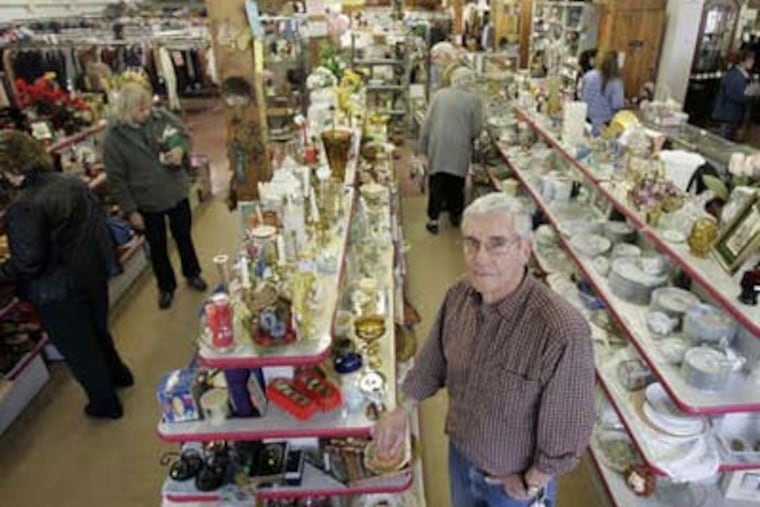
In May, Al Chagan will celebrate his 50th high school reunion. Many of the classmates he will see are retired, and some are enjoying themselves by playing golf in Palm Springs or sailing in the Caribbean.
Chagan (pronounced sha-GAN) has a different story to tell. At 67, he has no intention of retiring, and he is enjoying himself by helping run a business that he believes is making a positive impact.
That goal, in fact, is stated in the name - Impact Thrift Stores Inc. Chagan, a serial entrepreneur, is chief financial officer and treasurer of the Montgomery County nonprofit, which operates stores in Hatboro, Norristown, and Montgomeryville.
Last year, proceeds from the sale of "gently used" clothing and household goods enabled Impact to donate $173,000 to nearly 20 local charities. Since 2003, Impact has given out more than $800,000, and by the end of this year, total charitable giving will exceed $1 million, Chagan predicts.
The stores also provide full- and part-time jobs for 95 people, and enable those with community-service obligations to work in a place where they can learn good habits and contribute to the community.
"Of all the enterprises I've been involved with, this is by far the most gratifying," Chagan says. "Essentially, everyone benefits from the existence of this organization."
What's unique about Impact, Chagan says, is that it's unaffiliated with a large organization, such as a church, hospital, or school, and its focus is local. Nearly all the charities that benefit from its largesse are in Montgomery County and Philadelphia. They include the Blind Relief Fund, Jenkintown Day Nursery, Inter-Faith Housing Alliance, Manna on Main Street, and North Penn Valley Boys & Girls Club.
"This is a way to support local charities without touching your wallet," says Jo Greenawalt, Impact's director of marketing and charity relations.
As soon as the box truck that collects the donated goods is unloaded, items are sorted, priced, and displayed on shelves or racks.
"It moves, believe me," Chagan says of the merchandise.
Through its education program, Impact recruits and trains volunteers from high schools and colleges, and offers opportunities to those discharging community-service obligations.
Jon Walsh, 18, of Willow Grove, was sent to Impact three years ago to perform 20 hours of community service for skipping school. He liked the experience so much that he decided to continue. A senior at Upper Moreland High School, he works at Impact 25 hours a week, unloading trucks and sorting goods.
"Everybody here is really close and very supportive," Walsh says. "It's like a second family."
Robert Kuzmick is supervisor of victim and community services for the Montgomery County Juvenile Probation Department, which has sent hundreds of young people to Impact over the years.
"They've never turned down a kid," Kuzmick says, "and they act as mentors, providing moral guidance as well as teaching job skills."
Frank Hartwell, a former Lower Merion High School teacher and guidance counselor, is director of Impact's education program. Each year, about 35 students participate, including high school and college interns, special-needs students, young adults, and those performing court-ordered community service.
Hartwell handpicks a few of the latter for what he calls "competency community service." "We're trying to make it an educational experience," he says, "so they're not just sweeping floors but learning skills that will help reduce the recidivism rate."
Last year, an additional 230 or so students - from clubs, youth groups, and church groups - contributed time to Impact. Collectively, the education program resulted in the donation of more than 2,500 hours of work. "It's a tremendous help," Hartwell says, "and enables us to give away more."
Each location is organized like a department store, with separate sections such as clothing, furniture, books, and kitchenware.
Prices are low, bargains plentiful. "We don't try to get top dollar," Chagan says, "because we know our customers are trying to save money."
The other day, Sandie Hoelker, 54, of Fort Washington, was browsing through the clothing racks at the Hatboro store. A collector of teapots and salt and pepper shakers, she visits about once a week and considers the place "a treasure trove."
"The inventory changes constantly, and there's usually something new," she says. "It's a win-win situation, because I often find what I want, and I know I'm contributing to people who need it."
Chagan, who grew up in Merion and lives in Wayne, majored in economics at Colgate University, and earned an MBA from American University. After three years of corporate servitude, he began developing his own businesses - industrial diving and underwater construction, custom house building, dry cleaning.
In 2000, after exploring the feasibility of starting a thrift store for a local charity, Chagan realized the revenue-producing potential of such a business if managed correctly.
With the financial backing of a couple of local philanthropists, Chagan joined Paul Baur, a Tastykake owner-operator who was enthusiastic about starting a thrift store to aid local charities. The two began collecting donated items in spring 2001. They picked them up with Baur's Tastykake truck and stored them in a barn on a farm owned by Baur's parents in Horsham. That fall, they opened the first store in the former Santerian's Department Store, a Hatboro landmark.
Impact's board of directors determines how much it gives to the charities it supports. The charities receive a check for a committed amount each month, so they can count on that income in their budgets.
"We run it as a business," says Chagan, who earns $78,000 a year, "because we couldn't do all we do if we didn't run it as a business first, with high standards of conduct and integrity."
In May, Chagan will listen to his Episcopal Academy classmates rhapsodize about their leisure pursuits. He will be unbothered by envy.
"I would hate being retired," he says. "To be able to be involved in something like this, something that counts and that I enjoy, is a real blessing at my age, the icing on the cake."
If you know of any interesting stories or characters that capture life in the suburbs, contact Art Carey at 610-313-8106 or acarey@phillynews.com.