A day of good deeds as preparation of Passover
Skies were dark and the morning air cold as Samuel Domsky and Allan Stock pulled into their synagogue yesterday with 420 chickens.
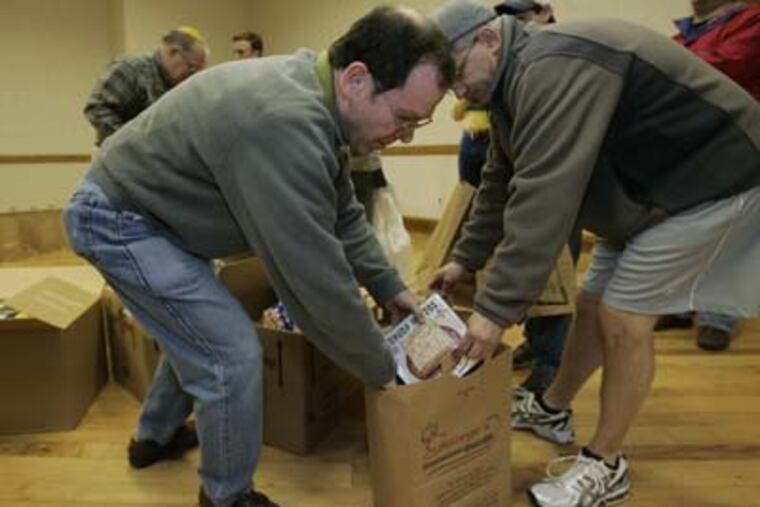
Skies were dark and the morning air cold as Samuel Domsky and Allan Stock pulled into their synagogue yesterday with 420 chickens.
It was the morning of the day before Passover, which begins at sundown today - and a morning like no other for these two. Each year since 1997, they have helped distribute thousands of seder meals to Jewish families across the region.
"The majority are elderly, single and female," explained Stock as he threaded his way through the synagogue's noisy main hall, where 80 volunteers in an assembly line were stuffing food into shopping bags.
"And believe me," he added, "some people have nothing."
That was about to change.
By 9 a.m., it looked like D-Day outside the synagogue as cars began queuing up and youngsters helped load them.
"It's an opportunity to do something good," said Louis Mayers, 12, as he and friend Cara Scatona, 13, lugged chickens, egg cartons, and apples into a van. Scatona said she had been doing it since she was 7.
Over the next few hours, 100 cars loaded with eggs, matzohs, applesauce, ground coffee, borscht, gefiltefish, macaroons, and chickens would fan out from Temple Sinai, making their ways to about 420 needy Jewish households in Philadelphia and the adjacent Pennsylvania suburbs.
Called Project H.O.P.E., or "Helping Our People Everywhere," and a creation of the Jewish community organization B'nai B'rith the program delivers two full shopping bags to each home - plenty for tonight's seder and enough to last most households several days.
Helping neighbors and teaching their young sons the Jewish tradition of mitzvot, or good deeds, is why Joshua and Jill Ladov were out there again this year.
"We live in a little bubble in Upper Dublin," explained Joshua, 41, a commercial-litigation lawyer, as he turned their Dodge Caravan onto Limekiln Pike shortly after 10 a.m. "We want the kids to see more of the outside world."
In the rear seats sat Matthew, 11, and Cory, 8, headed with their parents toward five homes in Philadelphia's Rhawnhurst neighborhood.
"Let's start with Rita Shapiro," said Jill Ladov, after studying their specially printed map, and tapped Shapiro's address into their van's GPS.
This was the third year delivering Passover meals for the Ladov family. "The first year was wonderful," Jill Ladov recalled. "The people were so receptive. They would invite us in, and we'd talk, and help put their food away.
"But last year was very different. There seemed to be more pride issues. People didn't want us to come in."
"They just wanted us to go away," said her husband. "But that's OK. It's not about us. It's about them."
About 10:25 a.m., Jill Ladov picked up her BlackBerry and tapped in a number, then heard a faint "hello."
"Mrs. Shapiro?" she asked. "This is Jill from Project H.O.P.E. I have a Passover delivery. . . . OK, see you shortly."
Five minutes later, they were parked outside a one-story, two-family detached house with a small lawn.
Matt and Cory lifted out two bags from the rear and, joined by their parents, carried them to the door, where Shapiro, 90, waited, leaning on a walker.
"It's very nice of you to come," she said, and invited them inside.
She declined their offer to put the food away, and lit up when Joshua pointed out the wedding photo on the wall.
"We got married 67 years ago," she said, and her eyes welled up as she told how she had followed her husband to California after he was drafted during World War II. He died two years ago, she said.
She spoke rapidly, telling the Ladovs about her three children, one of whom is in a home for the retarded, and how dependent she is on Social Security, and grateful for the company of her television.
"It's not easy living by yourself," she said. "I need company. That's what I need."
At last it was time to go. "Good Passover," Matt said, turning to her as he passed out the door.
"Thank you, dear," she said. "You, too."
The next recipient greeted them in her bathrobe.
"So nice of you to come," she said, and apologized for the papers on her table. "I'm doing my taxes," she said, and laughed. "God, I hate it."
Widowed and 84, she asked not to have her name used in the newspaper. She showed the boys pictures of her grandchildren, including a young girl in a Philadelphia Eagles shirt just like Matt's, and spoke of a son who died after 18 years with multiple sclerosis.
"I have a lot of aches and pains," she told them. "It's a blow to me being dependent."
The next house belonged to a dark-haired woman in her 30s who gazed warily from the door. She took the shopping bags from Joshua quickly and closed the door.
Their next stop took them to the home of Larry and Gloria Goldman. "Put it anywhere," said Larry Goldman, 80, a retired limousine driver, who introduced them to their dog and four cats.
Their three sons live far away, said Gloria Goldman, 77, "so it's just the two of us. But we enjoy being together."
The conversation drifted to their successful bouts with cancer, and to singer Frank Sinatra, whose photos lined the walls. Then Larry Goldman went down the hall and returned with a large, boxed toy firetruck.
"I got this for when we might have grandchildren," he said, and handed it to Matt. "But it turns out we're not going to have any. Our sons say they want to be independent."
He went down the hall again, this time returning with a boxed toy rescue truck. "I've been saving this one, too," he told Cory, "but I'd like you to have it."
Cory nodded. "Thank you," he said.
Last stop was the home of Anna Waldman, widowed and 86, who met them in a wheelchair on her front lawn, planting irises.
"Just put them on the steps," she told the boys, who carried the groceries. She said her son, "my caretaker," visits twice a day, and would put them away.
"I'm basically housebound," she told them, "but I love to garden." She wished them a zisn Pesach - "sweet Passover" - as they headed toward the car.
On the ride home, the family agreed it had been a pleasant morning.
"I liked doing it - helping," Cory said. "Everyone was nice except the lady who wouldn't let us in."
They talked about the emotions they encountered. Matt recalled that Shapiro's eyes had reddened when she spoke of her husband's death, and the boys tried to imagine what it was like to have multiple sclerosis.
"One day it could happen to us," Cory said.
"That's why you have to be thankful for what you have, and tell the people you love how you feel," their mother told them.
"I hope this makes you proud to be Jewish," she added. "It's a life lesson. You have an opportunity to touch other lives."