Returning to Haiti on a long-term mission
PORT-AU-PRINCE, Haiti - As the plane began its descent into Port-au-Prince, Luc Bouquet looked out the window at the rusted rippled-tin roofs and pool-blue tarps below, a tattered quilt covering the city's lumpy knees and ankles.
PORT-AU-PRINCE, Haiti - As the plane began its descent into Port-au-Prince, Luc Bouquet looked out the window at the rusted rippled-tin roofs and pool-blue tarps below, a tattered quilt covering the city's lumpy knees and ankles.
At ground level, Bouquet knew there was no comfort for the millions of bereft Haitians living in tents, shacks, and makeshift shelters.
The 52-year-old Haitian American nurse practitioner was returning from a weeklong visit with his family in Florida. He had been away from them more than two months, caring for victims of the earthquake. Helping to ease his people's suffering had had a profound effect on him.
He felt needed in Haiti. He felt at home here. And spiritually, he believed, he had been given a mission, to dedicate the rest of his life to serving his fellow Haitians. He was not a rich man, but with God's help he planned to build an orphanage, a church, and, in time, a nursing school.
His wife of nearly 25 years, Phénide, and their three children were proud of his self-sacrifice, but he was also needed back home. Bouquet had to choose. And because he was not a man to do anything halfway, either path he followed would mean turning his back on people he loved.
He had awoken this morning in a warm bed next to Phénide and would be sleeping this evening in a tent set on cinder blocks in a friend's mosquito-infested yard, where scavenging dogs tear through trash after dark and roosters deliver their wake-up calls hours before dawn.
The physical hardship, Bouquet says, doesn't bother him. Compared with most Haitians, he is living in luxury. Still, he says, "It's always hard the first day back. You've left your family. It's kind of sad."
He stands in a line at the arrival gate, where Haitian musicians in bright yellow Western Union T-shirts perform for the passengers waiting for a shuttle bus to the baggage claim. More than half work or volunteer for charitable organizations. One is an Episcopal trauma psychologist from Indiana. Another is an internist from Kansas. They share the camaraderie of the well-intentioned. Selfless generosity can be rewarded with ego gratification for those who participate in high-profile disaster relief.
When they reach the arrival terminal, where enormous fans circulate the hot air, they are greeted by chaos.
Baggage handlers heave duffels, backpacks, and heavy suitcases onto the floor. Bouquet joins the sweaty melee, searching for his belongings, and realizes that one of his bags is missing. It was loaded with ibuprofen, children's multivitamins, and fresh sheets Phénide packed for him. An airline agent assures him the bag will arrive later that afternoon.
A friend has come to meet him. Bouquet climbs into the pickup truck, and they begin the long, frustrating slog out of the airport, stuttering through traffic among honking drivers for whom the rules of the road are more conceptual than binding. A child jumps onto the side of the vehicle, clinging to the side-view mirror. He tilts his head and holds out one hand.
"I don't have any money," Bouquet tells him in Creole. He does not want to encourage begging. This is why he wants to start a school, he says. "If you can move them away from Port-au-Prince when they're young, you may have a chance to teach them."
The pickup crosses a bridge damaged during the earthquake. Bouquet doubts that it has been properly reinforced. "I don't want to get stuck here," he says nervously, but the structure holds.
On the road toward Lilavois 38, a neighborhood on the outskirts of the city, they pass scores of crumpled houses and shops untouched since the day now known simply as the dezas, the disaster. Broken columns dangle like stalactites from tilted roofs. But life has returned to the streets. Merchants seated under brightly colored umbrellas line both sides of the dusty streets, chiseling chunks off melting blocks of ice, arranging pyramids of tinned milk, soap, and canned mackerel. On aluminum trays and worn straw mats, they lay out neat rows of okra and tomatoes and mangoes and avocados. At intersections, young men hawk cell-phone rechargers draped limply, like snakes, over their forearms.
In the road outside a market, the pickup veers around a dead man. Someone has encircled his body with rocks to keep traffic from running over him. From the blood staining his polo shirt, Bouquet guesses he was a thief. Violence is on the rise. During February, 50 people were shot to death in the capital, the local newspaper reports, and 57 during the first two weeks of March.
Along the route, Bouquet and his friend are passed by armored vehicles and buses carrying U.N. soldiers, SUVs emblazoned with aid-organization logos, and truck after truck carrying debris out of the city.
Teams of workers, their faces powdered with limestone, have been hired to put rubble into wheelbarrows and sweep the streets.
Bouquet sniffs. "All they do is push the dirt around. They go as slowly as they can so they can get paid for more hours," he says. The cynicism seems at odds with his national pride.
Bouquet credits God for delivering him from a brutal childhood of caustic poverty and pitiless neglect. He met Phénide, who is also a nurse, when they were in their 20s, working with a youth group in church. In 1991, when their son, Ralph, was a toddler, they moved to the United States to escape the violence after a military coup.
In Florida, the couple built an enviable life, established their careers, and raised three high-achieving children. Ralph, a Harvard University graduate, is earning a master's degree at the University of Pennsylvania while he teaches at a Philadelphia high school with Teach for America. Jennica, 20, is a sophomore at Johns Hopkins University. Joan (pronounced Jo-ann), 17, is an A student.
None of them has ever visited Haiti, Bouquet says, although he hopes they eventually will join him in his volunteer work. Last year at his wife's urging, Bouquet says, he agreed to become a U.S. citizen, but he thinks of himself as Haitian.
"This is my country," he says. "What I am doing in Haiti is what I'm called to do. I feel I have to give back."
20 pounds lighter
When the earthquake struck Port-au-Prince on Jan. 12, Bouquet was safe at his home in Palm Bay, Fla., a placid residential town of yes-sir manners and church-on-Sunday neighbors. Five days later, he was in Haiti, tending to babies with fractured skulls, men with infected wounds, women with broken limbs. In the weeks that followed, he found himself straddling his own shifting tectonic plates.
On March 18, when he walked back in the door, Phénide was shocked. Her normally stocky husband had dropped 20 pounds. "And he was exhausted," she said.
As much as he had looked forward to seeing his family, Bouquet was too busy taking care of loose ends and too distracted with plans for his trip back to Haiti to relax and enjoy the reunion.
He met with his employers at Keiser University, where he taught nursing, to inform them he was quitting. He talked with his church's elders about support for his work. Any help they could provide for Phénide and his children, he would be grateful.
Phénide had worked in home health care for years, but with her husband away and her younger daughter at home, she could no longer take the 12-hour shifts the jobs required.
Bouquet said he did not worry about how they would manage without salaries and health insurance. "God," he said, "will provide."
Phénide said she prayed for her husband. "I don't want to stop him, because he's doing what he wants to do. What the Lord wants him to do. And he's doing good work. But I miss him."
She has not returned to Haiti since moving to Florida. Once Joan graduates, she intends to join her husband in his mission, going for two or three weeks several times a year. But Haiti is not a place she trusts enough to move back permanently because of its history of political instability and violence.
The morning before he left, the family attended services at the Melbourne Church of Christ.
"Luc!" said a man who had read of Bouquet's efforts. "It's so good to see you. I hear you're going back."
"Yeah," Bouquet said, "tomorrow."
"Is there any sense of control yet?"
"No."
Between homilies and songs, Bouquet read the church newsletter. The first item was about his work in Haiti and the help he had received from the Churches of Christ's Disaster Response Team.
At the end of the service, Bouquet was invited to address the congregation.
"It is such a blessing to be here today," he said. "I would like to thank you for your faithful prayers and financial support. . . . Though I work from 6 or 7 in the morning to 8 p.m., I never felt tired or exhausted. I think I have to be there and thank God for the privilege of serving him."
He concluded: "Everyone asks me. My wife and my children ask me. When are you coming back? I don't know."
The next day at 3 a.m., Phénide made Bouquet coffee and reminded him to take his passport. "All right, baby," she said. "Take care of yourself." They hugged and kissed lightly. He got in the car and backed out of the driveway. As the garage's automatic door closed, she kept waving.
Sleeping outdoors
Only the lucky and the brave in Port-au-Prince are still living under a solid roof. With hundreds of aftershocks sending shivers through the city, nearly everyone seems to sleep outside in tents or shelters made of bedsheets tied to wooden poles.
Bouquet, believing the house he owns in Delmas 33 was securely built, had stayed there with his deaf sister-in-law, Esther, and his nephew, Emmanuel, until late February, when he awoke at 1 a.m. and watched the ceiling rumbling for 23 seconds. "I said: 'That's it. This isn't safe.' "
A friend who has a house in Lilavois and had sent his wife and children to Fort Lauderdale, Fla., for at least the rest of the school year invited Bouquet to set up a tent on his property.
In early March, he was joined by three members of the Churches of Christ Disaster Response Team (DRT), who are building toilets and showers and a security wall on a site where Bouquet preaches twice a week, conducts a walk-in clinic, and plans to set up an emergency tent city.
"He's a very wise man," says Mark Cremeans, the 53-year-old director of the DRT, "and he's going to do whatever he sets out to do."
Church members have shipped a container full of medicines, tents, and emergency supplies, and are providing volunteers to work with Bouquet for the next few months.
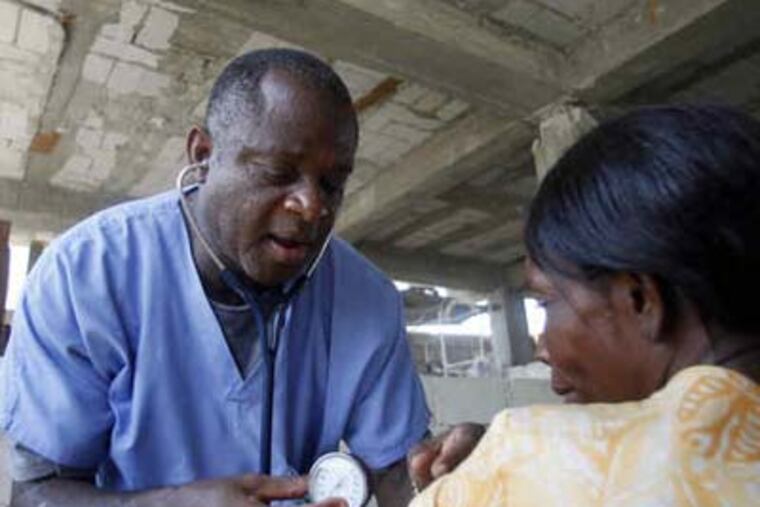
"I don't know when our deadline is," Cremeans says, wiping his forehead. Behind him, on an open concrete patio beneath a damaged roof, Bouquet is seeing dozens of patients.
The medical emergency has already passed. Now those he sees merely suffer the symptoms of poverty that the earthquake has exacerbated - anemia, dehydration, late-stage cancer that has gone undetected, skin diseases, intestinal parasites.
People have donated money to help victims of the earthquake, Cremeans explains, and "at some point, this will no longer be disaster relief. It will be a mission." When that time comes, the group will have to withdraw.
Distributing the supplies that the church has donated will require careful planning, Cremeans says. The volunteers nearly started a riot when they tried to hand out kits containing hand sanitizer, toothbrushes, toothpaste, and shampoo.
Bouquet says volunteers will soon start teaching informal classes. Community leaders will help identify families to move into tents on the property. One of the women who has come to hear him preach has offered to run the orphanage in her yard. The orphans, he says, will come from the university hospital. He has no contacts there, he says. "We'll just show up in the pediatric unit."
Long before the earthquake, literally hundreds of aid organizations with ties to U.S. churches had been working in Haiti. One of the issues world leaders discussed Wednesday at a U.N. donors conference was the need for coordination among large groups and small nonprofits.
Those who have spent years working with Haiti's poor view the eagerness of newcomers with caution.
"Everyone is well-intentioned, but many don't know what they're getting into in the end," says Jan Weber, regional medical coordinator at an orphanage that has operated outside Port-au-Prince for 22 years. "This whole country is so challenging. I witness every day how difficult it is to provide food and proper health care for these children. You have to find well-educated teachers and child-care workers, and the money to pay good salaries so they don't leave after two weeks. You have to guarantee a certain standard."
Bouquet insists he's aware of the challenges. "You will see," he says. "This is a step of the faith that I have in God."