As bust of founder arrives, AME church reaches out to those in need
Kneeling at the altar, members of the congregation clasped their hands in prayer and a soulful songstress brought the faithful to their feet Sunday at the Mother Bethel AME Church in Society Hill.
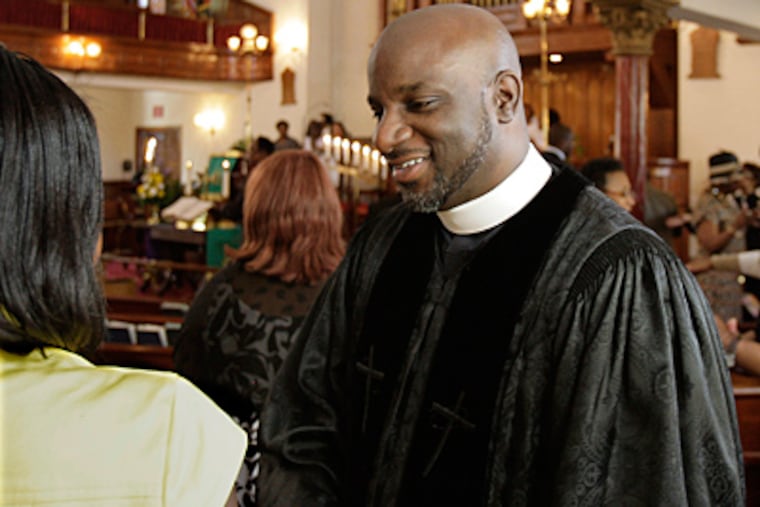
Kneeling at the altar, members of the congregation clasped their hands in prayer and a soulful songstress brought the faithful to their feet Sunday at the Mother Bethel AME Church in Society Hill.
But this Sunday will be a special cause for celebration at the historic church as it makes room in the Richard Allen Museum for the arrival of a 134-year-old marble bust of the AME founder.
The Richard Allen bust, which had been missing for decades, was recently found on a shelf in Wilberforce University's library. The Ohio school is loaning the bust to Mother Bethel for a year.
Today, the restored bust will be unveiled at 7 p.m. at First District AME headquarters, at 38th and Market streets. The bust will then be moved to the museum at Mother Bethel.
This is all "a part of that ongoing struggle to have artwork that represents everyone in the city," said Mother Bethel's senior pastor, Mark Tyler.
Allen, a former slave, educator and Methodist lay preacher, founded Mother Bethel church in 1794, less than a mile from St. George's Methodist Church, which Allen and others left in 1787 due to discrimination.
Eventually, he and the group formed the first independent black denomination, AME.
"This [building] made a very bold statement for the people here in Philadelphia, in the AME church on 6th and Lombard, saying that we're here, we're here to stay," said Thomas Koger, docent for Mother Bethel.
During the slavery era, black churches were "often the only places black persons could turn to for help," Tyler said.
The churches provided medical and burial assistance. It was the place where African- Americans could learn to read and seek help in obtaining freedom, Koger said.
Tyler said the church is just as involved as it was in the past, but today "there are different issues," including unemployment and financial hardship.
"I think because of the way in which the black church began, historically, there has been a great expectation placed upon the black church from those outside of the institution that the church would be more than just a place of worship," he said.
From the pulpit on Sunday, Tyler told congregants to stay strong in the face of recent economic adversity. Unemployment in the city is 11 percent, according to federal statistics from April.
"There is life after the shipwreck," Tyler said. "There are some of us who almost gave up. See what the end is going to be. Find a piece and hold onto it."
Tyler, 43, a father of four who grew up in Oakland, Calif., said that there was a brief period as a young adult when he "was heading nowhere," and that he sees that hopelessness in today's youth.
To counter that feeling, he said, the church is working to establish a mentoring program to teach young people to be entrepreneurs. For the hungry, a feeding ministry operates once a month preparing food for shelters.
The church "provides the nourishment we need to continue to go on," said church member Ebony Freeman, 27, of Blackwood, N.J.
"The church has to be concerned about more than just congregation on Sunday," said Tyler's wife, Leslie Patterson-Tyler, who organized a blood drive last weekend in honor of a member's daughter who died in December of sickle-cell anemia.
"We've been called in every era to play our role," said Tyler. "It's our call and charge to make sure that we use our resources to help make society a better place."