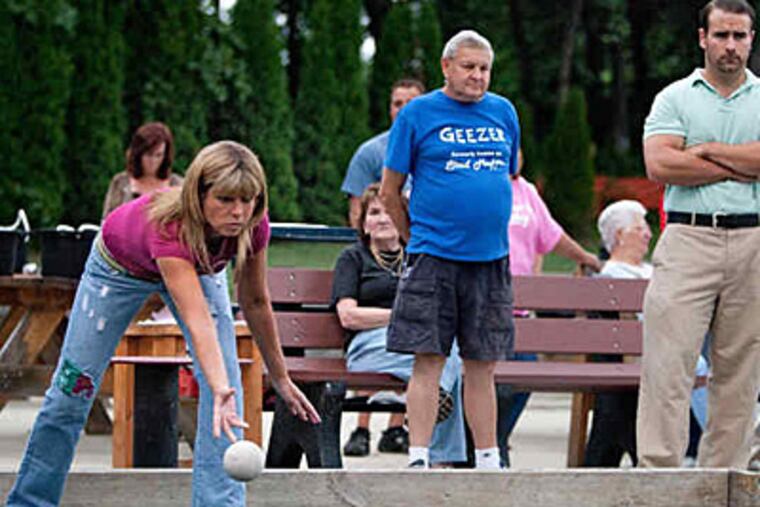
In a hilltop park at Bridgeport, in a country club south of West Chester, and in once-quiet spaces from Royersford to Conshohocken, droves of suburbanites have turned the roll-and-thump of a once-fading outdoor sport into a nightly excuse to cook out, socialize, and work their competitive nerves.
Bocce is back, and it isn't just for elderly Italian gentlemen this time.
"I'd be doing nothing if I wasn't doing this," John Sobetsky, 19, said last week between tosses with other young players on a new Bridgeport court that replaced a town tennis court.
Eighteen years after a trip to the Jersey Shore inspired a Norristonian to bring the ancient ball-rolling game to Montgomery County, dozens of suburban courts have sprung up in yards public and private. As part of a national trend, thousands of players take part in leagues that did not exist a decade ago, and old-line clubs that abandoned their bocce grounds are tearing up parking lots to rebuild them and join a pastime's rebirth.
"I've been in the sports business for over 20 years, and I've never seen a single sport take off like bocce has in the past three years," said Ed Metz, owner of Metz Athletic Construction in Doylestown.
Until 2008, perhaps five callers had asked Metz to set up bocce courts over the years, and he had always put their requests aside. Then he tried building one after learning he could use the same packed granular surface he uses on tennis courts.
Since then, Metz has constructed or rebuilt 17 more. The venues range from homes to retirement communities, all in South Jersey and eastern Pennsylvania.
"Now my wife wants one," Metz said, chuckling. "We played at a party and saw other couples drinking cold beers and heckling each other, and she said, 'I want you to build us one now.' "
Bocce is also exploding across the country, with about 25 million people who have played at least once, reported Phil Ferrari, 67, the loquacious president of the World Bocce League in Illinois.
In 2000, Ferrari - who has his own hotline at 1-800-OK-BOCCE to evangelize for the sport - told an Inquirer reporter that there were about four million participants, but predicted that, "in the next 10 years, there will be a bocce set in every household, like there is a phone."
A decade later, Ferrari said he believed that the sport - "an easy game to play, but a difficult game to master" - had almost lived up to his prophecy.
"They sell bocce sets in the major department stores and sporting-goods stores now," Ferrari said, "and 10 years ago, they didn't."
At its core, bocce is a simple game: Roll a small ball - a pallino - down an alley of clay, turf, or grass, then try to roll a set of larger balls closer to it than your opponent can. The game dates back 7,000-plus years to ancient Egypt, from which it spread to Greece, then Rome, and then America, where Italian immigrants kept it going for much of the 20th century.
At one point, the Philadelphia region was studded with leagues for all-male teams. A Bucks County club traces its roots to 1895. Photos from a Montgomery County banquet in the 1930s show dozens of tie-wearing men toasting the best among them.
They grew old playing together, and it almost made their sport extinct.
"There was a group, and we just lost it," said Louis Cappelli, 82, the third-oldest member of the Conshohocken Boccista Club, which he joined 61 years ago.
Aficionados boast that anyone, from children to the very aged, can handle the gentle effort of rolling a light ball down a clay alley. For old-line bocce players, it meant they did not need infusions of new blood the way leagues of graying bowlers or tennis players did.
"The old Italian guys, they were not interested in spreading this sport to anyone," Ferrari said. "It was their game."
By the late 1970s, Ferrari said, there were just 50,000 bocce players nationally. In the Philadelphia region, clubs closed or, like the Conshohocken group, built over their bocce courts.
"It wasn't popular, and it died out," said Kenneth Shipman, 60, who joined the Conshohocken club in 1972. "We had a generation gap where nobody wanted to play."
Pennsylvania's suburban bocce revival, in which leagues have waiting lists, and townships are clearing park space for courts, can largely be traced to the efforts of Norristown's David Fusco, 54, approaching his 20-year mark as an ambassador for the game.
In 1992, Fusco, a technician for a construction company, was vacationing in Wildwood when he saw a bocce court and asked an older Italian man to play. He lost - badly - as a crowd of 50 looked on from the boardwalk.
But something besides the bocce balls clicked.
"I thought, 'If we had this in Norristown, people would come to play,' " Fusco said.
Two years of council lobbying and volunteer labor later, Norristown had a 16-player league and two new bocce courts in Elmwood Park.
Sixteen years later, that league has 530 members and a waiting list.
"Once the courts were in," Fusco said, "nothing was hard after that."
His league's players and alumni have spread bocce's gospel through the surrounding suburbs.
Fusco - who has also helped the Special Olympics add bocce to its programs in most Pennsylvania counties - said he had been consulted on nearly a dozen bocce-court projects. In recent months, requests from Norristown league players have led East Norriton to plan a bocce court - scheduled to open next year - and Penn Oaks Golf Club in Thornbury, near West Chester, added bocce as its first new sport since opening 45 years ago.
"I think you're going to see this sprouting up all over the place," said Steve DiMarco, general manager of Penn Oaks, where the bocce court opened last Sunday.
About five years ago, Conshohocken's club - at that point a social organization with a bar - built courts. Crowds rolled in. Grills were set up. So were bleachers. Wine flowed as the balls rolled.
"Oftentimes, it turns into a party," said Tom Johnstone, 41, commissioner of the 300-person Conshohocken Bocce League, as he watched a match Wednesday evening with a beer in hand.
One 90-foot bocce court away, Adam Moore, 33, took a break between tosses to reflect on the bustling scene, with about 60 people chatting around the games.
"I've met a lot of people through bocce I wouldn't have otherwise met," said Moore, a funeral director.
A similar scene glowed in the back lot of Norristown's Holy Saviour Club, where Joseph Mirable, a regular player in Fusco's league, had led the construction of courts three years ago.
"You couldn't get more people involved, because of a lack of court time" in the original league, Mirable said.
Holy Saviour's courts last week offered a picture of the new bocce crowd: A team of women in their 50s and 60s were cheering, with red wine, their win over men about half their ages. Nearby, white-haired men nodded in approval and talked about how players can improve.
"When we first started playing here as an all-women team, our welcome wasn't as warm as we would have liked it to be," said Carol Facchine, 54, "but now when we win, they're buying the drinks. They're thrilled."
That night, Norristown's older league offered another sight that defied bocce's bygone stereotypes: Ed Clarke, 37, and Chris Campbell, 36, friends since their fraternity days, hashed out their fantasy-football draft strategies while waiting to throw.
Why bocce?
"When your friends get married and have careers and children, it's harder and harder to get to see them," Clarke said, "so it's that one night during the week when we can get people together."