The art of war
In Afghanistan, an Army corporal remembers fallen service members with patriotic vintage-style posters.
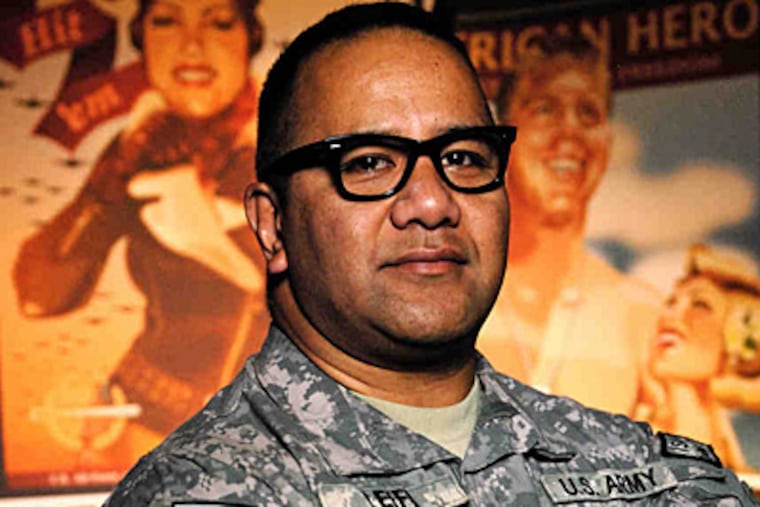
KANDAHAR, Afghanistan - Remembering the dead by carving their names on a cold, stone wall seemed too impersonal to U.S. Army Cpl. Poto Leifi.
Leifi, a California commercial artist-turned-soldier, thought the American soldiers killed in Afghanistan and Iraq should be remembered as full of life - and in a way that celebrated their patriotism.
After years of trial and error, Leifi makes posters in a vintage style that recalls the "Rosie the Riveter" and "Uncle Sam Wants You!" recruiting posters of World War II.
He calls his project "Freedom's on Me" - a patriotic twist on "Drinks are on me."
One of his first posters commemorated Marine Cpl. Mick Bekowsky, a 21-year-old from Concord, California, killed by a car bomb Sept. 6, 2004 in Fallujah, Iraq.
Bekowsky, who liked to race cars, hunt, and fish, is shown bare-chested, beaming toward the sky, arm around a woman in a vintage bathing suit. The poster dubs him "American Hero."
Leifi, a stocky man who wears black glasses, deployed to Afghanistan in May after a tour of Iraq. He launched his project in 2006. But his story begins on 9/11.
When he arrived at work in southern California that day, everyone was glued to the TV. "After that experience, work kind of lost its flavor," he said.
Leifi wanted to enlist, but his colleagues at work persuaded him that at age 34 he was too old.
He stayed busy with his career, designing soles for Skechers, the trendy footwear company, and vintage jazz posters for an art publisher.
Then in 2005, U.S. soldiers at a coffee shop told him he wasn't too old to join.
Leifi visited a recruiter. A year later, at age 39, he was in basic training in Fort Jackson, South Carolina.
Fired up about joining the military, Leifi searched the Internet for patriotic posters, but wasn't thrilled with what he saw.
"I'm a fan of the military posters created during World War II, so with the help of some friends as models, I began to make new posters with that vintage feel," Leifi writes on his website. He tried using the faces of those who had fallen, and "when I did, the posters came to life in a very profound way and the project took a whole new direction."
Leifi is assigned as a multimedia illustrator to a military psychological-operations unit in Kandahar province, a key front in the war in southern Afghanistan. He designs the posters after-hours, and has completed 10, using photographs and a computer software program for illustrators.
After he created the first few posters, word spread, especially through meetings of Gold Star Families, the military support organization. Other families commissioned posters, and he now has a backlog of 67 requests.
Leifi donates his time and talent. The families get seven free copies of each 16-by-20-inch poster. If they sign a release form, Leifi makes the posters available to others for $25 each, which helps recoup printing and shipping costs.
He has sold 237 posters, mostly to friends and other relatives and colleagues of the fallen.
His work for the military includes leaflets dropped to Afghans by aircraft, posters that illustrate the dangers of roadside bombs, and posters that help the public distinguish Afghan border policemen from Afghan soldiers.
"His chain of command is fine with him working in his off-time," said Lt. Col. Web Wright, a military public-affairs officer. "He has provided a couple of the posters to the headquarters, and they are displayed prominently.
Outside Leifi's office is a poster of Airman 1st Class Elizabeth Jacobson, 21, of Riviera Beach, Florida, who died Sept. 28, 2005, in Safwan, Iraq.
She is clad in a brown leather bomber jacket, her fists raised in a boxer's pose.
A red flapping banner behind her reads "Hit 'em hard 17th," a reference to her unit, the 17th Security Forces Squadron.
"I cherish her poster and what Freedom's on Me does for the families," said Sondra Millman, Jacobson's grandmother. "They bring light into what is a dark moment by bringing our heroes alive."