Aging professor's students help him recall the rhythms
Charlie Birnbaum and Rollin Wilber walked down the long hallway, wondering what they'd find at the end. They stopped outside the apartment door when they heard the Steinway.
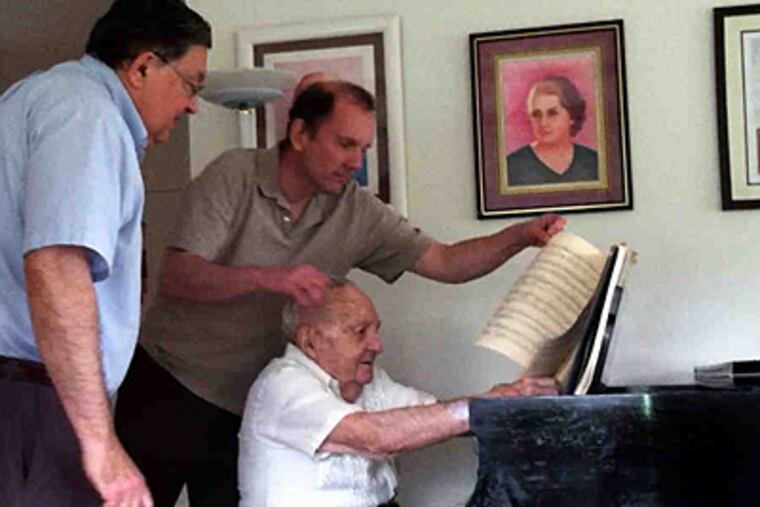
Charlie Birnbaum and Rollin Wilber walked down the long hallway, wondering what they'd find at the end. They stopped outside the apartment door when they heard the Steinway.
"It's a mazurka," Charlie whispered.
Their old professor was playing Chopin, his favorite.
The men lingered. Chopin's sublime music can stir the heart.
What they heard, however, was the music of a frail old man, 93, with dementia, who stumbled and hit wrong notes and forgot to use the pedals.
Yet in Wyncote House's stale hallway, Charlie and Rollin glowed. Marian Filar, whose soaring talent had taken him to Carnegie Hall, was playing again.
Seeing Filar at the piano, in a beautiful, clean apartment, art on the walls, trees and birds out the window, the sky, Charlie got misty-eyed.
He never thought, nobody had thought, Filar would ever be back at home, or happy again.
Filar gave Charlie a hug. "I missed you so much!"
"I missed you, too," said Charlie.
The old professor turned to Rollin. "I know you!"
"Yeah," replied Rollin. "I know you know me."
"Wait a minute," said Filar. "Where are you from?"
Rollin started taking lessons from Filar at 17. He's now 57 and still a fixture in the professor's life. Filar had helped Rollin find his musical soul.
"I'm Rollin," he said. "Rollin!"
The professor turned back to Charlie. "I didn't see you for a long time."
Charlie has visited twice a week for years, but he'd been away the last 10 days.
"I'm sorry," Charlie said. "I had some hospital treatments for a few days, and I feel much better."
"What are you complaining about?"
Filar had always been an autocrat. Or was he just confused? Charlie didn't want to alarm him. He kept it simple. "It's working and I'm feeling like a real person again."
"So you can come. You want to play?"
"No," Charlie said, "you play."
The professor continued as before, a shortfall from his former grace.
Charlie put Filar's foot on the pedal, grounding the old man in a lifelong habit. Like a heart beginning to pump, the foot knew what to do.
Born in Poland in 1917, Marian Filar survived seven Nazi camps, including Buchenwald. He lost his parents and two siblings in the Holocaust. In 1953, he came to Philadelphia to lead Settlement Music School's piano department. He continued to perform and became a music professor at Temple University.
He taught generations of student musicians, including Charlie and Rollin.
One student for 30 years, Gregg Pressman, a cardiologist, described Filar's sound:
"It was so gorgeous, and so right. So original his interpretation, the time and touch and the emotional pauses, unbelievable. He could transport you in a few measures. I never heard anybody play Chopin like him."
Charlie was 10 when he began studying with Filar. He's now 64, a grandfather.
"What Filar would demonstrate and produce, a beauty of sound, what he did with his fingers, we could absorb something that went beyond any verbal instruction.
"Just being next to greatness," added Charlie, "is in so many ways the legacy of what we have."
Charlie himself is the son of Holocaust survivors, a musical prodigy, soloing with the Philadelphia Orchestra at 11. But when life and the pressure of performing overwhelmed him at 21, Filar gave him hope.
"He says, 'Charlie, you'll get through this. Get back in school, finish your degree.' He's like creating a tunnel with a light. If you don't have that, you have no life. I can tell you that the only reason I've had a life is because of the door he opened through that crisis period.
"So to me it's a connection that can never, ever be broken."
When dementia began to rob Filar of his abilities, he became angry, explosive, impossible. He refused to believe he was suffering from any deficits, but he kept crashing his car, alienating those close to him, spurning help.
Charlie and Rollin made a pact to help. Filar, with no wife or children, had no one else.
In 2006, Charlie moved Filar into assisted living in Abington. Two units, side by side - one for Filar, one for his Steinway.
But Filar never accepted the transition. He grew paranoid, hostile. He deteriorated rapidly, seldom touching the piano. He'd call Charlie 10 or 12 times a day, day or night. His wallet was stolen, he'd say. "They" were cheating him.
So Charlie would drive up from Hammonton, N.J., an hour and a half one way. "I would say a prayer every time I went. How can I calm him down, maybe reset his brain?
"My role was to keep him part of the human race."
A year ago, Filar fell, was hospitalized, and went into the nursing wing. He needed nurses round the clock, but in his confusion he'd hit and kick them.
Rollin had an idea. He called a Filipina woman who had cared for his mother. She referred them to Danilo Reyes, 66, who moved onto the couch next to the Steinway and looked after Filar.
Gradually, Charlie and Rollin believed that their old professor, with Danilo's help, could move back into his own apartment in Wyncote.
Filar did, in December. Danilo cares for him, helped by a friend, Juliet Pineta, 60.
Filar could fall, be back in the hospital tomorrow. Charlie, who has a progressive muscle disease, might become too sick to visit.
Yet in his own way, even as his world continues to get smaller, Filar flourishes.
"He's having a new life now," said Danilo.
Charlie and Rollin took Filar to a Chinese buffet next to a Target store. For years it had been Filar's favorite. Now he asked, "What is this place?"
During lunch, Filar heard stories of his life, stories he had told many times and had now forgotten.
"Koprowski was your colleague at the conservatory," Charlie told Filar, "but when he heard you play at the conservatory in Poland, he figured he'd better look into another profession, and he became your doctor in the United States."
Charlie tucked a napkin into Filar's collar and brought him wonton soup.
Filar looked at Rollin. "Were you my student?"
"I was your student for many, many years. I'm Rollin."
Filar ate well. The friends treasured what they had been able to accomplish together. Unspoken was the understanding of how fleeting this moment was likely to be.
A moment worthy of Chopin, of aching, spare perfection.