For dog defenders Jen & Chase Utley, it's the 'pits'
IF YOU WERE married to a Phillie, how would you spend your free time? By decorating your P-shaped mansion in red, white and gray? Stocking your freezer with plastic batting helmets of vanilla soft-serve? Planning holidays with the Halladays? Mounting a nationwide defense of America's most dissed dog?
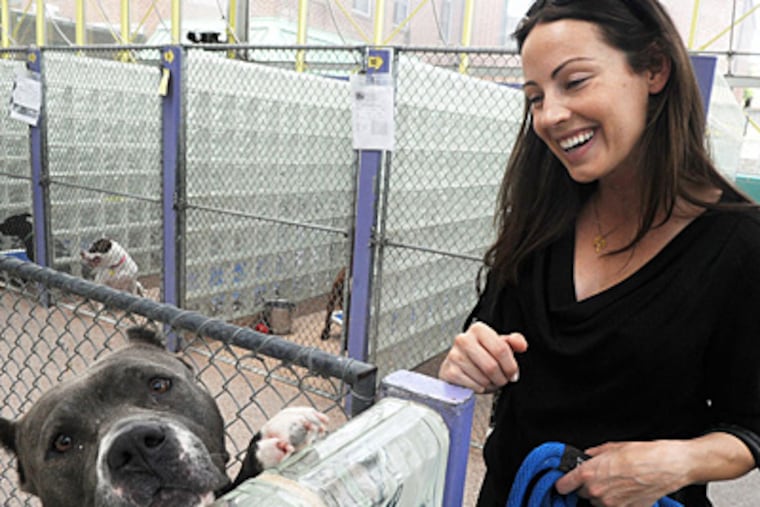
IF YOU WERE married to a Phillie, how would you spend your free time? By decorating your P-shaped mansion in red, white and gray? Stocking your freezer with plastic batting helmets of vanilla soft-serve? Planning holidays with the Halladays? Mounting a nationwide defense of America's most dissed dog?
If you're Jennifer Utley, you're definitely picking that last one. About four years ago, way back when she was new in town, she "wanted to do some volunteer work with animals," she said, so she walked dogs and cleaned cat cages at the Pennsylvania Society for the Prevention of Cruelty to Animals on Erie Avenue. Today, with more than a little help from a certain second baseman, Mrs. Chase Utley sits on the PSPCA's board and helms an all-out campaign to restore the reps of pit bulls (and then some).
If you had to narrow it down, you could say Jen and Chase's community mission is threefold.
First, they raise funds for the PSPCA, specifically for the organization's Humane Law Enforcement department, a/k/a "Animal Cops," and the animals they rescue. Second, they teach kids to be kind to animals. Third, most general: They speak up for dogs, which can't speak for themselves.
Mostly, they speak up for pit bulls, or, more correctly, pit bulls and pit-bull mixes. Jen Utley calls them "my pits."
Puppy love
On a recent sweltering Wednesday, the PSPCA is packed. The clinic is running its weekly special: low-cost vaccines. Pet owners file in with cat carriers, unhappily leashed mutts, a laundry basket of fluffy cotton-ball puppies, and dozens more Fidos and felines. A staffer tells a woman seeking shots for her pit-mix puppy that she'll first have to see the doctor for the dog's swollen-shut left eye. A ponytailed man runs in with a listless gray pit in his arms and tells another PSPCA worker, "She just stopped moving."
It's tense. It's hot. It's anything but glam.
Then there's Mrs. Chase Utley, cucumber-cool in a chic, black romper, oversized sunglasses and a designer bagful of snacks, for which she apologizes. (Jen and Chase are expecting their first child this fall, and, well, she's a bit hungrier than usual.) Jen steps naturally into the melee.
Past the reception area, she stops at a stack of cat cages to reach her fingers in for a few quick pets. In a crowded hallway, she greets the workers hustling by, by name. Ducking into the shelter hospital, she spots a badly battered cat with three legs. "Is this the one that got mauled by the German shepherd?" she asked. It is.
Like a tour guide, she explained what goes on behind each door. There's the isolation "iso" room for cats with communicable, usually respiratory, diseases. There's a space for dogs in crates awaiting the behavior evaluations that will determine whether they're adoptable and what kind of home would be best for them (with or without other dogs, children, a back yard). There's the "living room" where potential adopters can introduce their pets to new pets - sort of like speed-dating, with paws. There's a rec room for dog-training and volunteer gatherings, and separate rooms for older cats and smaller dogs.
Then there's the greenhouse, the dog-adoption floor, the largest and arguably loudest space in the place. It's 5,500 square feet, with 100 open-top kennels - all full. Each crate is made of glass brick with a chain-link door, next to which hangs a piece of paper with the residing dog's name, age and background.
Some are labeled "cruelty case"; others, "stray"; others, "surrendered by owner." Inside every cubbyhole are a bed and a toy, usually a Kong, a biteable rubber puzzle that hides treats. Inside at least 60 of the 100 kennels is also a pit-bull mix.
Some of the pits are big and tall, up to 75 pounds. Others seem half that size, maybe knee-high. There are plenty of brindleds and fawns, and a few pale blonds with blue and green eyes. Some have their fur clipped; others have their ears clipped. Many are gray and white, like the Utleys' pit, Jack. Most of them jump to attention when a person walks by.
"They're saying, 'Take me out! Take me out!' " said Jen Utley, scratching behind a dog's ears.
One clever pit catches her eye. He is big and brown and standing on hind legs, turning his head like a periscope above his kennel to watch incoming visitors. Utley goes to pet him. He places his paw on top of her hand. "I love him!" she declared. (Surely Chase wishes he had it this easy.)
His name is Roscoe. And, in a flash, the slender Mrs. Utley is in his kennel, sliding his big head into a blue leash and leading him outside to a recently built play area where dogs can be off-leash. She lets him go. He takes off. "Once they're out here, they just wanna run," said Utley. She tosses him a tennis ball. (In case you're wondering, she has a decent arm.) Roscoe misses, but brings it back to her. "He's not very coordinated," she said. "But this dog would entertain himself forever." She calls him "Boo" and "Chicken."
Dog days in court
Having tired Roscoe out - "all it takes is 15 minutes," said Utley - and returned him inside, where, she said, he'll be much calmer, and therefore more likely to be adopted, she's back outside, pointing out the Humane Law Enforcement's fleet of SUVs, trucks and unmarked cars, then stopping next to a long outbuilding that serves as a security kennel. "We'd need clearance to go in there," she said.
Inside the locked building are dogs rescued by HLE. Most are being held as evidence, awaiting the court cases of their former owners, now accused of animal cruelty, typically among other charges. Ninety percent of these dogs are pits. Several have been used to fight, breed or serve as "bait" in illegal dogfighting rings.
"If you walked through there, I guarantee you'd burst into tears," she said. "You walk in and half [of the dogs] throw themselves against a wall and start shaking."
Some of these animals will respond to rehabilitation. Many won't.
You may have heard the story of the Utleys and Etana, a boxer-pit mix that was savagely beaten and burned by a group of kids in the winter of 2007. Etana's largest wound was her fractured skull. She needed $3,000 worth of surgery. When Jen and Chase heard about the case, they did not hesitate. They paid Etana's medical bills. (Etana now lives with a family on a suburban Philadelphia farm.)
A few months later, the Utleys did a photo shoot with gray-and-white PSPCA pittie puppies born to a mother the HLE rescued from a dogfighting ring. There were 11 in all, mini bundles of energy, except for one. "He was like a blob," she said. "He just laid there." Jen couldn't help herself, "I was obsessed with that dog."
'Pit bulls are amazing'
Today, full-grown and much less blobby, Jack Utley is part of the family. (So much so that he recently stole Jen's pregnancy pillow.) "He's the love of my life," gushed Jen. "That dog has changed our lives." She continued, "Pit bulls are amazing: They have this gorgeous coat. They don't shed. They don't slobber. They're so sweet and playful . . . and they have that smile."
Not exactly the sort of thing you usually hear about these particular pups. But Utley, like many pittie lovers, is adamant. "I don't think there are good dogs or bad dogs. I think there are good owners and there are bad owners - like there are good parents and bad parents," she said.
She cites the American Temperament Test, on which pit bulls score higher than dachshunds, cocker spaniels and Jack Russell terriers - and most other breeds. She said pits used to be called "nanny dogs, because they're so great around kids." She pointed out that the dogs she sees misbehave in her Center City neighborhood are usually untrained small breeds.
Then why do pit bulls get the bad rap? In the wrong hands, pits can, not unlike other dogs, be the pits. They're strong, typically energetic, agile, trainable and loyal. But there are also a lot of them - and a lot that belong to owners who keep them cooped up, unable to interact with people or pets, lacking an outlet for their energy. Many are neglected, simply left without food or water, like most of the PSPCA's animal-cruelty cases.
Raising a well-behaved pit takes daily care, said Utley, but nothing out of the ordinary. "Animals need what we need: They need light. They need food. They need water. They need socializing," she said. "My dog has been around every type of person. He would never bite someone. It wouldn't even dawn on him."
Still, she said that every time she and Chase stand up for pits, even their own dog, they deal with anti-pit prejudice - "breed bias." Recently, Jack and his fellow pits were banned from one of her friends' otherwise dog-friendly apartment buildings. "It's so ridiculous," she said. "These dogs just look a certain way, and all of a sudden, there's an issue. I hope you don't judge people like that."
She noted that when a non-pit bites or turns violent, the dog's breed rarely makes headlines. But when it's a pit, that gets top billing.
Pits encompass three breeds (American pit bull terriers, American Staffordshire terriers and Staffordshire bull terriers), plus endless "backyard-bred" mixes. And with so many homeless - even the national organization Pit Bull Rescue Central can't estimate how many need homes - and with so many being mistreated and misunderstood, the public's attitudes toward pits must change, Utley said. "If [Chase and I] can help make that change, we're gonna do it."
For four years, the Utleys have brought attention to and raised money - so far, about a million bucks - for the HLE's fight against animal cruelty, at their baseball stud-studded casino night among other fundraisers.
PSPCA CEO Sue Cosby said the Utleys' fundraiser is "the largest single event that supports that department, so, really, our ability to stay out on the streets saving animals and rescuing animals from abuse and neglect is in large part because of the Utleys."
More recently, the couple created the Utley Foundation to teach children about kindness to animals. Their first project: creating a mural of kids with pets with elementary students at the Anna B. Pratt School in North Philadelphia. On the day of the unveiling, the students, many of whom had written stories and made drawings portraying animal violence they'd witnessed, carried signs that read, "We love Jack." The Utleys gave the kids buttons saying, "I'm an animal protector."
"We told them, 'You're a part of our team. Now you have a responsibility to be nice to animals, and to teach other people what you've learned,' " Jen recalled. "They were inspired by it."
Back at the PSPCA, Jen points to an empty lot next to the security kennel. That, she said, is where she and Chase would like to raise money to build a new security kennel - one with larger, indoor-outdoor crates, so cruelty-case dogs that aren't permitted into the other dogs' play area will be able to run and to breathe fresh air. (The old security kennel would become the new isolation unit for cats.)
The project's estimated cost: $3 million. Not a tiny price, even to a top-tier ballplayer. And yet, once again, Jen Utley seems undaunted. "We can do it," she said, "We'll do it. . . . I want this to be my legacy."
It's a bittersweet goal: sweet because Jen and her team are saving dogs' lives; bitter because there are so many lives to save. In other words, if she builds it, they will come.